
Tag Archives: crest

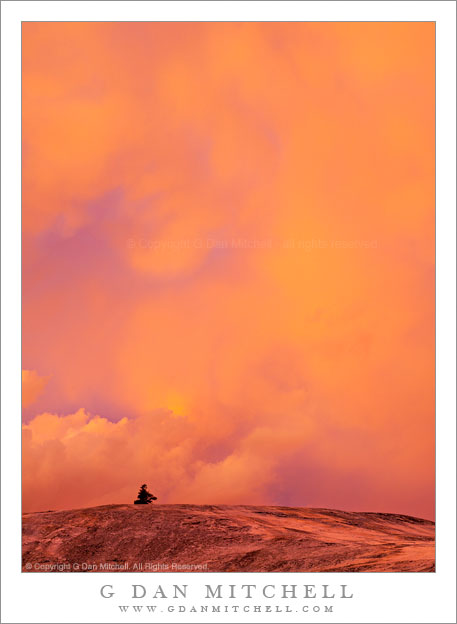
Tree, Granite Slabs, Evening Storm Clouds

Tree, Granite Slabs, Evening Storm Clouds

Tree, Granite Slabs, Evening Storm Clouds. Yosemite National Park, California. September 20, 2011. © Copyright 2011 G Dan Mitchell – all rights reserved.

A tree and granite slab are lit by brilliant sunset light from a dissipating evening thunderstorm, Yosemite National Park.

This was another of those sometimes-surprising bursts of evening Sierra color that results in effects so gaudy that they almost seem unreal – but this is real. I was camped down in a valley among trees so I wasn’t initially expecting much in the way of spectacular sunset photography. Instead, I planned to take advantage of the early shadows in the valley and get some evening photographs under soft light without any direct sun at all. I first worked some moving water where the nearby river flowed across granite slabs, and then I contemplated photographing some small plants in deeply cracked and patterned granite. As a worked my way across this granite, I remembered a small tree on the other side of the bowl that had looked like an interested photo subject a few days ago, so I walked over to that area where the tree stands in a shallow granite bowl.

Earlier in the afternoon I could see huge thunderheads building up to my east, but they did not move far enough west to affect me with anything more than a bit of gray sky. However, as the clouds built up to higher elevations, their tops began to take on the familiar “anvil” shape and the upper portions of the “anvils” began to spread to the west and out over my position. This is a classic setup for potentially spectacular evening sky color. Near sunset the clouds can pick up intense red/orange coloration from the sun setting in the west. At the same time, the storms begin to dissipate, creating semi-transparent “curtains” of virga (falling rain that doesn’t reach the ground), unusual shapes along the bottoms of the clouds, clouds emerging out of the gray murk as the sunset light picks them up.

As I arrived at my little tree, I quickly lost interest in that subject as the cloud light show began. First the bottom of the thunderhead began to turn brilliantly orange and red. Then the lower reaches of the small storm began to produce very unusual cloud shapes including mammatus clouds. Virga produced a brightly colored by semi-transparent scrim. It quickly became so bright that the red/orange colors began to wash the granite bowl, and I turned my camera from the little tree to the uphill granite surfaces and the clouds above.

In this vertical format image the tip of a small tree extends above the top of a dome-like area above me, and the brilliant light from the clouds washes the dome with color. The colors here have not been “amped up” in post – in fact, I’ve actually toned some of them down a bit!

G Dan Mitchell Photography
About | Flickr | Twitter | FacebookGoogle+ | 500px.com | LinkedIn | Email

Text, photographs, and other media are © Copyright G Dan Mitchell (or others when indicated) and are not in the public domain and may not be used on websites, blogs, or in other media without advance permission from G Dan Mitchell.

(Basic EXIF data may be available by “mousing over” large images in posts when this page is viewed on the web. Leave a comment if you want to know more.)
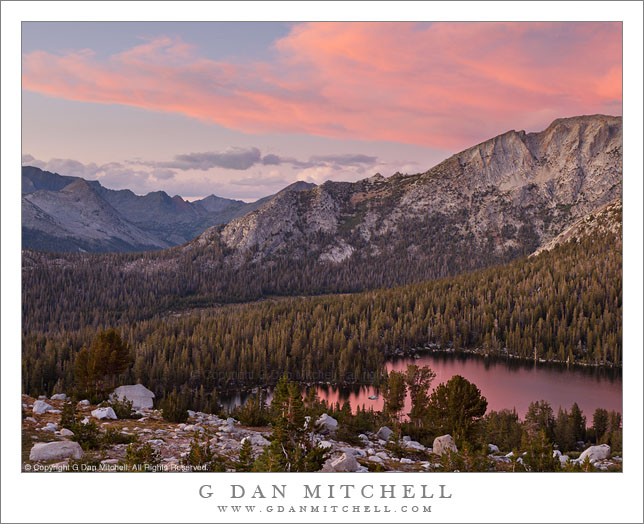
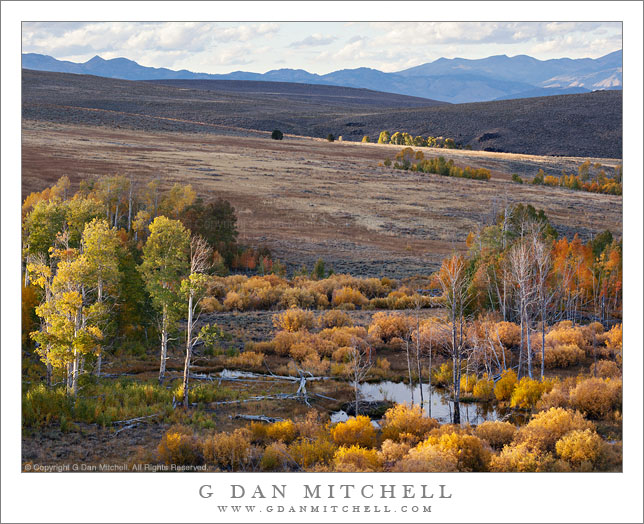
Thunderstorm Over Barney Lake

Thunderstorm Over Barney Lake

Thunderstorm Over Barney Lake. Near Mammoth Lakes, California. August 5, 2005. © Copyright 2005 G Dan Mitchell – all rights reserved.

Rain from an afternoon thunderstorm begins to fall above Barney Lake, in the eastern Sierra Nevada near Mammoth Lakes, California.

This is yet another older photograph that I found again while reviewing nearly a decade of raw files recently. I actually have previously posted another similar photograph of this scene in the past, but I think this one is also effective and is somewhat different.

I came to this lake when I had to leave a group of friends with whom I was about four days into a 14-day backpacking trip in the central Sierra back in 2005. On day four I woke up feeling less that great and thought I might be coming down with some sort of “bug” that I didn’t want to deal with in the back-country, partly because we were about to enter a section of trail with no quick and easy way out, and also because I didn’t want to take a chance on slowing down or halting the rest of my party. So I bailed out on the morning of day five. The rest of the gang went south on the John Muir Trail while I backtracked to the north and exited over Duck Pass.

I recall the day fairly well – perhaps because I travelled the trail twice in two days! It was easy hiking back along the JMT to the turnoff to the pass, where I paused to enjoy the view of Duck Lake. As I began the ascent to the pass above the lake, thunderstorms quickly developed, and I recall being surprised when the rain started much more quickly and much sooner than I had predicted. I believe I had to duck (no pun intended) beneath a nearby tree and quickly take out rain gear and pack cover before moving on in the rain. After I crossed the pass and started the descent towards Mammoth Lakes, the storm moved elsewhere and rays of light broke over Barney Lake below the pass where I paused to make a few photographs of this light against the backdrop of more distant peaks and falling rain.

G Dan Mitchell Photography
About | Flickr | Twitter | FacebookGoogle+ | 500px.com | LinkedIn | Email

Text, photographs, and other media are © Copyright G Dan Mitchell (or others when indicated) and are not in the public domain and may not be used on websites, blogs, or in other media without advance permission from G Dan Mitchell.

(Basic EXIF data may be available by “mousing over” large images in posts. Leave a comment if you want to know more.)
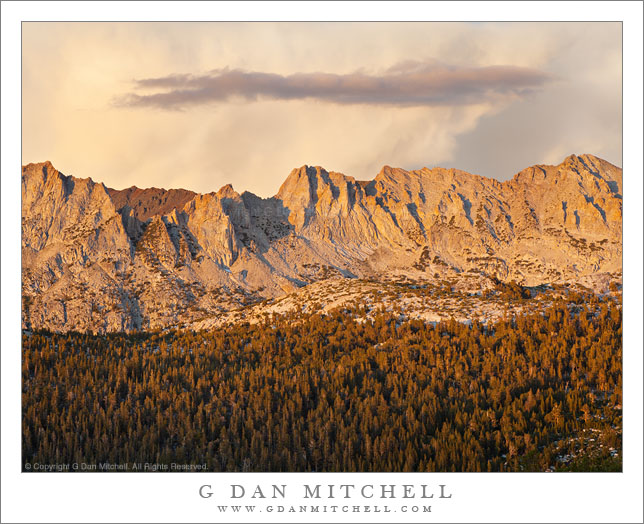
Sunset and Moonrise, Kuna Crest

Sunset and Moonrise, Kuna Crest

Sunset and Moonrise, Kuna Crest. Yosemite National Park, California. August 10, 2010. © Copyright 2011 G Dan Mitchell – all rights reserved.

The nearly- full moon rises above the sunset light on Kuna Crest, Yosemite National Park.

Kuna Crest runs up Lyell Canyon between the Lyell and Dana forks of the Tuolumne River with the Sierra crest at one end and Mammoth Peak at the other. (Mammoth Peak is the large peak straight in front of you as you top Tioga Pass entering Yosemite National Park.) This ridge can catch great sunset light during the summer, and as I came down from the pass, heading back toward my camp at Porcupine Flat, and saw the almost full moon appearing over the shoulder of the ridge I decided to quickly stop and make a few exposures as the last light was about to leave the forest and soon after the peaks.

If you have tried photographing a scene that includes the moon in the early evening you know that the exposure is a tricky thing. The moon is lit by daylight, so it isn’t too surprising that the “correct” exposure for the moon is close to a normal daytime exposure. But that is not the right exposure for the rest of the scene, which turns out to be quite a bit darker than daylight at this time of day. In this scene things were even more complicates as the very saturated red colors on the ridge were quite “hot,” while the foreground meadow and forest was in shade and both darker and cooler in color. Basically, the dynamic range between the moon and the foreground was too large for a single exposure… so I made several.

At the time of exposure I thought that I might need as many as three component images in the final photograph – they would be one exposed for the bright ridge and sky, one exposed for the rather dark and shadowed foreground, and possibly a third that correctly exposed the moon. To be on the safe side I bracketed four exposures. When I began to work on the image I figured out that in this case I could construct a final “believable” image from two exposures if I was careful and could make some additional adjustments during post.

This is an example of a shot in which the use of a graduated neutral density filter could have been problematic, but where exposure blending could work very well. (“Exposure blending” is one term for the process of manually combining two component exposures using masked layers in Photoshop. No, it is not the same thing as HDR photography.) One of the things that would have been quite tricking using graduated neutral density filters is that the division between the brighter upper half and the darker lower half is not linear. Instead, the roughly follows the curved boundary between the lower meadow and dark trees and the still sunlit trees and the peak and sky.

G Dan Mitchell Photography
About | Flickr | Twitter | FacebookGoogle+ | 500px.com | LinkedIn | Email

Text, photographs, and other media are © Copyright G Dan Mitchell (or others when indicated) and are not in the public domain and may not be used on websites, blogs, or in other media without advance permission from G Dan Mitchell.

(Basic EXIF data may be available by “mousing over” large images in posts. Leave a comment if you want to know more.)

Gaylor Basin and the Cathedral Range, Evening

Gaylor Basin and the Cathedral Range, Evening

Gaylor Basin and the Cathedral Range, Evening. Yosemite National Park, California. July 26, 2011. © Copyright 2011 G Dan Mitchell – all rights reserved.

Evening shadows stretch across the boulder-filled meadows and forests of Gaylor Basin with the peaks of the Cathedral Range on the skyline, Yosemite National Park.

On the first evening of my late-July four-day visit to Yosemite’s high country along Tioga Pass Road I decided to visit this favorite location of mine. It is a short (but steep!) hike from near Tioga Pass over a nearby ridge to reach this quiet basin with its many lakes, long distance views of the Cathedral Range, and the treeline terrain of rocks and trees that I believe is my very favorite in the Sierra.

I started out after my mid-afternoon “dinner” and the drive to the trailhead from my camp at Porcupine Flat. Probably because it was so late in the day, I met a fair number of people hiking back out but only saw two others in the entire basin once I arrived. I suppose this is one of the advantages of keeping odd “photographer’s hours” – while most people are heading back to camp to fix dinner, I’m heading out to catch the evening light.

In the end, I didn’t make many photographs on this evening. I mostly wandered, something I love to do in these high open basins. I walked around the first lake, passing over some still-unmelted snow, and crossed the very full outlet stream, trying to skirt the wettest portions of the meadow by looking for rocky terrain. I finally settled on an area just below the lake and made a few photographs of trees and rocks and the long, shallow valley leading toward the main trunk of the Tuolumne River and the mountains beyond. I finished just after dusk, climbed back up the ridge as darkness came on, and finished the hike back to my car with the help of the light from my headlamp.

G Dan Mitchell Photography
About | Flickr | Twitter | FacebookGoogle+ | 500px.com | LinkedIn | Email

Text, photographs, and other media are © Copyright G Dan Mitchell (or others when indicated) and are not in the public domain and may not be used on websites, blogs, or in other media without advance permission from G Dan Mitchell.

(Basic EXIF data may be available by “mousing over” large images in posts. Leave a comment if you want to know more.)