
Tag Archives: eastern

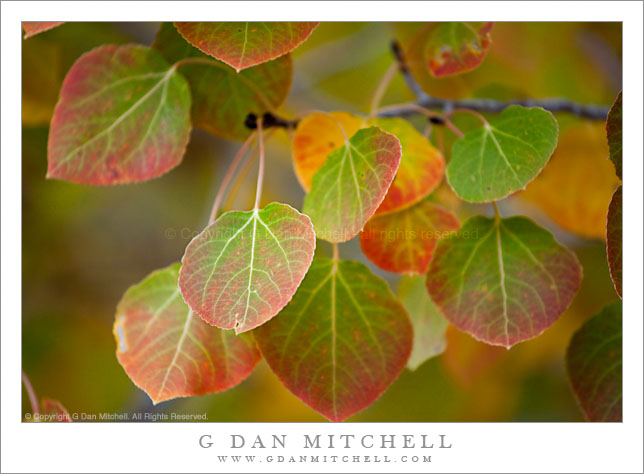
Red and Green Aspen Leaves

Red and Green Aspen Leaves

Red and Green Aspen Leaves. Sierra Nevada, California. October 3, 2009. © Copyright G Dan Mitchell – all rights reserved.

Red and green aspen leaves in the Sierra Nevada near South Lake.

I spotted a grove of small aspen trees with very colorful leaves as I was driving down from South Lake and just as the light was just about too dark to continue shooting – especially since the wind was rising and by this time blowing like crazy! It can be tricky to shoot aspen leaves close up even in a slight breeze, but shooting them in fading light when the wind is rising to near gale force is darn close to impossible!

While many of the trees in this grove were headed more in the yellow direction, I found a few that seemed to be going almost straight from green to red.

This photograph is not in the public domain. It may not be used on websites, blogs, or in any other media without explicit advance permission from G Dan Mitchell.

Web: G Dan Mitchell Photography
Twitter: http://twitter.com/gdanmitchell
Friendfeed: http://friendfeed.com/gdanmitchell
Facebook: http://www.facebook.com/gdanmitchell

keywords: red, green, yellow, aspen, leaf, leaves, tree, branch, bokeh, season, fall, autumn, sierra, nevada, mountain, range, california, usa, south, lake, bishop, creek, eastern, close, up, macro, nature, scenic, travel, vein, stock
Last Gasps of Eastern Sierra Fall Color?

Last week I decided not to head over to the east side for more aspen photography – a combination of still working over the many photographs I brought back from earlier visits, some other responsibilities, and continuing reports that the bizarre and unusual progress of fall color was continuing. (But see Michael Frye’s “Lazarus” blog post for hints of a different set of possibilities.)

Along those lines, the recent reports seem to fall roughly into two categories. On one hand we have continuing reports that the aspens are still turning to fall colors very, very late and, in some cases at least, reportedly going almost straight from green to brown or dropped leaves. On the other hand, during the past week I’ve seen reports and photographs of some possibly isolated but very striking aspen color. Without having been on the scene recently I’m going entirely by second- and third-hand reports… but it sounds like you might be able to find a few good trees still if you act quickly and are willing to look around a bit. (And don’t forget that not all trees are aspens – there are other fall color opportunities at lower elevations.)

My attention now turns to other subjects including other opportunities to photograph fall color. My target date for visiting Yosemite Valley to shoot meadows, oaks, dogwood, and maples in fall color has always been the very end of October or right around the first of November. That had been my plan again this year… but during the past week or so I’ve started seeing photographs and reading reports of some good fall color already appearing there. Is the next phase of the “Strange Fall of 2009” going to be early color in the Valley? I’m hoping to head up there this weekend to find out.

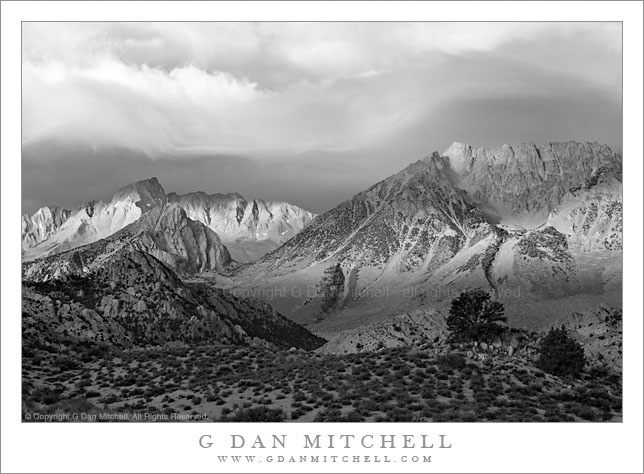
Autumn Storm Clouds at Dawn – Basin Mountain and Mount Humphreys

Autumn Storm Clouds at Dawn - Basin Mountain and Mount Humphreys

Autumn Storm Clouds at Dawn – Basin Mountain and Mount Humphreys. Sierra Nevada, California. October 3, 2009. © Copyright G Dan Mitchell – all rights reserved.

Early morning light above the Buttermilks illumunates Basin Mountain and Mount Humphreys under the clouds of an early autumn storm over the Sierra Nevada crest.

This is another of several exposures I made on this beautiful early October morning when I decided to abandon my plans to be at North Lake for dawn after spotting these astonishing clouds over the eastern Sierra as I drove through the Buttermilks on my way up into the Bishop Creek drainage. I drove out on gravel roads into the high desert until I found what looked like an interesting juxtaposition of near hills, mountains beyond, the peaks of the Sierra in the distance, and the clouds that were dropping light snow up higher in the range above.

Needless to say, the light and the cloud forms were constantly changing as I watched this scene. I waited until the closer rocky hills began to pick up a bit of a glow from the sun low in the eastern sky, and then I made a number of exposures as the sun struck lower on the mountains and as the patterns of light and shadow from racing clouds moved across the peaks.

This photograph is not in the public domain. It may not be used on websites, blogs, or in any other media without explicit advance permission from G Dan Mitchell.

Web: G Dan Mitchell Photography
Twitter: http://twitter.com/gdanmitchell
Friendfeed: http://friendfeed.com/gdanmitchell
Facebook: http://www.facebook.com/gdanmitchell

keywords: basin, mountain, mount, humphreys, sierra, nevada, mountain, range, crest, buttermilk, high, desert, owens, valley, trees, rocks, boulders, morning, dawn, light, illuminate, black and white, dramatic, ridge, peak, shadow, storm, clouds, patterns, bishop, california, usa, eastern, slope, escarpment, season, fall, autumn, early, stock

Tioga Pass and Alternatives as Winter Approaches

Lots of us northern and central California photographers make trips to the eastern Sierra in the summer and fall – I know that many of you have been there in the past month to photograph aspens and other fall color. For many of us the standard route to the “east side” is through Yosemite National Park and over Tioga Pass on State Highway 120 to Lee Vining and the area near Mono Lake. From here it is a short drive south to Mammoth (about a half hour) and Bishop (an hour) and points south, including Big Pine, Independence, and Lone Pine.

As the fall season arrives and winter weather approaches, Tioga Pass becomes a less reliable route and eventually closes for the season. The seasonal closure typically occurs sometime in late October or in November, though the historical records show that it has happened as late as January 1!

Continue reading Tioga Pass and Alternatives as Winter Approaches