Patterns in eroded shoreline sandstone rocks at the Point Lobos State Reserve, California.
The rugged Point Lobos shoreline in places exposes some very interesting rocks, including sections like this one where layers of different colored sand stone are gradually worn away, revealing underlying layers of different colors and textures and sometimes exposing surprising color contrasts. On days when the light is very soft (or very boring!) I may seek out some of these rocks and photograph them since the softer light lets details appear that might easily be washed out in harsher light.
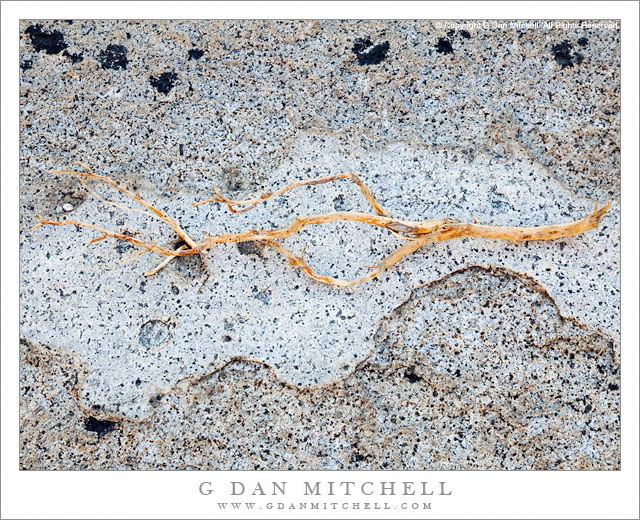
A dead branch lies on glacially-polished granite in the Yosemite National Park back-country.
I made a promise to someone to not say where this photograph was made – I’ll just say it is in Yosemite National Park. But the exact location really doesn’t matter too much, as these large expanses of glaciated granite slab are a common feature throughout the park, and you could find similarly interesting geology in thousands of locations.
I was a little surprised to find this weathered branch in this location, since it was a good distance from any trees and also not near any flowing water. Besides its location, a few other things about it caught my attention. First, its curving shapes lined up in a way tht seems to tie in with the bit of glacially-polished granite that lies beneath it. (And, yes, this is exactly where the branch was when I found it.) In a way, the larger shape of the lighter area of granite winding across the photograph from side to side almost seems like a much thicker echo of the curving shape of the branch. In addition, the warm brown tones of the branch seem to stand out a bit – though perhaps more in a larger print – against the relatively drab color of the rock.
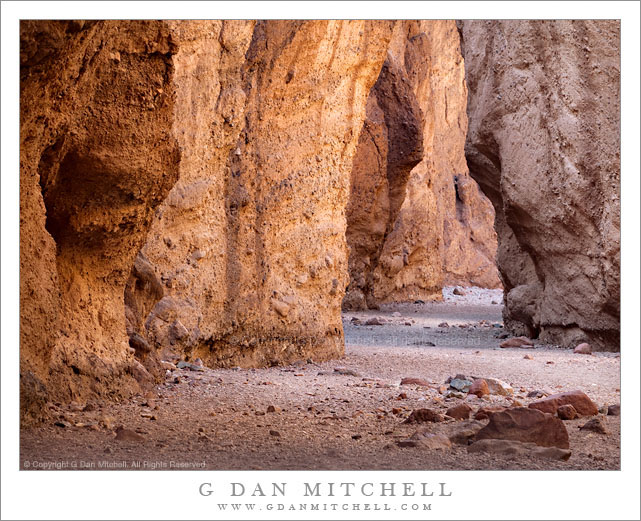
A gravel wash in the bottom of the narrow confines of Natural Bridge Canyon, Death Valley National Park.
These narrow canyons, of which there are a number of great examples in Death Valley, can provide some interesting photographic opportunities, but they also can pose some real challenges. Much of the rock in these places is, frankly, rather drab and of low contrast. However, at the right time of day and on a day with the right light and in the right parts of these canyons, the glowing light reflected down into the canyons from overhead rock walls can produce warm and diffused light and bring interesting colors to the place.
I made an unusual decision to use a very long focal length for this photograph – it was shot with a 100-400mm zoom at 330 mm. More typically I would probably tend to use wide angle focal lengths in the confines of such a canyon. However, because I wanted to juxtapose the different colors and shapes of the sections of canyon wall along the narrow and twisting wash, I chose the long lens to compress the distance. Although I think the photograph creates a feeling that I’m positioned very close to the foreground rocks and the darker bit of canyon wall on the left, I was actually quite a distance back from this spot.
Morning clouds fill the sky above the Manifold at Zabriskie Point, Death Valley National Park.
I posted a monochrome version of this photograph yesterday, so there is perhaps a bit less to say about it in this post. To recap briefly, this is a photograph I made over three years ago during a spring visit to Death Valley NPS. This was a bit of a different morning for photographing at Zabriskie Point, if I recall correctly. Usually, photographing here is pretty straightforward – and once you’ve shot it a couple times in “normal” conditions, there is a basic pattern to the progression of light that becomes fairly (though perhaps not totally) clear. Normal conditions here basically mean perfectly clear skies with the sun coming up to the left from the perspective of this photograph or behind in some of the other familiar shots that include Manley Beacon – and light that sequentially illuminates subjects beginning with the highest peaks of the Panamint Range across the Valley and gradually working down into the Valley and finally to the rugged shapes at Zabriskie Point itself.
But clouds can change everything. If I am going to shoot at Zabriskie, I watch for conditions that will bring them. I will generally not stop there if it is “another beautiful clear sunrise” at Zabriskie. (If you haven’t been there before, you should stop and take in this stunning scene, but I’m often looking for something a bit different.) While the results in clear conditions are relatively predictable, they are not at all as predictable when there are clouds. You can end up with something very special… or with a drab, flat, and gray scene. But that’s the thing about special conditions – they wouldn’t be special if they were predictable and frequent!
Thinking back to this morning, my recollection is that it may have been one of those when I arrived to think, “Oh, boy, clouds!” – only to think a bit later, “I wish those clouds would move and give me some light!” I recall some bits of dawn light that were mostly blocked by the clouds. But the very clouds that blocked the hoped-for first dawn light thoughtfully assembled themselves into these impressive forms just a bit later, at right about the time that the warm side-light was getting down into the rugged folds of the Manifold and Gower Wash.
This photograph is not in the public domain and may not be used on websites, blogs, or in other media without advance permission from G Dan Mitchell.