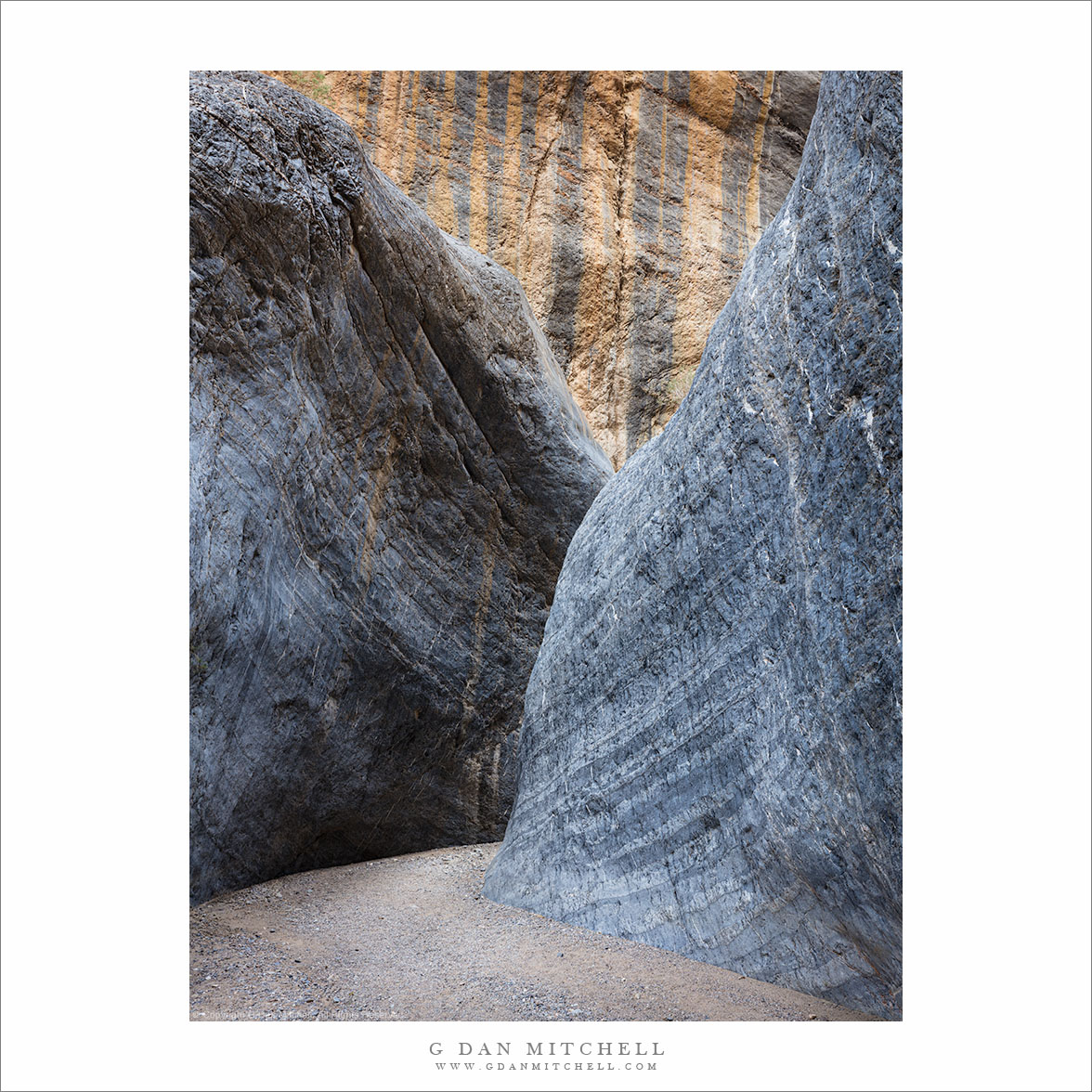
“Canyon Bend” — A bend in the canyon narrows, Death Valley National Park.
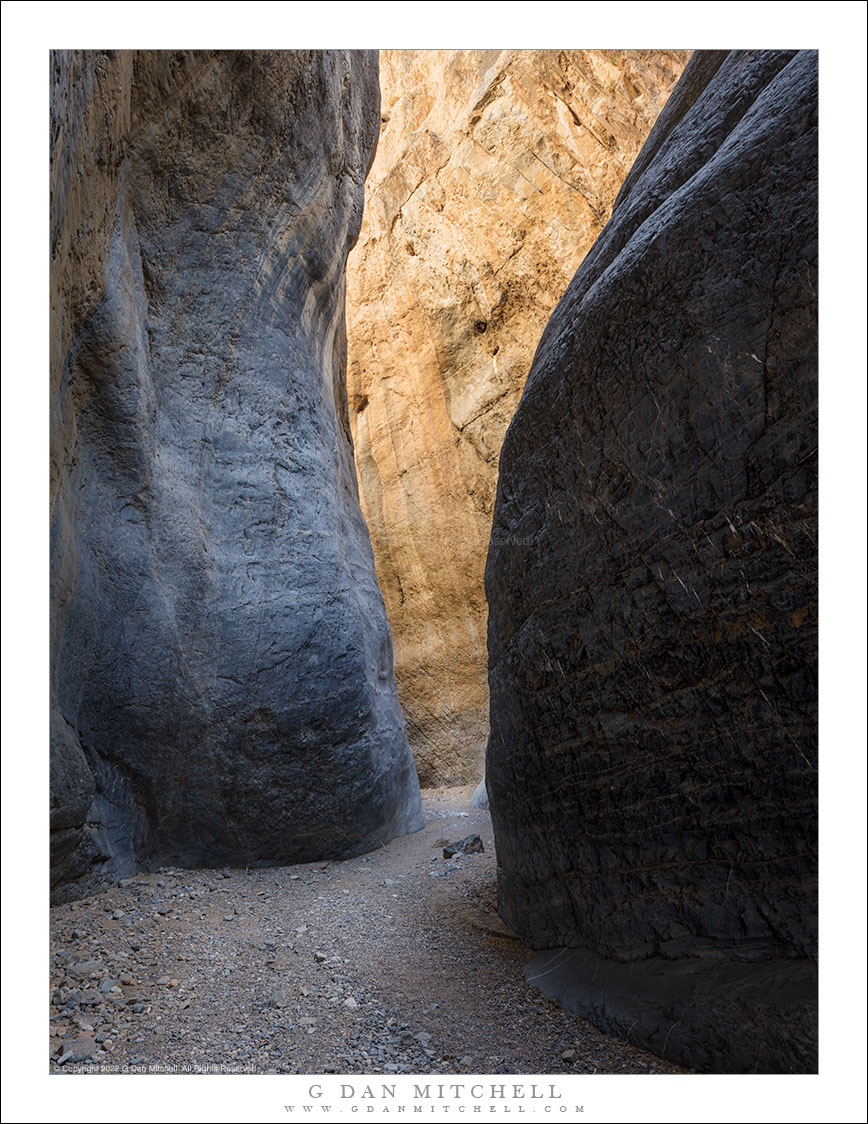
Slot canyons and “narrows” are among the most compelling desert landscapes. Desert landscapes tend to be exposed, open to the sky and wind, and blasted by the midday sun. The space seems horizontally oriented, often with a distant horizon and perhaps low mountains rising from playas. The canyons contrast almost every way. They are places of shade, protected from wind, and the distant horizontal views are cut off, replaced by close surfaces covered with angles and curves.
There are many small canyons in Death Valley National Park, and they may be among its least-known and most interesting features. A few are popular, but most are off the beaten path and some are downright difficult to get to. Their lonely quality is part of the charm, and I hope it stays that way. This spot presents a fascinating combination of the blue-light, shadowed stratified walls, the water stained face in the warmer light above, and the canyon floor covered in gravel washed down by flowing water.
G Dan Mitchell is a California photographer and visual opportunist. His book, “California’s Fall Color: A Photographer’s Guide to Autumn in the Sierra” from Heyday Books, is available directly from G Dan Mitchell.
A trail winds through redwood forest, past ferns and rhodendrons, Del Norte State Park.
As I write this post, it has been a 100+ degree day with wildfire smoke drifting across the Bay Area and mostly forcing us inside — and I know it is much worse in many other parts of California and the West. Barely more than two months ago we walked this coastal trail through redwoods on a cool June morning as fog drifted overhead and rhododendrons bloomed. How long ago that seems now! But looking forward an equal amount of time we can hope that this nasty, dry, hot summer will be behind us and, with luck, autumn rains will return.
Photographing redwood forests can be a tricky thing. Deep in the forest the light can be so low that exposures as long as a second or more a necessary. Meanwhile, even on the most still days there is always a slight bit of air motion, and the long palm fronds and hanging plans are virtually never still. And when the sun rises higher in the sky and sends a few beams of light to the forest floor, the difference between the sunlit spots and the shadows can be huge. In this photograph, in order to produce something that reflects what we see when we look around such a scene, I had to carefully control the brightness of the bits of sky at the top of the photograph and the stray beams of light along the trail… and then ensure that the dark areas were bright enough to make details visible.
G Dan Mitchell is a California photographer and visual opportunist. His book, “California’s Fall Color: A Photographer’s Guide to Autumn in the Sierra” is available from Heyday Books, Amazon, and directly from G Dan Mitchell.
Photographer Keith Walklet hikes past subalpine lakes in the Yosemite National Park backcountry.
This is an extra fun post for me to share because it ties a whole bunch of strings together — and it somehow manages to memorialize literally the first instant of my friendship with Keith Walklet. Back n 2008 I had heard from Charles Cramer that he and a group of fellow photographers would be spending a week or so in a Yosemite backcountry location that was very familiar to me, as part of a long term project that took them into the backcountry to make photographs every year. I mentioned that I might just backpack in on my own and look them up. I arrived in the neighborhood, but couldn’t find them, so I went ahead and set up my own solo camp and got to work exploring and photographing. A day or two later I was descending cross-country from a high, rocky lake when I spotted a heavily-laden figure coming up the valley, skirting a lake and heading my direction. Judging from the absurdly large load he was carrying I knew it was either an overburdened backpacker… or a photographer. I suspected the latter.
I quickly made a couple of exposures as he approached — mostly thinking that the figure in this landscape might be interesting. I made this photograph less than a minute before our first meeting. I had never met him, but I guessed he might be part of Charlie’s group and he confirmed. We spoke a bit — I don’t recall many details of the conversation aside from finding out where they were camped and that he was probably heading to the lake I had just left — and then I continued down canyon as he continued up. A day later I caught up with the group at their camp as I began my walk back out to the trailhead. This was the end of my trip, but it was the beginning of a longer, fulfilling journey with this band of friends: Keith, Scot, Mike, Karl, Charlie, and occasionally others. The next summer I hiked in to meet them for a couple days at their next location. The summer after that I still went in on my own, but walked with them and camped with the group for several days. And the next summer I began to participate in these wonderful expeditions every summer, spending a week or more in the glorious Sierra backcountry with a wonderful group of photographers and friends. (And, yes, we’ll be doing it again later this summer. I’ll perhaps have more to say about that later this season.)
G Dan Mitchell is a California photographer and visual opportunist. His book, “California’s Fall Color: A Photographer’s Guide to Autumn in the Sierra” is available from Heyday Books and Amazon.
Look across Owens Valey from a perch high in and Eastern Sierra canyon.
The east side entries to the Sierra Nevada high country bring all sorts of associations for me. My earliest experience with the range was always on the west side, coming across the great Central Valley, rising into the foothills, entering the great forests, and much later finally getting in sight of the highest, rocky peaks. My first trip to the east side, at least the first one I can recall, came much later. A friend roused me from my comfortable west-side stupor. He had gone to grad school at UCLA, and thus his orientation to the range was to drive up through the desert, parallel the immense eastern escarpment for miles, and then ascent abruptly into the range. After going into the range that way once… I was hooked.
Almost any east side entrance or exit will also produce long views into the depths of Owens Valley, and across that dry valley to the Inyo and White Mountains. These comprise quite a mighty range on their own, and the many are often surprised by their first view, when they discovered the there are peaks to the east and are just as high as those of the Sierra. I made this photograph near a trailhead in one of the east side canyons. We were just heading out for a week of backcountry photography in Sequoia-Kings Canyon, and as we started up the trail I paused to look back to the east.
G Dan Mitchell is a California photographer and visual opportunist. His book, “California’s Fall Color: A Photographer’s Guide to Autumn in the Sierra” is available from Heyday Books and Amazon.