
Tag Archives: in

Pelican Flock

Pelican Flock - A high key rendering of a photograph of a flock of pelicans above the Point Lobos State Reserve
A high key rendering of a photograph of a flock of pelicans above the Point Lobos State Reserve

Pelican Flock. Point Lobos State Reserve, California. July 16, 2012. © Copyright 2012 G Dan Mitchell – all rights reserved.

A high key rendering of a photograph of a flock of pelicans above the Point Lobos State Reserve.

I photograph birds sometimes – more these days than at some times in the past – but they are generally not my main passion in photography, with a few exceptions. The first of those, however, is photographing pelicans along the Pacific Ocean coast of California where these big, magnificent birds seem to stand apart from the other birds of the area. They are bigger, they often coast rather than flapping wings quickly, when seen they are most often simply passing by on their way to and from some unknown other place, and they overall seem to me to have an almost prehistoric aspect.

Most often when I photograph them I go to some place where I think they will pass and I wait. Places where a rocky peninsula extends a bit into the ocean can be likely spots, as are the top edges of certain bluffs above cliffs, where they seem to float past on updrafts from onshore winds. Often as I wait and watch for them I see other birds and I may photograph them, but I’m always watching in the further distance for the groups of pelicans, usually strung out in lines of a few birds to, sometimes, many – and as soon as I spot them the other birds are forgotten as I watch the pelicans approach. I understand that this year the California pelicans are stressed by some sort of environmental change and many have died and others seem undernourished. This may partly explain why I saw so few on this July visit to Point Lobos, mostly only stray groups of two or three that were separated widely from one another. But late in the day a huge flock came from the south and, surprisingly, rather than floating past quickly they moved slightly inland, where I think they found a thermal, and spent several minutes coasting in circles as they rose higher.

G Dan Mitchell is a California photographer whose subjects include the Pacific coast, redwood forests, central California oak/grasslands, the Sierra Nevada, California deserts, urban landscapes, night photography, and more.
Blog | About | Flickr | Twitter | Facebook | Google+ | 500px.com | LinkedIn | Email

Text, photographs, and other media are © Copyright G Dan Mitchell (or others when indicated) and are not in the public domain and may not be used on websites, blogs, or in other media without advance permission from G Dan Mitchell.
Home Bay, Drakes Estero

Home Bay, Drakes Estero
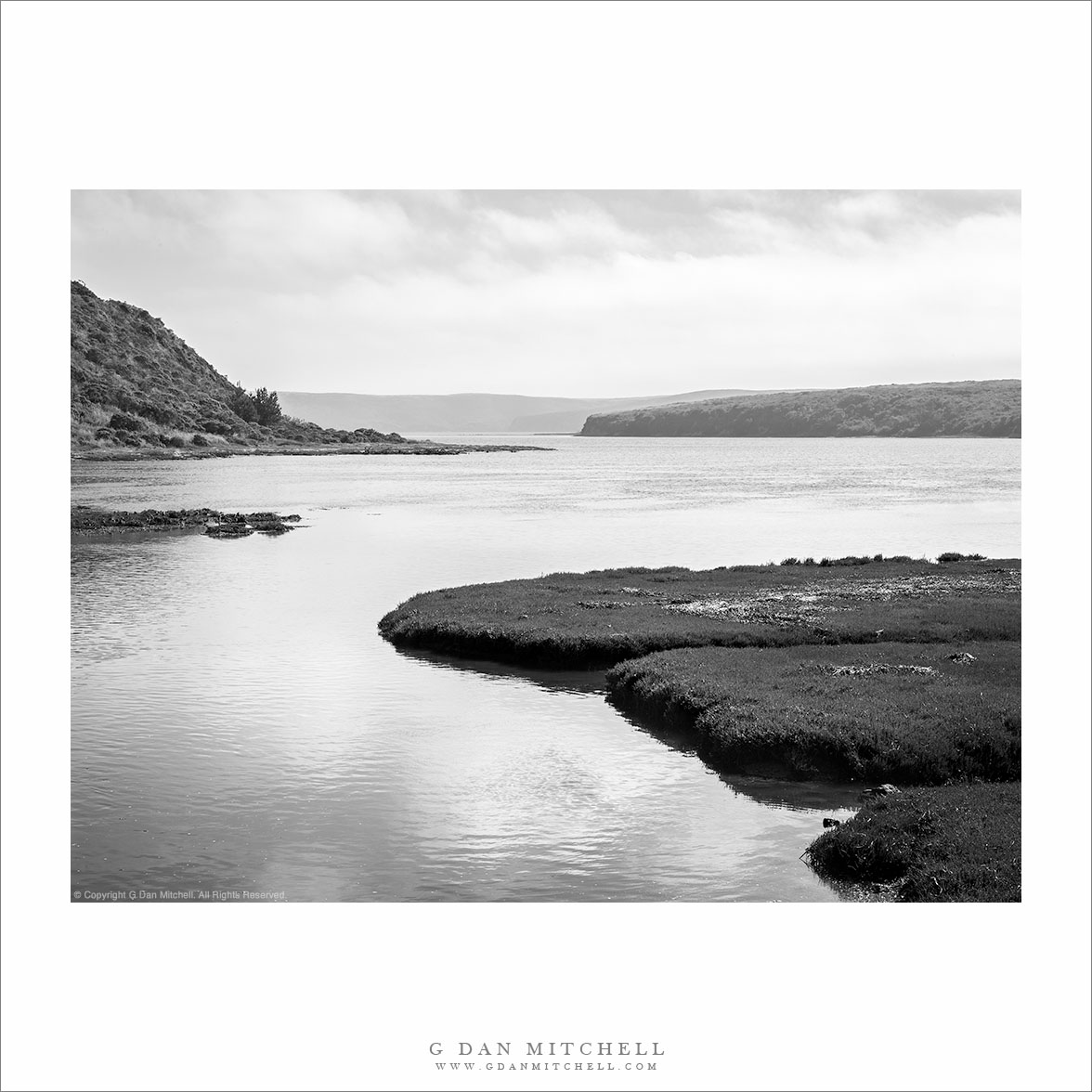
“Home Bay, Drakes Estero” — Fog rolls in over Drakes Estero beyond Home Bay, Point Reyes National Seashore

This quick late-July visit to Point Reyes was an opportunity to re-learn a few lessons about going out to make photographs. I drove up to San Francisco, where my wife was to be involved in a music performance — the plan being to drop her off and then drive on over the Golden Gate Bridge to Point Reyes. It is often cold and windy there, even in the summer, but this was a very warm period and it looked like the coast might be clear of fog. With this in mind, I planned to either visit the Limantour Beach or else hike out towards Drakes Bay.

I should have sensed that things were about to evolve in ways that I had not planned for when, during a brief stop at the Point Reyes visitor center, the rangers announced that the road to Limantour was closed since a fire had just started in the area! With that option gone, I figured that Drakes Bay would be my objective, and I had images of afternoon and evening light on this day of little or no fog. I drove on out to the Estero trailhead where it was, in fact, quite sunny, though a bit windy. I loaded up my camera pack with a few lenses and a tripod, and set out towards Drakes Head, thinking I might make it there for late afternoon light. Soon I saw the telltale puffs of incoming fog overhead, and I came around a bend in the trail to see that the fog had already moved in to the west and over Drakes Bay. Fortunately, iin most cases I would rather photograph in “interesting” weather than in supposed perfect blue sky weather.

At a point where the trail descended to cross a dike at the head of Home Bay, I saw this conjunction of near and far forms, with the distant bluffs under the incoming fog, so I stopped to make a few photographs before moving on. To make a potentially long story a bit shorter, the temperature quickly dropped and the wind picked up to levels that made photography increasingly difficult. I managed to work with one other scene that included a curving snag in front of the bay, but it was already becoming difficult to find a calm moment in the wind to click the shutter. I kept going, finally reaching the trail junction that heads off towards Drakes Head, only to realize that I would never get all the way out there in time to return before dark. Cutting the hike short after a bit more than an hour and a half of hiking, I began to retrace my steps back to the trailhead.

In the end, this is really the only photograph that I came away with – despite carrying that fully loaded camera pack out and back! But this reminded me of a first lesson, namely that it is worth the effort even if I only come back with a single shot that I like. This one, to me, evokes the relative isolation and quiet of this spot in the upper reaches of the calm waters of Drakes Bay, with the fog bank beginning to assemble across the distant bluffs. A second lesson is that sometimes on a photographic quest, it is OK to simply enjoy the surroundings. A practical photographer can remind himself or herself that scouting is a good thing, and that things not photographed this time may well be on a future visit. And a long-time hiker can – and did – remind himself that sometimes it is just fine to leave the camera in the pack and just enjoy the wind and the space.


Leave a comment or question using the form. (Click the title to see the full article and to comment if you are viewing it on the home page.)

G Dan Mitchell is a California photographer and visual opportunist. His book, “California’s Fall Color: A Photographer’s Guide to Autumn in the Sierra” (Heyday Books) is available directly from him. Blog | Bluesky | Mastodon | Substack Notes | Flickr | Email

All media © Copyright G Dan Mitchell and others.

In Praise of the Canon 24-105mm f/4 L IS

(Note: Though Canon no longer sells this lens, it is still around and may be a useful lens for photographers using DSLRs.)

Sometimes it seems like the Canon 24-105mm f/4L IS lens doesn’t get the respect it deserves. It probably doesn’t help that it is often described as a “kit lens” because Canon bundles it with some of their full frame DSLRs. Having a maximum aperture of only f/4, it lacks the f/2.8 aperture found on some other Canon L zooms. It uses an “extending” zoom design that moves the front element when the focal length changes, and some mistakenly associate this with lower quality lenses. It certainly doesn’t have the panache of the high-end, large-aperture primes, with their big  f/1.4 or f/1.2 maximum apertures, nor of the big and impressive f/2.8 L zooms, nor the exotic and equally expensive tilt/shift lenses——nor does it have their correspondingly large selling price.

Continue reading In Praise of the Canon 24-105mm f/4 L IS →

Murphy Point and Murphy Hogback, Evening

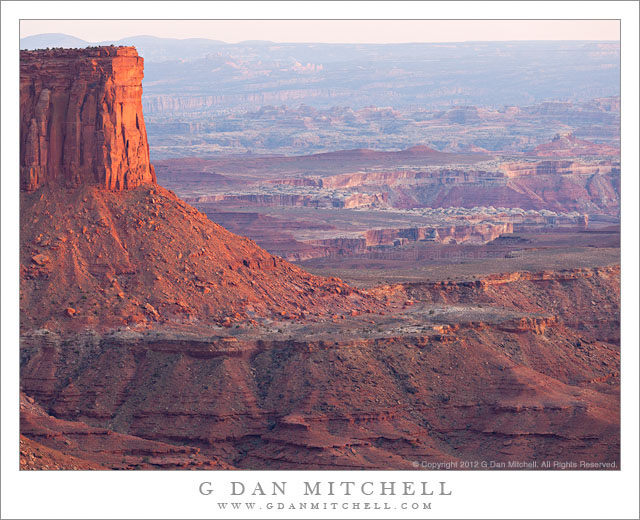
Murphy Point and Murphy Hogback, Evening - Evening light on the brow of Murphy Point, with Murphy Hogback leading to the right and the areas of the Green and Colorado Rivers confluence and the Needles beyond, Canyonlands National Park.
Evening light on the brow of Murphy Point, with Murphy Hogback leading to the right and the areas of the Green and Colorado Rivers confluence and the Needles beyond, Canyonlands National Park.

Murphy Point and Murphy Hogback, Evening. Canyonlands National Park, Utah. April 6, 2012. © Copyright 2012 G Dan Mitchell – all rights reserved.

Evening light on the brow of Murphy Point, with Murphy Hogback leading to the right and the areas of the Green and Colorado Rivers confluence and the Needles beyond, Canyonlands National Park.

When I photographed from the Green River Overlook in Canyonlands National Park back in early April, I arrived there in the evening with one shot definitely planned out ahead of time (though the conditions were, as they often are, a bit of a pleasant surprise once I arrived) and one sort of half planned. The first was a shot across the rugged terrain to the west and southwest through which the Green River has carved a deep and twisting canyon. The second was of more or less the same subject, but shot in vertical format with a longer lens and tracking some of the formations out toward the horizon.

Once there, I quickly figured out my shooting location – to be honest, there are quite a few options and unless you include cliff-top foreground subjects you don’t have to be terribly particular. I composed the first, landscape-orientation shot and then sort of went back and forth between that image and the vertical shot as the light evolved. As I did this and the low angle light began to cut through some of the haze a bit more, the terrain to my south that I had not really thought about earlier started to look a bit more interesting. From the Green River Overlook, the upper sandstone cliffs first curve back away from the river canyon, then run south, and once again extend a bit out into the canyon at Murphy Point, the impressive prominence at the left side of this photograph. One thousand feet below, Murphy Hogback – a flat-topped ridge – extends further toward the Green River. Beyond that the terrain extends into the distance, full of features that were unfamiliar to me but still very impressive – a series of plateaus, often with white rock edges, steep drop-offs into deep canyons, more distant and barely visible towers and other formations. From what I’ve read since then, I’m pretty certain that beyond the shoulder of Murphy Point, I am seeing the area roughly where the Green and Colorado Rivers meet and beyond that the area known as The Needles.

G Dan Mitchell is a California photographer whose subjects include the Pacific coast, redwood forests, central California oak/grasslands, the Sierra Nevada, California deserts, urban landscapes, night photography, and more.
Blog | About | Flickr | Twitter | Facebook | Google+ | 500px.com | LinkedIn | Email

Text, photographs, and other media are © Copyright G Dan Mitchell (or others when indicated) and are not in the public domain and may not be used on websites, blogs, or in other media without advance permission from G Dan Mitchell.