
Tag Archives: light

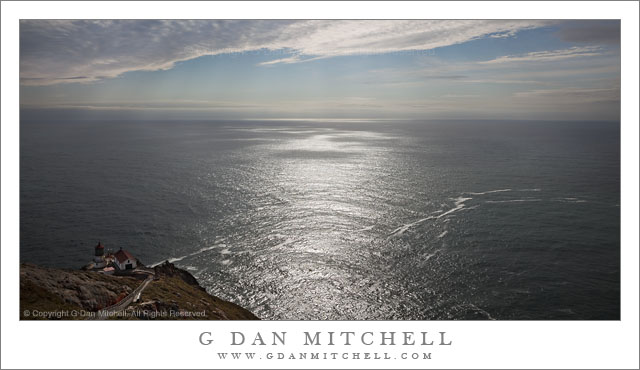
Point Reyes Lighthouse, Pacific Ocean

Point Reyes Lighthouse, Pacific Ocean

© Copyright G Dan Mitchell – all rights reserved.

Afternoon light reflects on the surface of the Pacific Ocean beyond the Point Reyes lighthouse.

Although our trip to Point Reyes was not primarily to do photography, somehow I ended up bringing back quite a few photographs! This photograph was made from the iconic overlook at “the point” and right above the long stairway down to the historic lighthouse. On this afternoon high clouds were streaming in from the Pacific and casting a mottled pattern of light and shadows on the surface of the Pacific Ocean.

This spot is often completely socked in by clouds and/or extremely windy and cold. However, this was perhaps the most benign afternoon I’ve experienced there. The temperatures were very comfortable – we were a bit too warm on the walk to the point. The sun was out, and the wind was nearly still at times.

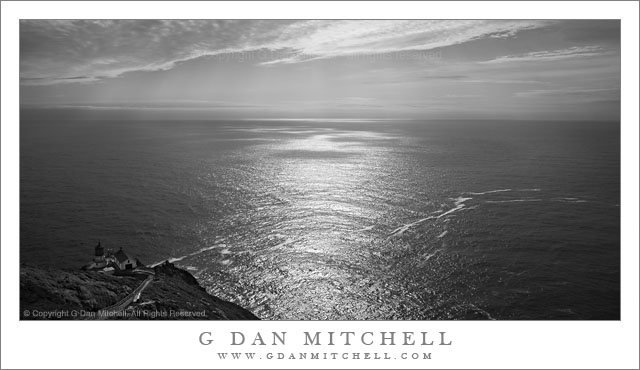
I wasn’t certain when I made the exposure of whether it would end up being a black and white or a color photograph. I’m still not sure! I’m sharing the color version first, but a black and white rendition will follow in tomorrow’s post.

G Dan Mitchell Photography | Flickr | Twitter (follow me) | Facebook (“Like” my page) | LinkedIn | Email
Text, photographs, and other media are © Copyright G Dan Mitchell (or others when indicated) and are not in the public domain and may not be used on websites, blogs, or in other media without advance permission from G Dan Mitchell.
Three Elk, Point Reyes

Three Elk, Point Reyes

Three Elk, Point Reyes. Point Reyes National Seashore, California. May 30, 2011. © Copyright G Dan Mitchell – all rights reserved.

Three tule elk grazing on hills above Drakes Beach at Point Reyes National Seashore, California.

This is one more – and possibly the last – in the series of tule elk photographs that I made at the Point Reyes National Seashore on Memorial Day. A group of perhaps eight or ten bull elk were grazing along the top of the hills above Drakes Bay when we encountered them in beautiful late afternoon light. As soon as I got out with my camera they moved just a bit further away, but still well within photography range.

There is a typical sequence in how I usually photograph creatures such as these. Because I never know how long they will stick around, I begin my just shooting them in any way that seems even somewhat interesting, perhaps muttering to myself, “At least I have tule elk shots in my portfolio now!” But after getting a few “insurance” shots right off the bat, I start to be more selective and more observant. Initially, I’m looking for a variety of interesting individual shots. These might include a single animal separate from the group, perhaps the full group, and perhaps sub-groups of two or three. I also pay a lot of attention to their positions, watching to make sure that faces are visible. (In this shot, the leftmost elk is partially obscured, but because his eyes are still visible and because of the way his antlers align with those of the front animal, on balance I don’t think this is a big problem.) I also watch for distracting elements, and may stop shooting if they are present. For example, the rear end of an elk is bright white and, uh, not the most photogenic part of the beast – so I wait until an animal presenting its backside to the camera either moves out of the frame or rotates into a better position.

I also try to think the same way I think when photographing a group of people. Their faces and eyes are the most important things, with the relationships their positions create among them being a very close second. Here two of the elk are looking almost at me, but slightly past my left shoulder. The third animal seems to be looking more toward the other two, creating a different sort of relationship among the animals. These things are so fleeting that I sometimes don’t see them until they have happened, so I have learned to not be conservative about exposing a lot of frames!

To the extent that I have control over such things, I also like to think about the angle of the light on the subjects. Sometimes you have no choice – you simply have to shoot from where you are. However, with these elk I did have some range of options. They were along a road, and I chose to stop a bit before their position because the light coming from the left would light them in a more dramatic and interesting fashion than if I had gotten closer and shot them with the light right behind me. In addition, I try to look beyond the animals themselves and be aware of how they position themselves against background subjects. This particular shot isn’t a great example, but in others I might wait for the moving animals to position themselves in a place where the background elements relate to them in some interesting way.

With all of this detail, you might get the idea that I’m standing there making a series of careful and logical calculations about how to shoot these guys. That’s not really what happens at all. Much of it turns out to happen in a quick and intuitive and almost subconscious manner “in the moment.” I’ve probably written here before about my belief in the important of “practice” (something I learned from my musical background) when it comes to being able to work and see quickly and effectively.

G Dan Mitchell Photography | Flickr | Twitter (follow me) | Facebook (“Like” my page) | LinkedIn | Email
Text, photographs, and other media are © Copyright G Dan Mitchell (or others when indicated) and are not in the public domain and may not be used on websites, blogs, or in other media without advance permission from G Dan Mitchell.
Mammoth Peak Reflected in Tioga Tarn

Mammoth Peak Reflected in Tioga Tarn

Mammoth Peak Reflected in Tioga Tarn. Yosemite National Park, California. July 22, 2010. © Copyright G Dan Mitchell – all rights reserved.

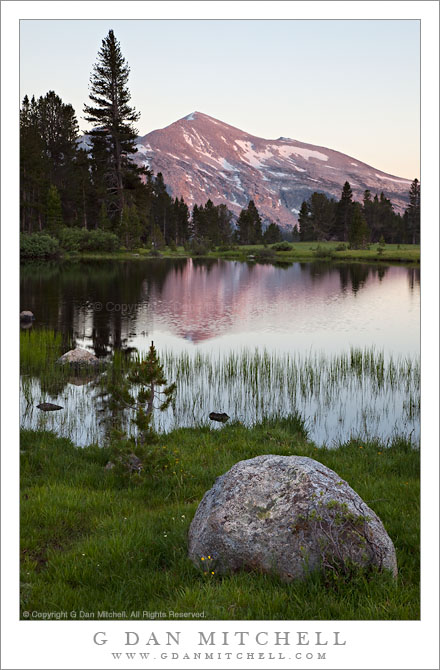
Mammoth Peak in sunset light, reflected in the still surface of Tioga Tarn, Tioga Pass, Yosemite National Park.

This view of Mammoth Peak on Kuna Crest in the Yosemite High Country from the Tioga Tarns at the top of Tioga Pass is a classic Sierra Nevada scene. The foreground tarns are lush green in the early summer after the snow melts out and fall into shadow early in the evening as the sun drops behind the ridge between this area and Gaylor Lakes. Mammoth Peak, however, has an almost unobstructed line of sight to the west, so this peak continues to hold the sunset light until the last possible minute. (Don’t let the peaceful appearance of the scene fool you – I was being devoured by clouds of mosquitos as I made these exposures.)

In order to deal with the extremely large dynamic range between the Mammoth Peak snow fields in direct sun and the very dark shadows of the nearby forest I resorted to exposure blending and a few other post-processing techniques. With exposure blending, I make two exposures, one optimized for the brightest areas of the scene and the second a slightly longer exposure to capture a bit more of the shadow detail. In post I began with the darker frame, since that presented Mammoth Peak the way I remembered it. Then I placed to other exposure beneath it and used a mask layer to reveal some of the lighter areas from the lower layer.


G Dan Mitchell is a California photographer and visual opportunist. His book, “California’s Fall Color: A Photographer’s Guide to Autumn in the Sierra” (Heyday Books) is available directly from him.

G Dan Mitchell: Blog | Bluesky | Mastodon | Substack Notes | Flickr | Email


All media © Copyright G Dan Mitchell and others as indicated. Any use requires advance permission from G Dan Mitchell.

‘Rim of the World’ Overlook, Morning

'Rim of the World' Overlook, Morning

‘Rim of the World’ Overlook, Morning. Sierra Nevada, California. May 7, 2011. © Copyright G Dan Mitchell – all rights reserved.

The view toward Yosemite and the High Sierra from the ‘Rim of the World’ overlook above the Tuolumne River canyon along highway 120.

‘Rim of the World’ is the name given to a scenic overlook above the deep valley of the Tuolumne River along route 120, the northern route into Yosemite National Park. It is something of an odd place. It is a fairly pedestrian traffic pullout, though it overlooks the immense and impressively deep canyon of the Tuolumne. But the view is at least partially obstructed by things like power lines. However, it is a view that on clear days can extend great distances to very high Sierra peaks.

I most often simply blow past the spot on my way to or from the park. However, on this morning as I passed I thought the low morning light looked interesting so I found a spot to turn around and drove back. There was a bit of high cloudiness, and the light was coming across the folds of these foreground hills from the right, lighting up various bits of ridge and trees and illuminating the morning haze enough to amplify the effect of distance. If I’m not mistaken, the further ridge with its faintly seen snow fields is in the area of Mount Hoffman.

G Dan Mitchell Photography | Flickr | Twitter (follow me) | Facebook (“Like” my page) | LinkedIn | Email
Text, photographs, and other media are © Copyright G Dan Mitchell (or others when indicated) and are not in the public domain and may not be used on websites, blogs, or in other media without advance permission from G Dan Mitchell.