
Tag Archives: light

Wooden Building and Stairs in Moonlight

Wooden Building and Stairs in Moonlight

Wooden Building and Stairs in Moonlight. Mare Island Naval Ship Yard, Vallejo, California. April 16, 2011. © Copyright G Dan Mitchell – all rights reserved.

The light of the full moon illuminates the facade of a wooden building, and outside stairway, and passing overhead fog clouds at Mare Island Naval Ship Yard.

Since I was out doing night photography this weekend, I’m going to use this as an excuse to insert a night image into the recent stream of Death Valley photographs. (There are more of those, but a bit of variety can’t hurt.) I got an email from Tim Baskerville, the guiding light (guiding dark?) of The Nocturnes, the San Francisco Bay Area night photography group. Tim has introduced and guided many new night photographers over the past few decades, and The Nocturnes group is a sort of loose collective linking together lots of night photographers and providing instruction, online resources, and shows of night photography work. As this is the 20th year for the group, lots of special activities are taking place and this little spontaneous get-together at Mare Island was one of them.

A small story from this weekend’s shoot may illustrate the widespread effect of Tim’s work with night photography in general and with the Mare Island location specifically. Those of us who were to meet Tim at Mare Island arrived to find other photographers already assembled at the indicated meeting place – but we didn’t really recognize most of the group. It turns out that another night photography group (loosely organized, as I understand it, by Thomas Hawk and Ivan Makarov) was going to be there as well. We spoke with them a bit and then they departed for the far end of the island. (They returned later and we worked side by side.) But then, a few minutes later, more vehicles began to show up and we thought that they might be the rest of our group, especially when someone asked “Are you the Nocturnes?” But no, this was a third night photography group, this one out of Sacramento!

In any case, as the light diminished and night came on we started shooting. We had a nearly full moon, which can be a wonderful asset, not so much as a subject (it is very difficult to include the full moon in night shots) but for the beautiful light is sheds on other subjects that might otherwise be very dark. On top of that, we had a combination of some high clouds (which are relatively stationary) and low fog (which creates a nice luminous glow as it quickly passes). I decided to begin the evening’s work by photographing this wooden-sided building and its outside staircase, illuminated by the moonlight, and with a bit of the cloudy sky and faint star trails.

G Dan Mitchell Photography | Flickr | Twitter (follow me) | Facebook (“Like” my page) | LinkedIn | Email
Text, photographs, and other media are © Copyright G Dan Mitchell (or others when indicated) and are not in the public domain and may not be used on websites, blogs, or in other media without advance permission from G Dan Mitchell.

Hills and Sunrise Haze, Death Valley

Hills and Sunrise Haze, Death Valley

Hills and Sunrise Haze. Death Valley National Park, California. March 31, 2011. © Copyright G Dan Mitchell – all rights reserved.

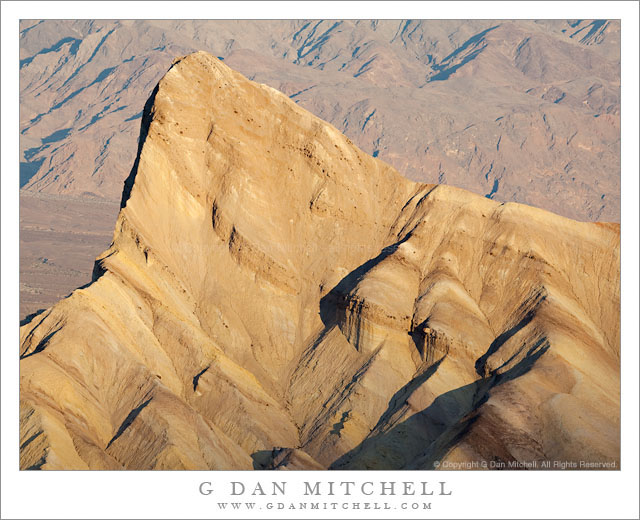
Sunrise light shines through morning haze to silhouette low hills in central Death Valley.

On the last morning of my late-March Death Valley shoot, I was on top of a low hill in roughly the middle of the Valley, not far from the “Devils Cornfield” area, mainly to photograph the Mesquite Dunes and the nearby transverse dunes against the backdrop of the Cottonwood Mountains. But this spot gave me a 360 degree panoramic view of a huge section of the central Valley, so while I waited for “just right” light on my intended subjects I also had time to see and photograph other subjects.

These low hills, mostly bare but sprinkled here and there with a few small plants or even a creosote bush or possibly a mesquite tree, were in the morning haze that sometimes settles in the bottom of the Valley before the daytime winds clear it out. The sun had just come over the Funeral Mountains to the east and was shining at a very low angle through this haze, so I pointed the camera (with a 400mm focal length lens!) almost straight into the sun (shading the lens with my hand) and made a few shots of these hills receding into the hazy distance across the Valley

G Dan Mitchell Photography | Flickr | Twitter | Facebook | Email
Text, photographs, and other media are © Copyright G Dan Mitchell (or others when indicated) and are not in the public domain and may not be used on websites, blogs, or in other media without advance permission from G Dan Mitchell.
Desert Wash at Base of Tucki Mountain, Dusk

Desert Wash at Base of Tucki Mountain, Dusk

Desert Wash at Base of Tucki Mountain, Dusk. Death Valley National Park, California. March 29, 2011. © Copyright G Dan Mitchell – all rights reserved.

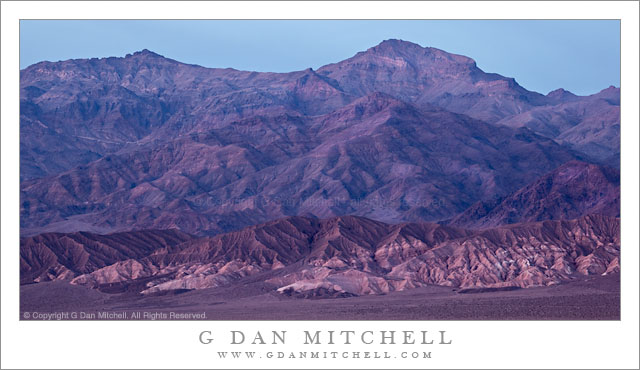
Soft rose-colored dusk light illuminates an alluvial fan below a canyon at the base of Tucki Mountain, Death Valley National Park.

This is one of several photographs from the recent Death Valley trip that beg the question, “Is that color real?!”*

Yes, this really is the color of the light from this scene.

I learned quite a while ago that the interesting light most definitely does not end at sunset – often the best and most interesting light comes after the sun has set. Sunset on this evening had been quite interesting, but a few minutes after the sun set the last brilliant red light struck high clouds overhead and lit up the entire scene with this lurid and intense wash of color.

The scene is a large desert gravel wash where a drainage canyon spills out into Death Valley at the base of Tucki Mountain and forms a huge alluvial fan. I had climbed to the top of a low hill to shoot late afternoon and sunset light, so I had a good vantage point to view this wash beyond intervening hills. Tucki Mountain itself is a massive lump of a mountain that rises above Stovepipe Wells – what it lacks in terms of an impressive and jagged summit peak in makes up for by means of its sheer bulk. It constitutes a large spur off of the Panamint Range and almost seems like a small sub-range all by itself.

*After I originally wrote the text to this post I made a 12″ x 16″ test print of this photograph. As I often do, I put the print out on a table in our living room so that I can see it in a context other than that of my small studio. My wife, who is a very perceptive viewer and who has seen the results of, uh, printer errors (for real fun, print on the back side of your paper by accident some time…) looked at these colors and said, “Is something wrong with your printer?” Ah, I love critics! ;-)

G Dan Mitchell Photography | Flickr | Twitter | Facebook | Email
Text, photographs, and other media are © Copyright G Dan Mitchell (or others when indicated) and are not in the public domain and may not be used on websites, blogs, or in other media without advance permission from G Dan Mitchell.

Mesquite Dunes and Cottonwood Mountains

Mesquite Dunes and Cottonwood Mountains

Mesquite Dunes and Cottonwood Mountains. Death Valley National Park, California. March 29, 2011. © Copyright G Dan Mitchell – all rights reserved.

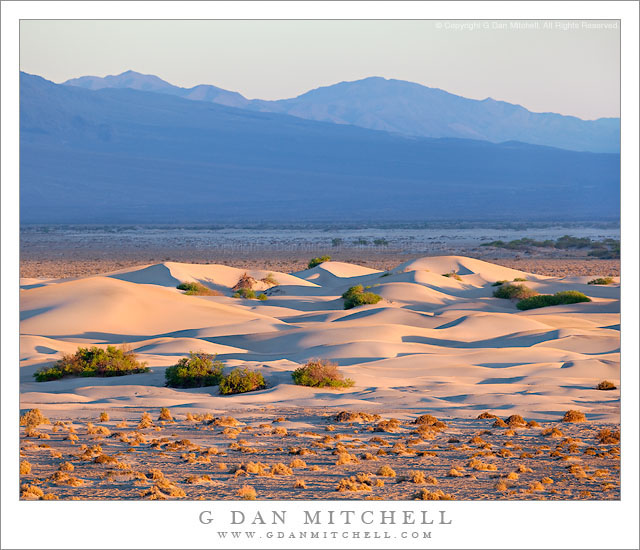
Soft and hazy late-afternoon light on Mesquite Dunes and lower Cottonwood Mountains, Death Valley National Park.

The color of the sand dunes of Death Valley changes radically at different times of the day, in different weather conditions, and even seasonally. Many of the photographs of these dunes – the “Mesquite Dunes” in the middle Valley near Stovepipe Wells – are made in the early morning or in the evening. At those times the dunes take on the colors of sunrise/sunset light (generally very warm yellow to golden colors) or the pre-dawn or (better yet) post-sunset light of the sky, which can include a range of colors from blues to pinks to purples and so on. Judging by photographs you might think that the dunes are brightly and intensely colorful. (Or black and white, but that’s a different story.)

Most of the time the coloration is quite different from what we see at the early and late “edges” of the day. The less saturated colors at other times of day can be a bit more complicated to shoot, but they can also create some wonderful subtle effects if you happen to look in the right place at the right time. Late in the afternoon on this early spring day, there was some haze in the atmosphere – perhaps from some blowing dust and/or some clouds and moisture that had been around earlier. As the sun drops at Mesquite Dunes, it goes behind mountains to the west well before actual sunset. When this happens, the dunes are gently back-lit by soft light from the western sky, and the backlit haze mutes the colors of the dunes and, even more, the distant slopes of the rugged Cottonwood Mountains.

My idea here was to isolate the undulating shapes of the softly lit dunes in front of the background of the very, very muted colors and shapes of the lower Cottonwood Mountains, which are obscured by haze. There is some color in this scene, but it is subdued and edges quite a ways towards pastels.

G Dan Mitchell Photography | Flickr | Twitter | Facebook | Email
Text, photographs, and other media are © Copyright G Dan Mitchell (or others when indicated) and are not in the public domain and may not be used on websites, blogs, or in other media without advance permission from G Dan Mitchell.