
Tag Archives: pattern

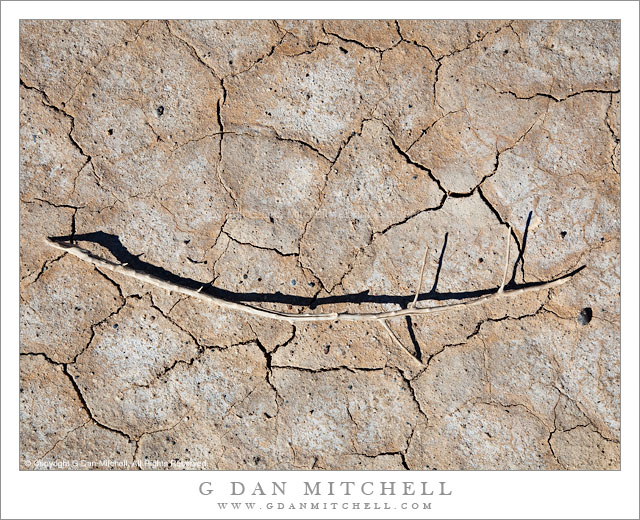
Branch on Playa, Panamint Valley

Branch on Playa, Panamint Valley

Branch on Playa, Panamint Valley. Death Valley National Park, California. March 31, 2011. © Copyright G Dan Mitchell – all rights reserved.

A lone branch lies across dried mud on the playa of Panamint Valley, Death Valley National Park.

First, a story about the location. My first visit to Death Valley was sometime in the late 1990s, when the “hiking and biking” club at my kids’ middle and high school did a trip there. The club is a long and interesting story that I don’t have time or space to describe here fully. Suffice it to say that the teacher, “Mr. Hodges,” had for decades taken kids on amazing outdoor adventures throughout the western United States every year, and that the trip that year was to involve visits to several places in the park and then a backpacking trip down to the Valley from up in the Teakettle Junction vicinity. This may sound like a crazy thing to do with a bunch of school kids, but the group had a record of success. I was along as a parent chaperone since my oldest son was a participant in the trip.

The “readers digest” version of the story of the trip is that, as is often the case near the beginning of April, we encountered an astonishing range of weather conditions. Early on it snowed and the wind blew at gale force levels. This forced us to abandon our initial backpacking plans after we had already camped overnight near Teakettle Junction, and to head back down to the Valley. We readjusted our plans and decided that we might still be able to do an overnight hike down the length of the upper Valley and (leaving out a bunch of intervening adventures in this narrative) we arrived at Stovepipe Wells and set up camp… just in time for a tremendous dust storm to blow in. The next morning the “bus” arrived that was to take the kids and a few of the chaperones home (the rest of us were in a truck carrying tons – literally – of gear on the roof rack and in a trailer) and we headed up to cross Towne Pass. It turned out that the “bus” (which was more or less a large airport shuttle-type van) was ill-equipped for these conditions and after struggling up the pass and then racing down the other side, the transmission blew out at the bottom of the descent into Panamint Valley. Those of us in the truck pulling the trailer arrived a few minutes later to find a group of scared kids and parents who had just experienced more excitement than they wanted.

I have a strong visual memory of “Mary,” one of the parents, who had just had a bit too much excitement walking quietly north away from the road and across this playa. Ever since that time, this place that most people would probably blow right past, has almost always warranted a stop as I passed by on my way out of the Valley. This trip was no exception. I left my camera gear in the car and just walked a ways out onto the playa. As I walked, even though I had been certain that my photography for this trip was finished, I started noticing some of the small details on the playa… and I went back to my car to get my camera, then returned and made a few hand-held exposures of some of these small subjects.

G Dan Mitchell Photography | Flickr | Twitter | Facebook | Email
Text, photographs, and other media are © Copyright G Dan Mitchell (or others when indicated) and are not in the public domain and may not be used on websites, blogs, or in other media without advance permission from G Dan Mitchell.
Zabriskie Point Gully, Morning Light

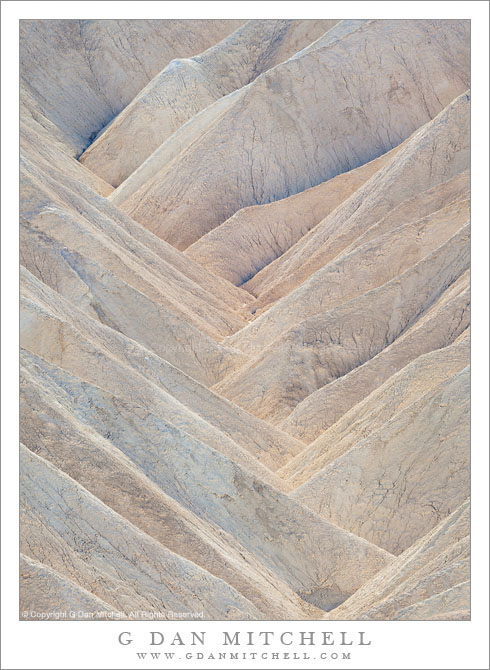
Zabriskie Point Gully, Morning Light

Zabriskie Point Gully, Morning Light. Death Valley National Park, California. February 20, 2011. © Copyright G Dan Mitchell – all rights reserved.

Morning sun back-lights the dense pattern of folds in a small gully at Zabriskie Point, Death Valley National Park, California.

In some ways I think this is one of the more subtle and complex of the various photographs I have made that isolate small sections of the Zabriskie Point landscape, especially the eroded patterns of the small gullies below the main viewing area. This photograph, like many in this series, was made after the normal “dawn light” time period, and at this time the sun is higher in the sky. It begins to back-light the tops of the furrows and gullies and the brighter light reflects down into the lower portions of the gully. There are a tremendous number of overlapping ridges and the color variations are quite large, though subtle at the same time. Some areas have a very blue cast, being in shadow and lit almost completely by the open blue sky. Others take on warmer tones, especially if they are illuminated by light reflected from the warm-tones earth. An area of thin clouds was floating above the scene and its shadow slightly softened and muted the light that otherwise might have been quite stark.

G Dan Mitchell Photography | Flickr | Twitter | Facebook | Email
Text, photographs, and other media are © Copyright G Dan Mitchell (or others when indicated) and are not in the public domain and may not be used on websites, blogs, or in other media without advance permission from G Dan Mitchell.

Eroded Sandstone, Point Lobos

Eroded Sandstone, Point Lobos

Eroded Sandstone, Point Lobos. Point Lobos State Reserve, California. July 20, 2010. © Copyright G Dan Mitchell – all rights reserved.

Patterns in eroded shoreline sandstone rocks at the Point Lobos State Reserve, California.

The rugged Point Lobos shoreline in places exposes some very interesting rocks, including sections like this one where layers of different colored sand stone are gradually worn away, revealing underlying layers of different colors and textures and sometimes exposing surprising color contrasts. On days when the light is very soft (or very boring!) I may seek out some of these rocks and photograph them since the softer light lets details appear that might easily be washed out in harsher light.

G Dan Mitchell Photography | Flickr | Twitter | Facebook | Email
Text, photographs, and other media are © Copyright G Dan Mitchell (or others when indicated) and are not in the public domain and may not be used on websites, blogs, or in other media without advance permission from G Dan Mitchell.

Corn Lilies – Sierra Nevada

Corn Lilies - Sierra Nevada

Corn Lilies – Sierra Nevada. Yosemite National Park, California. June 30, 2010. © Copyright G Dan Mitchell – all rights reserved.

High Sierra corn lilies grow profusely near a waterlogged meadow in the high country of Yosemite National Park.

I had spotted this little meadow area on my way to photograph earlier in the morning at Tenaya Lake, so on my return I decided to wander down into this wet, meadowy area where a small creek flows in the early summer season. As I walked up the stream I came upon large and lush stands of corn lily plants in a boggy area where the stream turned and twisted through a flat area.

I have long been a fan of these plants. I’m fascinated by them at every phase of their annual life cycle, from the time when they first poke up from ground newly free of snow, through this phase when they grow thick and wildly green, to the first hints of brown at the tips of the leaves (which always seem to come a bit too early), to the time in late August when they begin to turn brown and yellow and hint at the coming fall, to the dry stalks that fall over in late September and October.

It is somewhat hard to give up the beautiful green color when you photograph the plants at the peak of growth, as these were when I photographed them at the end of June. However, I like the way that black and white abstracts the curving and sweeping shapes of the plants. (And I always think of John Sexton’s wonderful corn lily photograph when I work with this subject!)

G Dan Mitchell Photography | Flickr | Twitter | Facebook | Email
Text, photographs, and other media are © Copyright G Dan Mitchell (or others when indicated) and are not in the public domain and may not be used on websites, blogs, or in other media without advance permission from G Dan Mitchell.