Tag Archives: photography

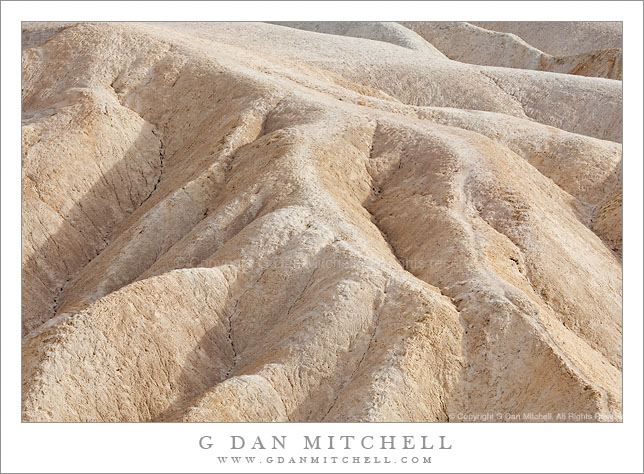
Erosion Patterns in Afternoon Light, Zabriskie Point

Erosion Patterns in Afternoon Light, Zabriskie Point

Erosion Patterns in Afternoon Light, Zabriskie Point. Death Valley National Park, California. March 29, 2010. © Copyright G Dan Mitchell – all rights reserved.

Slightly overcast afternoon light on erosion patterns in the Gower Gulch area of Zabriskie Point, Death Valley National Park, California.

After posting such a long string of close views of the hills at Zabriskie Point… it is starting to become difficult to say much original and new about the photographs in this series! This one was made rather late in the afternoon – about 4:00 p.m. – when the light is usually still too harsh and bright for most photography here. Fortunately, some high and thin clouds diffused the light a bit – but still didn’t take the light too far in the soft direction.

It perhaps goes without saying that this another in my series of long-lens studies of small elements of the large and iconic scene at this location. I’ve photographed this particular bit of folded geology before, and I’m still interested in the combination of soft, almost organic shapes and the crazy patterns of lines and shapes heading every which way. From lower left to upper right the lines shift almost completely.

This photograph is not in the public domain and may not be used on websites, blogs, or in other media without advance permission from G Dan Mitchell.

G Dan Mitchell Photography | Twitter | Friendfeed | Facebook | Facebook Fan Page | Email

Technical Data:
Canon EOS 5D Mark II
Canon EF 100-400mm f/4.5-5.6 L IS USM at 200mm
ISO 100, f/16, 1/60 second

keywords: gower, gulch, zabriskie, point, erosion, gully, ridge, hill, crack, dirt, curve, fold, geology, shadow, light, afternoon, overcast, diffuse, death valley, national, park, california, usa, north america, landscape, nature, scenic, travel, detail, stock
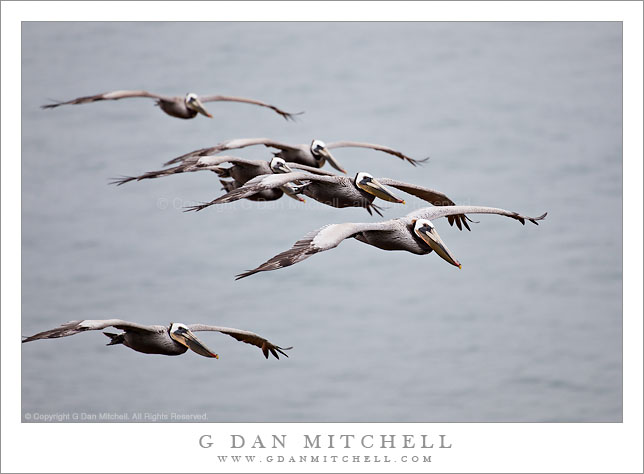
Pelican Flock in Flight

Pelican Flock in Flight

Pelican Flock in Flight. Near Davenport, California. May 15, 2010. © Copyright G Dan Mitchell – all rights reserved.

A flock of pelicans in flight over the Pacific Coast near Davenport, California.

Since I’ve recently posted other photographs of pelican flocks along the Pacific coast of California, I’ll keep the commentary shorter on this one. While driving along Highway One just north of Davenport, California – close to Waddell Creek, actually – I noticed a spot that looked ideal for photographing shorebirds: a place where the land extended a bit further toward the ocean and where access to the to top of the high bluff was fairly easy. The birds often fly along the tops of these bluffs, I assume because they can coast in the updraft created by wind coming off the ocean. If I am patient and/or lucky a flock may pass by very close to me. It still isn’t easy to get a photograph – there are a number of challenges: if the birds are below me the camera wants to focus on the water or the rocks beyond the birds, tracking a flock of moving birds that fills the viewfinder is no easy thing, not all birds are equally photogenic (depends on position, health of the bird, etc.), and I have to be able to anticipate their appearance and then react instantly.

This flock was very cooperative! They were so kind as to arrange themselves in an appealing formation – and to make sure that “everyone can see the camera!” They also made a slight turn toward the coast, allowing be to see their heads and eyes. And their passage was relatively slow and predictable.

This photograph is not in the public domain and may not be used on websites, blogs, or in other media without advance permission from G Dan Mitchell.

G Dan Mitchell Photography | Twitter | Friendfeed | Facebook | Facebook Fan Page | Email

Technical Data:
Canon EOS 5D Mark II
Canon EF 100-400mm f/4.5-5.6 L IS USM at 400mm
ISO 400, f/5.6, 1/1000 second

keywords: pelican, bird, sea, pelagic, shore, ocean, coast, davenport, california, usa, north america, nature, fauna, wildlife, flock, group, bill, wing, water, pacific, fly, flight, brown, stock

Headlands Near Davenport

Headlands Near Davenport

Headlands Near Davenport. California Coast. May 15, 2010. © Copyright G Dan Mitchell – all rights reserved.

Foggy sky along the coastal headlands near Davenport, California.

I stopped along the edge of the bluff at a spot on the California Coast Highway (highway 1) where I know that I can photograph seabirds as they cruise just feet away from the top of the cliff. Although my attention was first on the birds, I was also aware of the expansive views of the coastline from this high spot on the road, and I thought that the glowing fog-filled sky to the southwest might be worth photographing. I decided to place the horizon very low in the frame and expose so that the thin line of coastal bluffs extending into the frame from the left would be much darker than the water or the sky.

While I had a pretty good idea that this would end up as a black and white photograph – the colors in the foggy and gray conditions were not that special – I wasn’t certain when I made the exposure of just what I would do with it in post. As soon as I opened the file though I had a pretty good idea of what I wanted to do. In the end, for an image that might seem so simple, this photograph required quite a bit of post-processing work.

This photograph is not in the public domain and may not be used on websites, blogs, or in other media without advance permission from G Dan Mitchell.

G Dan Mitchell Photography | Twitter | Friendfeed | Facebook | Facebook Fan Page | Email

Technical Data:
Canon EOS 5D Mark II
Canon EF 70-200mm f/4 L USM at 200mm
ISO 100, f/11, 1/120 second

keywords: davenport, california, usa, north america, headlands, bluff, coast, shore, surf, wave, horizon, fog, clouds, cliff, rocky, ocean, sea, shoreline, highway, one, black and white, monochrome, landscape, seascape, travel, scenic, nature, beach, shoal, minimal, sky, stock

Fifteen Ideas For Photographing Professional Bicycle Races

Some might be surprised to find that I take every opportunity to photograph bicycle racing. Although I’m primarily an urban and natural landscape shooter (to generalize just a bit) I also have a passion for shooting a few other surprising subjects. One of these is professional bicycle racing. Although I never raced, I was at one time a very serious cyclist. I trained with folks who did race and for several years I rode as if I were preparing to race, doing over 10,000 miles per year. With that in mind, it might  seem less surprising that I interrupted my photographs of Death Valley, the coast redwoods, and the Pacific coastline to post a week of bicycle racing photos.

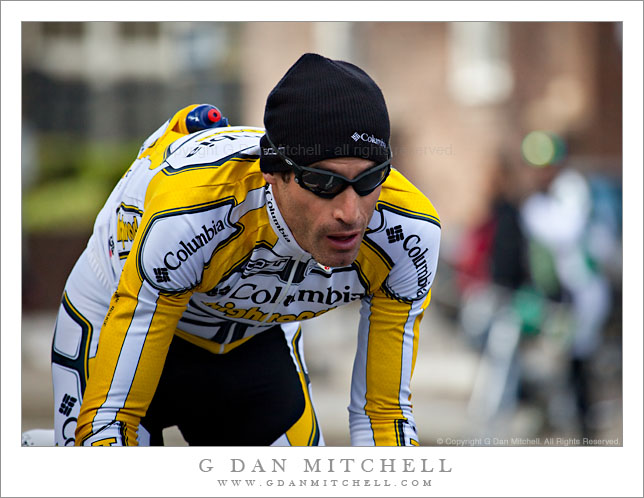
During the last few years I’ve been fortunate to be able to shoot stages of the Amgen Tour of California professional stage race in northern California. As I’ve done so, I’ve gradually figured out more strategies that let me get some effective photographs. Here’s a quick summary of a few of them.

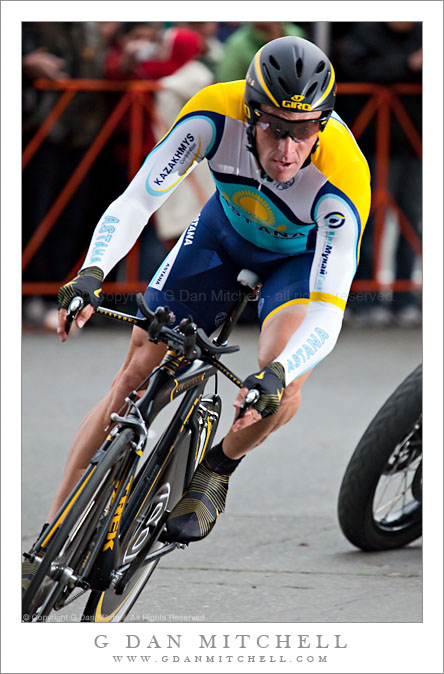
  1. Time trials, especially those on short courses, can be the best opportunity to shoot riders on their bikes. Each competitor rides the course individually, so you can get a clear view of the rider approaching. Because lower ranked riders go first, you can experiment with locations, lighting, and so forth on them… and have your shooting strategy worked out by the time the big names arrive.
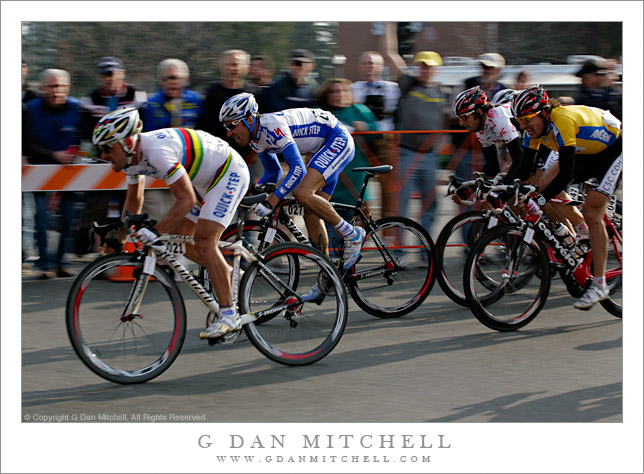
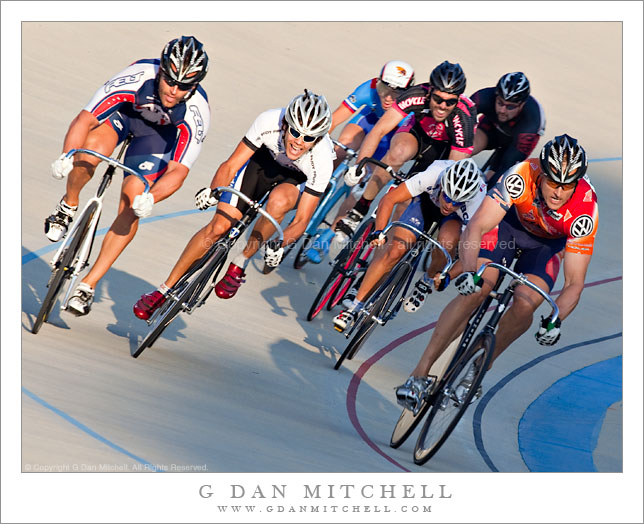
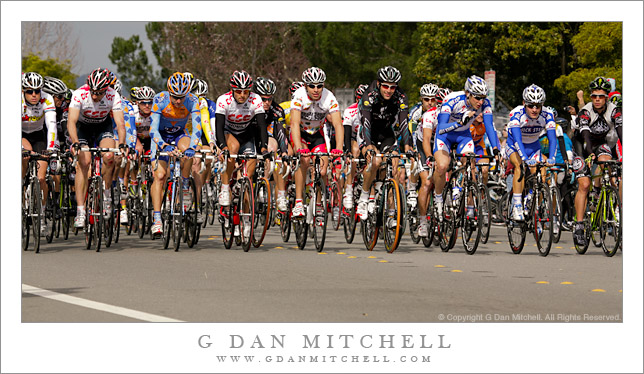
  2. If you want to shoot the peloton (the pack of riders) try to do so at a start in a downtown area that includes “parade laps” – where the pack does a few loops at less competitive speeds before heading out on the open road. You’ll have similar opportunities at the end of a stage that finishes with several downtown loops, though things tend to happen a lot faster at the end than during the parade laps.
  3. If you try to shoot a sprint finish and cannot be right at the finish line – and you probably cannot – try to be in the area 100-200 meters from the line. At this point there is tremendous action as the final sprint starts to take place and, in my experience, some very dramatic shots are possible – even more so than at the finish line when the race has usually already been decided.
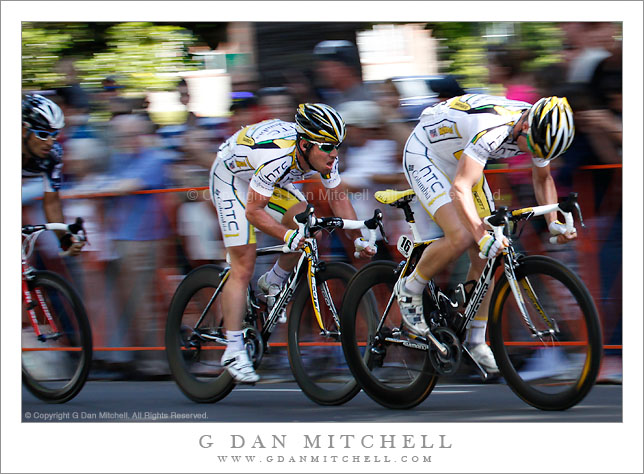
  4. In all of these situations, unless you are very experienced at tracking riders close up with a long lens as they fly by at high speed… practice on every rider that comes by. I’ll even practice tracking support motorcycles, police escorts – anything that moves. Eventually you want to pan smoothly while you remain continuously aware of the position of the riders in the frame – and the non-rider elements in the background. To put it mildly, this isn’t easy – and it takes a lot of practice.
  5. When you track riders moving at high speed, think about putting their torsos/hips in the center of the frame vertically. Unless you are shooting very tight, if you center their heads you’ll get lots of empty space above them and cut off their legs and bikes.
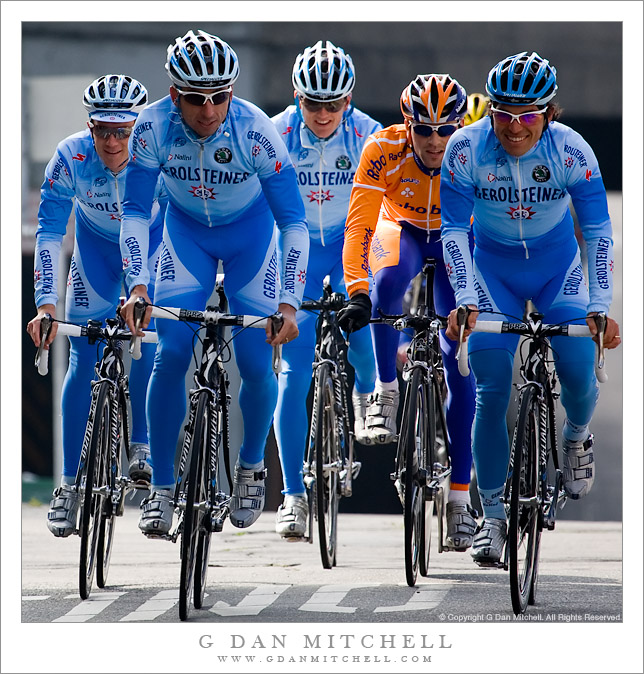
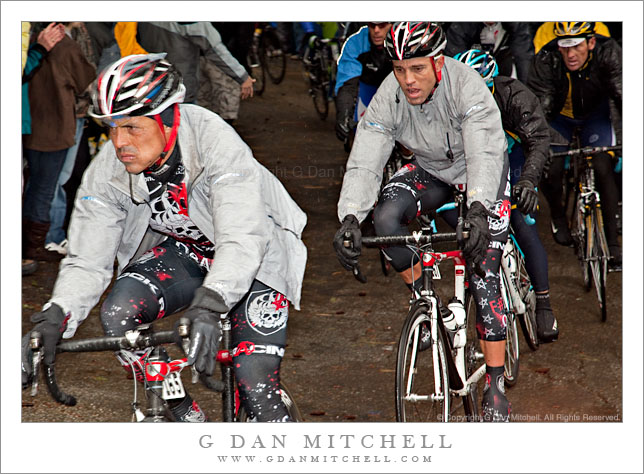
Team Gerolsteiner Warms Up for the Prologue
  • Pick your shooting location carefully. You certainly want a spot where the riders are likely to be in dramatic and dynamic positions. Turns can be good for this, for example. But also carefully consider the background to your shot – who is standing on the other side of the road and what is beyond the riders. (I once shot a series of riders warming up for a time trial… only to realize later that there was a bright green outhouse behind them!) Also think carefully about the ambient lighting. If the riders are backlit there is a good chance that they will be very dark. I try to place myself in a position where they will be front or side-lit.
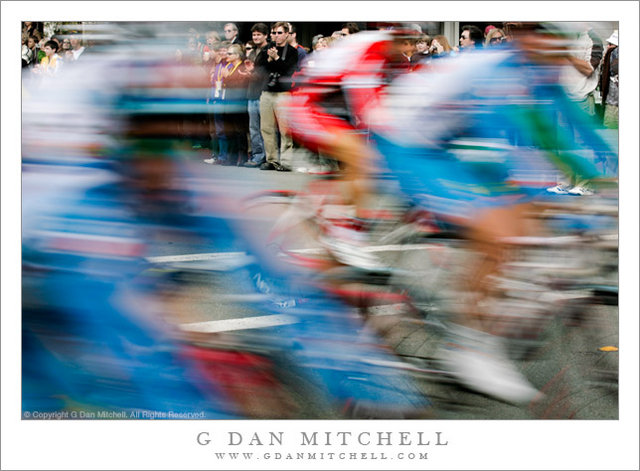
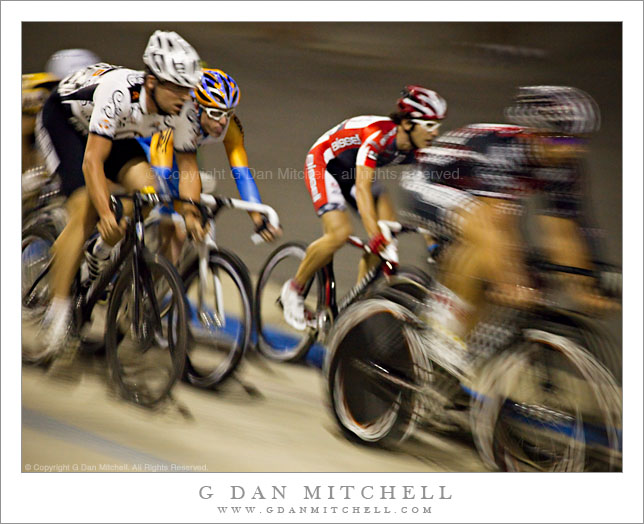
  • Counter-intuitively, very high shutter speeds may not always be a good choice. Yes, you may stop the action – but you also may end up with very static looking shots. In many cases you’ll more effectively capture the speed and motion of racing if you lengthen the exposure and track the riders, thus allowing some motion blur.
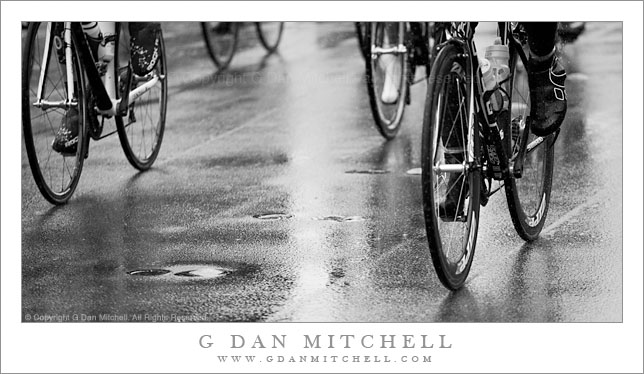
  • Don’t let bad weather dissuade you from shooting. Often rain or clouds or fog can make for some of the most dramatic images. Be careful with your gear, but try to take advantage of these conditions.
  • If you are going to try to shoot the pack in the middle of a long road stage, you need to plan carefully. The road will often close well before the peloton arrives, so you need to be in place well ahead of time – an hour or many hours before the race passes. If possible, scout the area where you think you’ll shoot ahead of time. Look for a dramatic setting – an expansive view, a bridge, forest, anything that can make your shot something other than just “bikes on a road.” Consider shooting on an uphill section – the pack will go more slowly. Try out different focal lengths to see what will work best in your location. Consider having two camera bodies with different lenses – a telephoto to do long shots as the group approaches and a shorter lens to shoot the pack as it is right in front of you.
  • The pack will pass very quickly. A few motorcycles will pass, then the pack will suddenly appear in a rush of color and wind, followed quickly by the support vehicles… and then they are gone. You’ll have only seconds to shoot. You must pick your spot ahead of time. You’ll almost certainly want to use burst mode – perhaps shooting jpg so that you can get more images before the camera buffer fills. Better to err on the side of using a focal length that is too short (wide) than one that is too long (telephoto) – you can crop later if necessary.
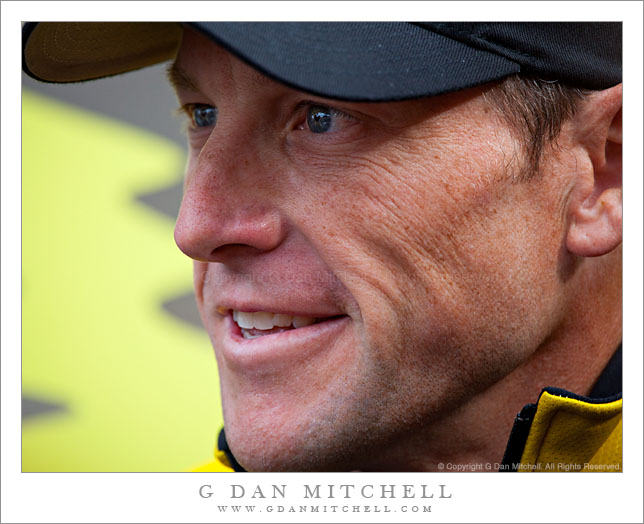
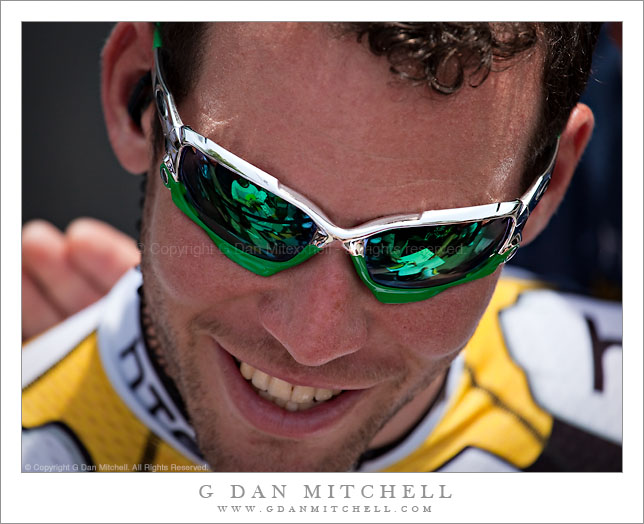
  • The actual race is not the only thing worth shooting – there are many, many interesting subjects before and after the race. I often find interesting subjects among the spectators waiting for the pack or even watching the peloton pass. One of the great things about pro bike racing is that you have amazing access to the riders in the team area before the race. I often spend at least an hour there before the race, shooting like crazy so that I don’t miss anyone. You may look up and see Lance Armstrong riding past you five feet away, or you might see some guy you don’t recognize talking to fans – only to find out later in the day that he was the stage winner. I generally use a relatively long lens in this area and “snipe” – getting close shots of riders. (You’ll generally have far fewer opportunities like this after the race, when the riders quickly disappear.)
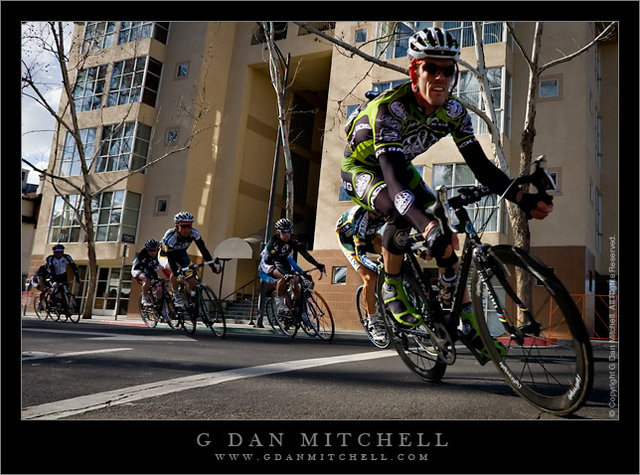
  • Occasionally try things that aren’t quite so obvious. I once found myself on an inside corner a few blocks from the end of a stage as the peloton came into town. I put on my widest lens – a 17mm zoom – and stuck the camera through the fence down low to the ground. With the camera in burst mode I shot as riders leaned into the turn only a foot or two from the camera.
  • Large apertures are often better than small apertures. Yes, the small apertures give you greater depth of field – but they also force you to shoot a slower shutter speeds (not always a bad idea…) and put non-central subjects in sharper focus. Often the riders will stand out more against an out of focus background than against a busy in-focus background. (It is difficult to generalize too much about this though – if you are already throwing much of the scene out of focus by using a slow shutter speed, there can be advantages to the smaller aperture.)
  • When shooting individual racers, especially in the team area, do shoot a lot of frames – but also think carefully about what the riders are doing and what they look like. I’ll often try to quickly get an initial shot that is serviceable – but once I get that I become a bit more selective. I’ll watch the subjects face for the most interesting expression or better light. I’ll also watch to see them interact with fans – this often creates really compelling moments.
  • Shoot a lot. Things happen quickly, and not just on the course. Not every shot is going to be a great one, but you’ll often have little time to carefully consider each shot – better to work on instinct. (Oddly, I realized a few years ago that the closest experience to this might be shooting certain types of wildlife – birds in flight for example.)
  • © Copyright 2010 G Dan Mitchell – all rights reserved.

    G Dan Mitchell is a California photographer whose subjects include the Pacific coast, redwood forests, central California oak/grasslands, the Sierra Nevada, California deserts, urban landscapes, night photography, and more.
    Blog | About | Flickr | Twitter | FacebookGoogle+ | 500px.com | LinkedIn | Email

    Text, photographs, and other media are © Copyright G Dan Mitchell (or others when indicated) and are not in the public domain and may not be used on websites, blogs, or in other media without advance permission from G Dan Mitchell.