
Tag Archives: red

Osgood Place

Osgood Place
Osgood Place

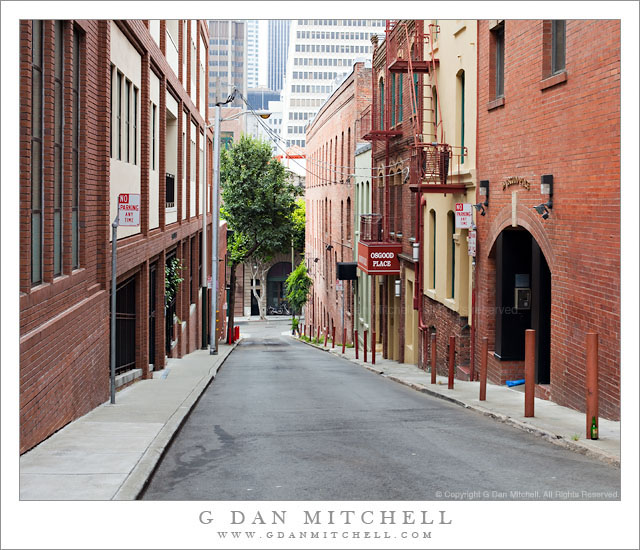
Osgood Place. San Francisco, California. July 12, 2010. © Copyright G Dan Mitchell – all rights reserved.

A steep street in downtown San Francisco with a sign for “Osgood Place.”

I came across this photograph from last summer while going over old raw files again this week. To be honest, I barely remember shooting this scene, and the only hints about the precise location are the “Osgood Place” sign (referring to one of the buildings) and the base of the Transamerica Pyramid beyond the end of the street.

When I saw it this week, something caught my attention about it. I like the vantage point that roughly as high as the third story of buildings near the bottom of the street – this does some slightly odd things to perspective lines. I also like the various types of red to brick-red coloration and the row of steel posts along the narrow sidewalk. The subtle green beer bottle against the first post at the right is a touch I like, too. ;-) It is surprising that I managed to take a photograph of this area of San Francisco that includes no people.

(Update: Thanks to some folks who saw this photograph elsewhere, I have learned that the street is also called Osgood Place.)

G Dan Mitchell Photography | Flickr | Twitter (follow me) | Facebook (“Like” my page) | LinkedIn | Email
Text, photographs, and other media are © Copyright G Dan Mitchell (or others when indicated) and are not in the public domain and may not be used on websites, blogs, or in other media without advance permission from G Dan Mitchell.
Redwood Trunk, Detail

Redwood Trunk, Detail

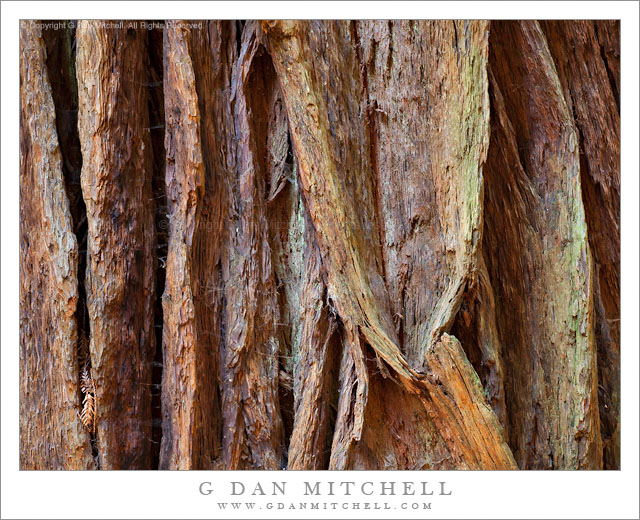
Redwood Trunk, Detail. Muir Woods National Monument, California. April 29, 2011. © Copyright G Dan Mitchell – all rights reserved.

Detail view of the convoluted textures of the bark of a coast redwood tree, Muir Woods National Monument.

I’m fascinated by the patterns of tree trunks and bark, and I often try to find ways to make photographs of the thick and rugged bark of coastal redwoods – but not always with a lot of success! The subject is trickier than it seems at first. Even during the daytime these forests can be quite dark – and occasional beams of direct light pose their own problems along the lines of harsh shadows. When shooting close up, relatively small apertures are needed since some amount of DOF is required to get the closest parts of the thick bar, and the deeper parts along the frame edges decently in focus. Low light and small apertures means long exposures, and even a bit of air movement will move leaves, bits of grass, or (in the case of this photo) spider webs. And when a bit of interesting filtered light does make it down through the forest canopy, it is often there and gone within a few seconds. (On this same day I came across a beautiful shadow on the side of one redwood that included the shapes of some nearby alder trees. It was wonderful! It was also gone 10-15 seconds later when I got my camera into position!)

I photographed this bit of bark shape and texture along the main trail at Muir Woods on this late-April morning. As is my usual plan, I had arrived very early – before the park actually opens – and was able to wander around without the typical crowds that appear once the post-breakfast tour buses arrive from nearby San Francisco. In this spot it was quite dark, but there was just a bit of filtered and reflected light to bring out the textures and colors of the redwood bark.

G Dan Mitchell Photography | Flickr | Twitter (follow me) | Facebook (“Like” my page) | LinkedIn | Email
Text, photographs, and other media are © Copyright G Dan Mitchell (or others when indicated) and are not in the public domain and may not be used on websites, blogs, or in other media without advance permission from G Dan Mitchell.
Post-Sunset Glow, Amargosa Range

Post-Sunset Glow, Amargosa Range

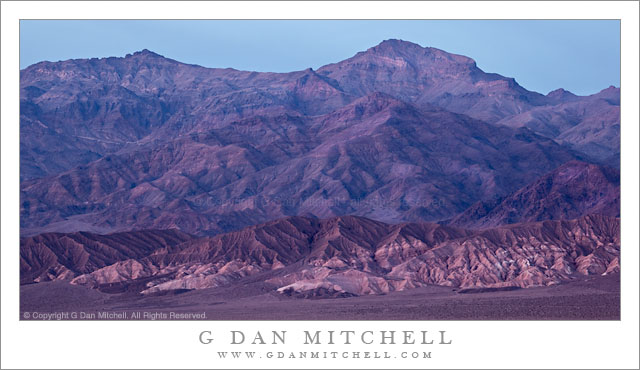
Post-Sunset Glow, Amargosa Range. Death Valley National Park, California. March 29, 2011. © Copyright G Dan Mitchell – all rights reserved.

Post-sunset light from bright red clouds casts a reddish glow on the Amargosa Range, Death Valley Buttes, and the Kit Fox Hills.

I think this might be the second in what I could call the “impossible color” series from my late-March trip to Death Valley. (The previous image was a photograph of a wash/alluvial fan at the base of Tucki Mountain, photographed on the same evening.) The lurid and unreal colors are not the result of post-processing gone horribly wrong – the light was actually this color for a short period. The sun had already gone down behind the Cottonwood Mountains to the west of my shooting location in the middle of Death Valley not far from Stovepipe Wells. It had been an interesting sunset with the usual increase in warm colors and some attractive clouds in the sky.

What happened next was something that is probably familiar to those who have done a lot of landscape photography, though they recognize that it is not something that you can quite predict. After the sun had set and dusk was coming on, some final light from far to the west, where the sun had probably already dropped just below the horizon, began to strike high clouds above Death Valley. (I could sort of see this coming, since I had noticed increasing color in the sky further to the east.) As this happened, these clouds began to glow with an intense red color that was mixed with the normal bluish tones of dusk light and surface features took on this purple/red glow for just a brief moment before the light faded.

(Those who look very carefully may notice that the sky above and to the east of the mountains is a lot bluer than the mountains themselves. The color had already left the sky to the east, and at this point was coming from the sky directly overhead and to my west.)

I’m still trying to sort out the complex geology of this area and the ways that features are named. The larger range containing these peaks is called the Amargosa Range, though it encompasses many smaller named sub-ranges – I think these might be part of the Grapevine Mountains, roughly in the neighborhood of Thimble and Corkscrew Peaks. A dark peak in front of the main range at the very far right may be part of Death Valley Buttes, and the banded foreground hills are sometimes called the “Kit Fox Hills.”

G Dan Mitchell Photography | Flickr | Twitter | Facebook |
LinkedIn | Email
Text, photographs, and other media are © Copyright G Dan Mitchell (or others when indicated) and are not in the public domain and may not be used on websites, blogs, or in other media without advance permission from G Dan Mitchell.

Manly Beacon, First Light

Manly Beacon, First Light

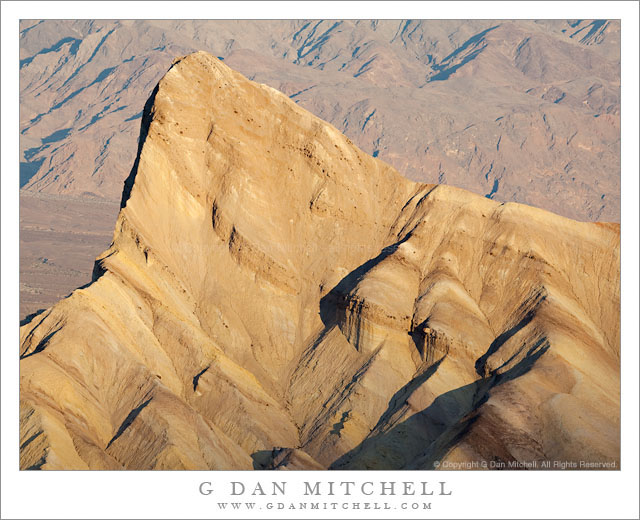
Manly Beacon, First Light. Death Valley National Park, California. March 30, 2011. © Copyright G Dan Mitchell – all rights reserved.

The first morning light strikes Manly Beacon at Zabriskie Point, Death Valley National Park.

Icon alert!

I had more or less promised myself that I would not photograph at Zabriskie Point on this trip – been there, done that – unless the conditions were really special. But I miscalculated my morning start on this day and discovered that I wasn’t going to make it to my intended destination in time. As I passed Zabriskie on my way to the “other place,” telling myself that I still had a half hour before I needed to be in place for the early light… I noticed that clouds above this area were already starting to pick up the pink color of dawn light. I hesitated for a moment – I really wanted to photograph that other subject – but quickly realized that it would make a lot more sense to the shoot the subject that was here in the light that was developing than to drive further and miss out entirely on the first light.

So I turned into that familiar parking lot with its familiar fleet of photographers’ cars and quickly loaded up my gear. I was a bit surprised that I saw so few people up above at the official overlook, but it was quite windy and I figured that perhaps they had just dropped down on the other side of the wall below this spot. In any case, I had a different spot in mind, one further to the right, so I headed over that way and quickly discovered that the wind was blowing almost too strongly to make photographs. I made a couple of shots from a small gap there and then headed up toward the overlook. At the top of the little trail from the parking lot I dropped onto the small use trail to the side of the wall and was again surprised to see almost no other photographers. I walked a few feet farther and discovered that the “usual crowd” was huddled in a small area in the lee of the wall, trying desperately to find protection from the wind.

These days, my main project when I stop at Zabriskie is to find and photograph small, isolated elements of the landscape with a long lens. For the most part – unless truly magical conditions are present, and they weren’t on this morning – I don’t really spend much time on the classic views of Gower Gulch, the Valley, and the Panamint Range. However, since I’m there and know the progression of the light fairly well at this point, I’m not about to pass up the opportunity to get a better image of one of these iconic subjects. So as the first light was about to hit the summit of Manly Beacon I turned my rig that direction and spent a couple of minutes photographing it as the line between shadow and morning light traveled down its face.

G Dan Mitchell Photography | Flickr | Twitter (follow me) | Facebook (“Like” my page) | LinkedIn | Email
Text, photographs, and other media are © Copyright G Dan Mitchell (or others when indicated) and are not in the public domain and may not be used on websites, blogs, or in other media without advance permission from G Dan Mitchell.