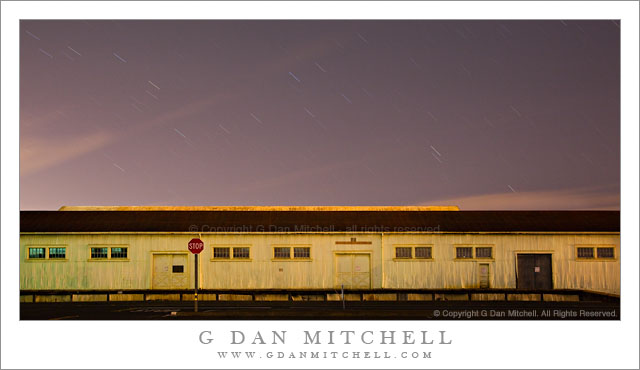
Night photograph of an old industrial building and a stop sign beneath sky with star trails, Mare Island Naval Ship Yard.
This old building at the historic Mare Island Naval Ship Yard appears to be some sort of warehouse and loading dock, judging by the raised flat area attached to the front of the building and the large doors. I made the photograph from the middle of a large empty parking lot, and in addition to the horizontal form of the yellow corrugated metal building, I wanted to include the green glow through the windows at the far left and the red stop sign. The sky has a bit of a warm glow that is coming from the urban areas of the East Bay – Mare Island is on the fringe of this area.
A small shack with interior lit by red and green lights at the Mare Island Naval Ship Yard, California.
At last weekend’s night photography shoot with The Nocturnes at Mare Island Naval Ship Yard I wandered a bit further afield than I have on some previous visits, eventually ending up in an area where I have only photographed once before when I unsuccessfully shot a couple of large barn-like buildings. (I think I have a shot of these buildings from this trip that I like, and I’ll post it later on.)
While spending nearly a half hour photographing a light post against the backdrop of a very dark brick building (which amounted to two photographs, given the long exposure times and the follow-up “dark frame exposures) I kept thinking I saw a faint red glow inside a small nearby building. At first I thought that one of my fellow night photographers might be doing some light painting, but the light seemed awfully dim. Eventually I noticed that it was also quite constant – and light painting virtually always involves moving the hand held light source around in order to get a smooth lighting effect. Once I finished shooting the light pole (unsuccessfully, it turns out) I decided I would go over and see what was creating this light.
The buildings appears to be a small “guard shack” or similar, a very old and very dilapidated one room structure. Inside, as best as I could tell, there is a small table, a few chairs, a digital clock of some sort with green letters, and some kind of very dim red light. Intrigued, I decided to see if I could photograph it. One technical problem was going to be the very large difference in lighting between the bright light on the clock and the extremely dim exterior, made worse by the dark color of the building. I figured that I could probably put enough extra light onto the building’s exterior using a very small key chain LED light than I happened to have with me, and that is the major source of light on the front of the building and on the yellow foreground curve – I simply walked around on both sides of the building and moved the small light over its surface.
In the end, I think this is another example of night photography as a source of a certain kind of “fantastic” lighting. The actual scene was very, very dim, and the the intensity of the colors here is almost entirely the result of the very long exposure and a bit of improvised lighting on the yellow curb behind the fence – a photograph of something that cannot be seen with our own eyes.
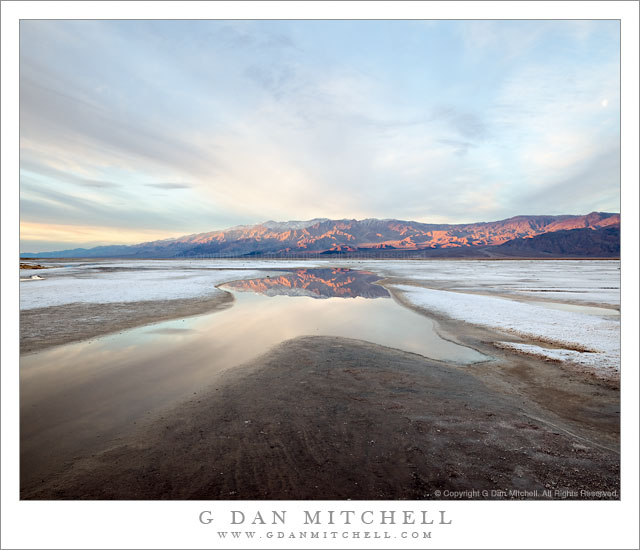
The first dawn light on the snow-dusted Panamint Range is reflected in shallow winter pools on the salt flats of Death Valley National Park.
This is yet another story of serendipity, I think, though it also does involve some advance work – which should please those who become uncomfortable with the idea that not every landscape photograph results from a slow and deliberate and well-planned process! ;-)
The general location of this scene is along a section of salt flat just below the Salt Creek turnoff from the main highway – it is the first area of obvious salt flats that you come to as you head south towards the Furnace Creek area. One one of my first photographic visits to Death Valley I recall stopping near this location along the road and trying to make a photograph pointing down the length of the Valley. It was not successful, but I’ve always been a bit intrigued by this location where the road has to curve around to the east to avoid this salt flat. A day or two earlier on this trip I had stopped along the road at almost this exact location during the “boring light” part of the day after shooting somewhere else. I had wandered – without any camera gear – down across the wash to a patch of brown salt grass and beyond to the edge of the salt flat. I had noticed a lot of things: the very alien nature of this landscape consisting of mud and caked salt and not much else, the surprising presence of some worms and larvae in this tremendously salty water, the fact that the water seemed to seep from beneath the wash, and the interesting shapes that the water created as it slowly spread along the edge of the salt flat.
Move ahead to this morning, the final one of this trip to Death Valley, and I was up well before first light. I had several ideas about what I might photograph, but had not made a firm decision yet since the weather was something of an unknown. I had a vague idea about heading north up the valley and photographing the first light on the hills along its western edge. I was keeping open the possibility that spectacular light might make it worth while to photograph Zabriskie. But I really didn’t know.
I drove to the Furnace Creek/Scotty’s Castle junction and pulled over to watch the light begin to grow. There were lots of clouds! It looked like a lighter area might evolve straight to my east, but I couldn’t quite see photographic potential in it. To the north things looked pretty bleak. There was some possibility that light could happen way to the south, but I wasn’t convinced. I decided to drive a bit south and see what might happen, and very soon I came back to this place where I had stopped earlier. The light wasn’t very promising – clouds to the east seemed likely to block the sunrise light even though there were some interesting cloud patterns overhead that were starting to become more transparent as the sky began to lighten.
Then I caught just a bit of light on some of the higher clouds above the middle level clouds and I started to wonder if the light just might make it through. I went to the back of the car and grabbed my camera with one lens already attached and mounted it on the tripod. I wasn’t sure if I’d want wide or tele for some of the possible subjects, so I grabbed two additional lenses and stuck them in a shoulder bag and headed down the wash, not really looking up too much, just heading straight towards these little areas of water that I remembered from earlier. As I got close to the edge of the flats I saw that, indeed, a band of sunrise light was coming in below the cloud deck to the east (something I have learned to watch for) and starting to light up the highest peaks of the Panamints. I knew that if this light survived long enough to make it down across the range that it was going to happen fast, so I quickly headed out onto the edge of the flats, more or less ignoring the larger scene and simply looking for an interesting reflecting pool. As I set up – working very quickly now – the first sun lit up the face of the panamints and revealed radiating cloud shapes above. I had perhaps two minutes of this light… and then the small gap along the eastern horizon must have closed up as the light disappeared and went back to gray.
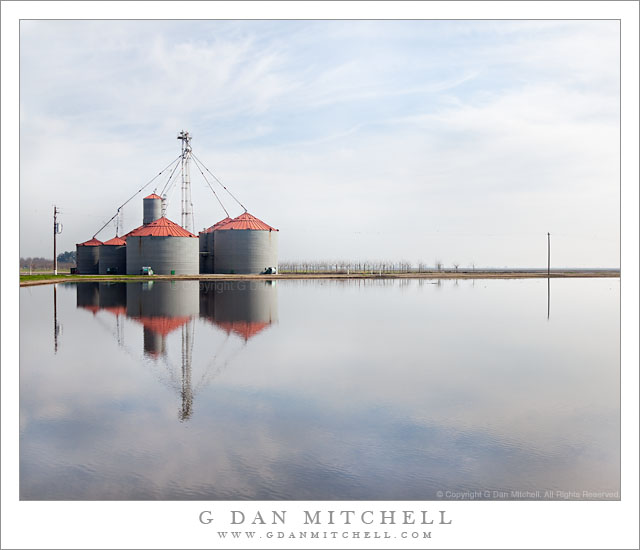
Agricultural facilities and Central Valley sky reflected in the surface of a flooded field.
This area turned out to be fun place to shoot. It is along a fairly nondescript road that branches off from Interstate 5 midway between Stockton and Sacramento and eventually dead-ends against a levee lining the Cosumnes River. I had been told that it is a good place to look for migratory birds – and, indeed, it is. Although it was hard to see them due to the very thick tule fog when I first arrived shortly after dawn, when I came back in the early afternoon the sky had cleared and the many fields, vineyards, and ponds along the road were filled with waterfowl.
I first saw this set of “structures” (silos? Being a “city boy,” I’m not certain of the right way to describe cylindrical storage facilities like this) as I drove out from Interstate 5 towards the river. They make for quite a striking sight – they are quite large, they are tall and the tower above is even taller, the brick colored roofs stand out against the other colors, and they are reflected in the still water of surrounding ponds. It was on my way back past them that I saw the view over this pond. I had just stopped to make another photograph of the ponds and I thought I was finished for the day – my thoughts were getting back to the highway and heading home. But I decided to walk down to a levee that let me place the structures and their reflections across the water and surround the image of the building and the thin horizon line with sky above and below.
Photographer and visual opportunist. Daily photos since 2005, plus articles, reviews, news, and ideas.
Manage Consent
To provide the best experiences, we use technologies like cookies to store and/or access device information. Consenting to these technologies will allow us to process data such as browsing behavior or unique IDs on this site. Not consenting or withdrawing consent, may adversely affect certain features and functions.
Functional
Always active
The technical storage or access is strictly necessary for the legitimate purpose of enabling the use of a specific service explicitly requested by the subscriber or user, or for the sole purpose of carrying out the transmission of a communication over an electronic communications network.
Preferences
The technical storage or access is necessary for the legitimate purpose of storing preferences that are not requested by the subscriber or user.
Statistics
The technical storage or access that is used exclusively for statistical purposes.The technical storage or access that is used exclusively for anonymous statistical purposes. Without a subpoena, voluntary compliance on the part of your Internet Service Provider, or additional records from a third party, information stored or retrieved for this purpose alone cannot usually be used to identify you.
Marketing
The technical storage or access is required to create user profiles to send advertising, or to track the user on a website or across several websites for similar marketing purposes.