
Tag Archives: sage

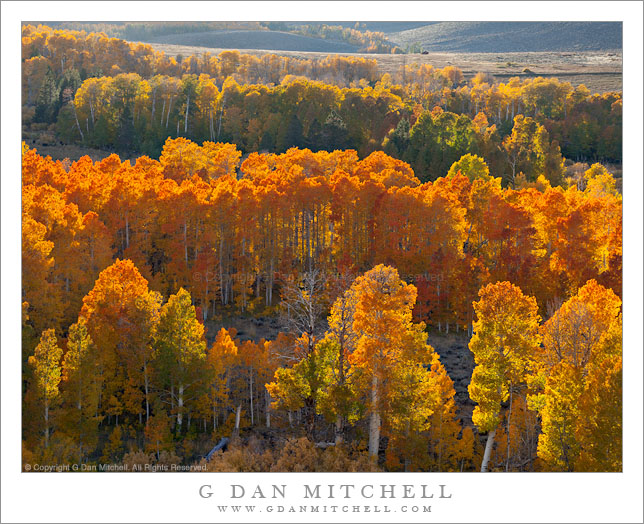
Aspen Groves, Conway Summit

Aspen Groves, Conway Summit

Aspen Groves, Conway Summit. Eastern Sierra Nevada, California. October 16, 2011. © Copyright 2011 G Dan Mitchell – all rights reserved.

Late afternoon sun backlights the immense aspen groves near Conway Summit, California.

As the sun dropped toward the peaks of the Sierra crest to the west of Conway Summit, beams of light occasionally broke through the partly cloudy skies and backlit these brilliantly colored aspen groves alongside highway 395. I’ve shot here enough times over the past few years to understand how the light works here – though I admit that every time I think I understand, I discover something new! For me, the ideal is to go to Conway Summit right at the peak of aspen color, or perhaps a bit earlier when a few green trees remain, and to shoot in late-afternoon light, aiming almost directly into the sun. The color of the light coming through these leaves is almost unbelievably intense and saturated – and, in fact, is a bit of a tricky thing to photograph!

There are many attractive things about Conway Summit when it comes to aspen viewing. (There are also, admittedly, a few less attractive things, such as shooting from the edge of a four-lane highway!) The stands of aspens are extensive here, covering many acres. Because of the slightly elevated viewpoint, the observer can look down into and across the trees as they follow the slope gently rising toward the Sierra. There are actually a large number of separate groves that stand mostly in lines stretching from left to right, and each of them is often in a different stage of color development at this point in the season, with the result being that trees of almost every shade from green to brilliant red can be seen at once.

G Dan Mitchell is a California photographer whose subjects include the Pacific coast, redwood forests, central California oak/grasslands, the Sierra Nevada, California deserts, urban landscapes, night photography, and more.
Blog | About | Flickr | Twitter | FacebookGoogle+ | 500px.com | LinkedIn | Email

Text, photographs, and other media are © Copyright G Dan Mitchell (or others when indicated) and are not in the public domain and may not be used on websites, blogs, or in other media without advance permission from G Dan Mitchell.

(Basic EXIF data may be available by “mousing over” large images in posts when this page is viewed on the web. Leave a comment if you want to know more.)
Aspen Groves, Afternoon Light

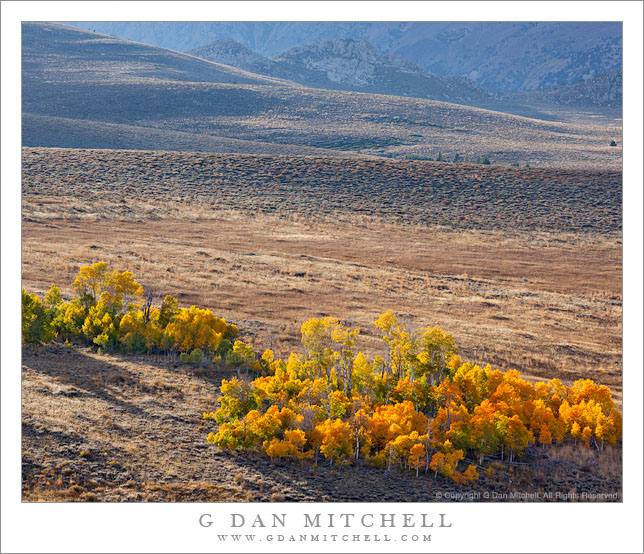
Aspen Groves, Afternoon Light

Aspen Groves, Afternoon Light. Conway Summit, California. October 16, 2011. © Copyright 2011 G Dan Mitchell – all rights reserved.

Late afternoon sun backlights the brilliant fall colors of aspen groves along the eastern slope of the Sierra Nevada near Conway Summit.

This is one of what is likely to be a series of very gaudy and colorful photographs of autumn aspen color, much of it photographed at Conway Summit along highway 395 just north of Lee Vining and Mono Lake. Keep your sunglasses handy!

If you happen to arrive at the Conway Summit area at the right point in the fall color season, you can be treated to an astonishingly large and brilliant show of aspen color. (It isn’t a sure bet though. Some years it is not nearly as spectacular. ) This year the trees seemed to turn quite suddenly. A week earlier there had been a lot of very green trees at this elevation along the east side of the Sierra, and many of us expected that the most striking colors would not come until as much as a week later. But nature wasn’t listening, and one week after I had seen so much green, the aspens all along the eastern escarpment of the range were turning golden and many other shade, frequently all the way down to the level of Owens Valley.

After shooting in the early morning out in Owens Vally and then hiking up to Parsons Lake in the middle of the day, I finally made my way up north to Conway Summit just before what I regard as the ideal time to photograph aspen color here, namely during the last hour or so before the sun drops below the peaks of the Sierra to the west. During this period the trees are back- and side-lit in very dramatic ways. While shooting almost directly into the sun can be tricky, the backlit trees really light up. At first I was a bit concerned when I arrived since clouds over the crest threatened to end the light show early, and they actually did interfere at times. But they also broke up the light a bit and provided a combination of ever-changing light and shadow patterns. One moment the light would strike one area and I would shoot in that direction. A moment later that light was gone, but shortly it would appear in another spot – and I’d swivel the camera around and work that subject for a moment.

This little pair of groves is one that I’ve watched and photographed for several years. I like the way that it stands apart from the much larger main groves and has the plain grass and sagebrush covered hills as background. I made a series of exposures of this subject, and in this one the light crossing from left to right not only struck the colorful trees but also lit up some of the gentle ridges of the slopes beyond.


G Dan Mitchell is a California photographer and visual opportunist. His book, “California’s Fall Color: A Photographer’s Guide to Autumn in the Sierra” is available from Heyday Books and Amazon.

Blog | About | Flickr | FacebookEmail

Links to Articles, Sales and Licensing, my Sierra Nevada Fall Color book, Contact Information.


All media © Copyright G Dan Mitchell and others as indicated. Any use requires advance permission from G Dan Mitchell.

Schoolhouse Ruins, Rhyolite

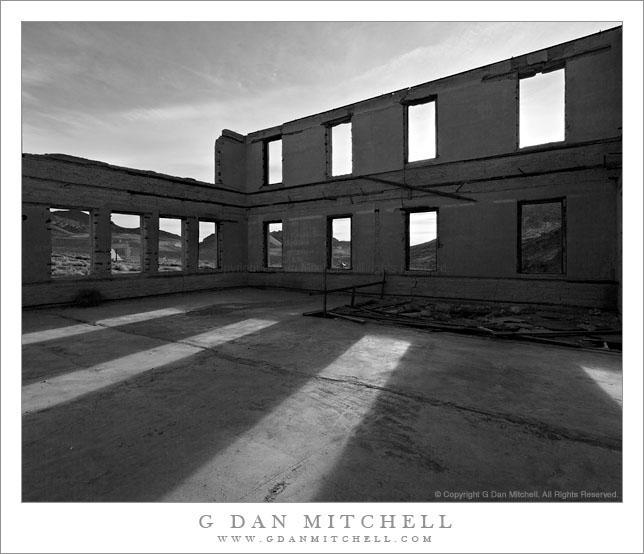
Schoolhouse Ruins, Rhyolite

Schoolhouse Ruins, Rhyolite. Rhyolite, Nevada. April 1, 2009 © Copyright 2009 G Dan Mitchell – all rights reserved.

Morning sunlight shine through the window frames of the ruins of the abandoned schoolhouse in the ghost town of Rhyolite Nevada, near Death Valley National Park.

The ghost town of Rhyolite, Nevada is located just east of the boundary of Death Valley National Park, along the edge of the Amargosa Valley, and not far from Beatty, Nevada, which itself is close to the Nevada Test Site. Put all of that together and you have the potential for a bit of a spooky place!

Rhyolite was a short-lived mining town in the early 1900s, when it apparently was home to thousands of people who streamed to this forsaken landscape to find silver. The town was eventually abandoned – although some mining still takes place in the area – but a good number of the larger buildings are still there, in various states of decay. An old train station that looks pretty fancy is fenced off to keep us out, but you can walk (respectfully and carefully!) among many other old structures including the old school house that is the subject of this photograph.

I’ve been out here a number of times and dawn is my favorite time to photograph here. The light makes it to many of the old ruins very shortly after actual sunrise, and there is a moment of often beautiful light at this time. From Rhyolite the hills inside Death Valley National Park are visible to the west and above the nearer hills you can see Telescope Peak, the highest point in the park at over 11,000′ elevation.

The school (like a few of the other ruins) looks like it must have been a very large and robust structure. Even though the roof and the second floor are gone, almost all of the exterior walls still stand and don’t show any immediate signs of incipient collapse. On this morning I made a series of photographs from just inside one of the “doorways” of the school with a wide-angle lens. I selected and shared a few of them back in 2009, but I recently went back to my original raw files and decided to try this one in black and white.

G Dan Mitchell Photography
About | Flickr | Twitter | FacebookGoogle+ | 500px.com | LinkedIn | Email

Text, photographs, and other media are © Copyright G Dan Mitchell (or others when indicated) and are not in the public domain and may not be used on websites, blogs, or in other media without advance permission from G Dan Mitchell.

(Basic EXIF data may be available by “mousing over” large images in posts when this page is viewed on the web. Leave a comment if you want to know more.)
Mono Lake, Thunderstorm

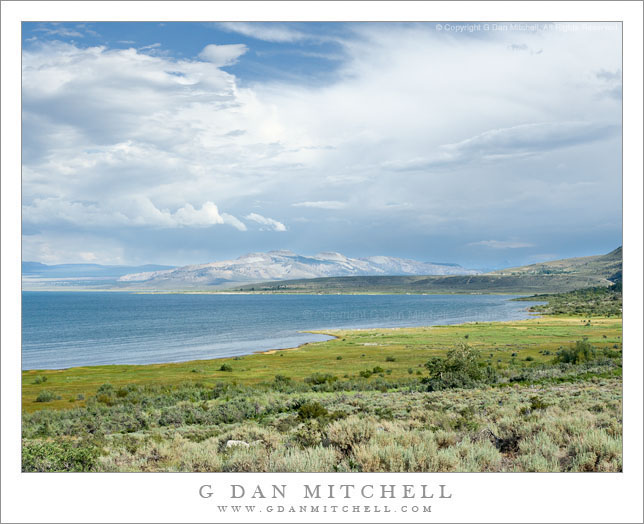
Mono Lake, Thunderstorm

Mono Lake, Thunderstorm. Mono Lake, California. July 23, 2007.© Copyright 2007 G Dan Mitchell – all rights reserved.

Eastern Sierra Nevada thunderstorms build over Mono Lake, Mono Craters, and Lee Vining, California.

Mono Lake can be an unforgiving place in which to try to make photographs during the day, but sometimes one gets lucky! It is a wonderful place, but if you only know it from photographs – which, of course, tend to be made at the most appealing times – you might not know that it is often hot and hazy and dry during the day. These are among the reasons that it is a place often photographed at dawn or at sunset on days when the clouds are interesting. (The latter poses its own set of problems, since the Sierra Nevada range begins to block the light well before actual sunset.)

But I did get lucky on this late July afternoon. It was thunderstorm weather, so there were some very impressive clouds floating around. However, the clouds did not completely fill the sky, so patches of light were moving across the landscape – in this photograph one illuminates the green area at far right along the shore and, more importantly, the Mono Craters beyond the far shore of the lake. And the vegetation around the lake was still green, or at least green enough to look alive in this light.

G Dan Mitchell Photography
About | Flickr | Twitter | FacebookGoogle+ | 500px.com | LinkedIn | Email

Text, photographs, and other media are © Copyright G Dan Mitchell (or others when indicated) and are not in the public domain and may not be used on websites, blogs, or in other media without advance permission from G Dan Mitchell.

(Basic EXIF data may be available by “mousing over” large images in posts when this page is viewed on the web. Leave a comment if you want to know more.)