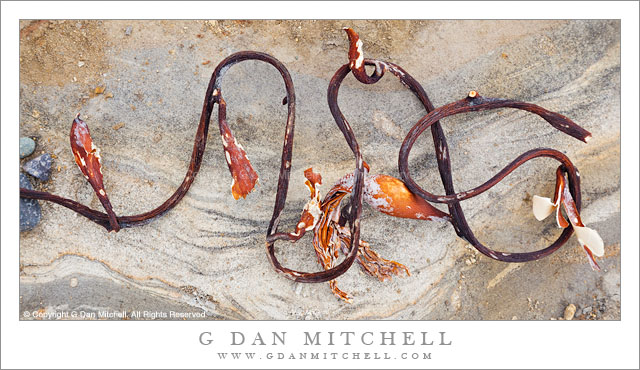
A twisted piece of seaweed tossed onto sandstone rocks at Weston Beach, Point Lobos State Reserve.
Bits of sea life-like this illustrate one of the great reasons to walk slowly and carefully along the shoreline with eyes wide open. I photographed this section of dried seaweed just as I found it, lying on this stratified bit of sandstone on Weston Beach at Point Lobos. It is hard to imagine how a plant that, I presume, might have been fairly straight underwater, ended up in such a wonderfully twisted shape and to sit on this bit of rock with its own shallow curve.
I was a bit surprised to find this and some similar nearby examples on this beach. I’m used to coming here in the high-wave months of winter, when storm surf can cast all sorts of interesting things far up on the beaches and beyond the usual high-water line. But at this time of year the surf is often a lot calmer, as it was on this day, and I don’t expect to see nearly as much “stuff” washed up.
G Dan Mitchell is a California photographer whose subjects include the Pacific coast, redwood forests, central California oak/grasslands, the Sierra Nevada, California deserts, urban landscapes, night photography, and more. Blog | About | Flickr | Twitter | Facebook | Google+ | 500px.com | LinkedIn | Email
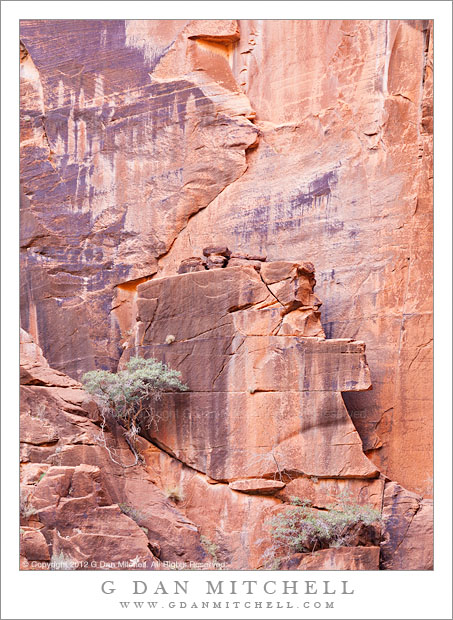
Plants grow among cracks of a fractured sandstone cliff, Zion National Park.
On my first morning in Zion (we had arrived there the previous afternoon) we headed up into the park and Zion Canyon, though which the Virgin River flows. Although I was more or less not looking for icons to photograph, I had stopped along the way to photograph that icon, the view of the Watchman from the bridge on the Mt. Carmel highway. (At least I could console myself that I was not shooting it at the usual sunset time, but instead in the early morning. ;-) After a brief stop for that purpose, I headed up the canyon with a plan of visiting the Weeping Rocks and seeing what sort of photographs might be possible there.
After a short walk up to the rocks, I figured out that it wasn’t going to quite be my photographic “cup of tea.” However, along this walk I did find some other interesting subjects. One that I’ve shared previously was a very close view of some brand new spring leaves on the trees that grow along the trail. Another subject was the nearby sandstone cliffs that here come down close to the level of the trail. One area nearby featured immense vertical blocks of the striking red sandstone, with interesting crack systems and some plants growing in the cracks. I made several exposures of this area in full shade, and this vertical composition is one that I like a lot. I’ve probably said this before and I’ll no doubt mention it again, but for a guy who is so used to shooting the equally impressive but much less colorful granite of the Sierra, the colors of these rocks proved irresistible! And the color variations are amazing – here you can see some areas where the color trends toward purple.
G Dan Mitchell is a California photographer whose subjects include the Pacific coast, redwood forests, central California oak/grasslands, the Sierra Nevada, California deserts, urban landscapes, night photography, and more. Blog | About | Flickr | Twitter | Facebook | Google+ | 500px.com | LinkedIn | Email
The ruins of the Cook Bank in the ghost town of Rhyolite, Nevada, with barren desert hills under a pre-sunrise sky.
This was the closest to the winter solstice that I’ve visited Rhyolite, so I shouldn’t have been surprised by several things. First, the sun came up not only later, but also a bit further south along the horizon – and the light that would usually strike these ruins at sunrise was blocked for a while by a large hill that sits next to the town. Second, it was cold! Third, no one else was there at sunrise! This is a bit unusual since in the Death Valley high season (which arrives a bit later in the year), Rhyolite can be a pretty popular place… for a ghost town… in the middle of the desert… in Nevada. :-)
Because I have photographed here several times before and for the reasons mentioned above, I took a bit of a different approach to photographing the place this time. The winter light, some high clouds, and the different point along the horizon of the sun rise meant that the light was quite different from what I’ve occasionally had to work with in the past. At first I was a bit disappointed to realize that the direct dawn light was not going to strike the old Cook Bank and other nearby buildings. But when some clouds to the east obscured the direct light and high, thin overhead clouds begin to pick up color and fill in the shadows, I saw that other interesting lighting was going to make up for it. At the moment that I made this photograph, those clouds to the east (right) of my position beautifully softened what might otherwise have been some stark and harsh light on the pinnacles beyond the town. They also created an unusual and beautiful quality of light for a few moments – a reddish-pink quality from the light reflected from the clouds but with a few soft quality.
I decided to shoot from a distance with a long lens so as to control the position of the ruins against the background hills, and the longer focal length makes these hills more prominent than they would be if I shot the building with a shorter focal length from a closer position. This also allowed me to more carefully eliminate some distracting elements that invariably appear at old sites like this. (The first times I visited, access to most of the ruins was quite unimpeded. Now fences have been erected around some of them. Part of me regrets the loss of access, but the greater part of me understands that this will allow these buildings to be around longer so that more people will get to see them. I stayed behind the fences.) If you look around on the web a bit, you can find some wonderful old photographs of this town when it was a bustling place with thousands of residents, and when the Cook Bank was a very impressive and modern-for-the-time building.
G Dan Mitchell is a California photographer whose subjects include the Pacific coast, redwood forests, central California oak/grasslands, the Sierra Nevada, California deserts, urban landscapes, night photography, and more. Blog | About | Flickr | Twitter | Facebook | Google+ | 500px.com | LinkedIn | Email
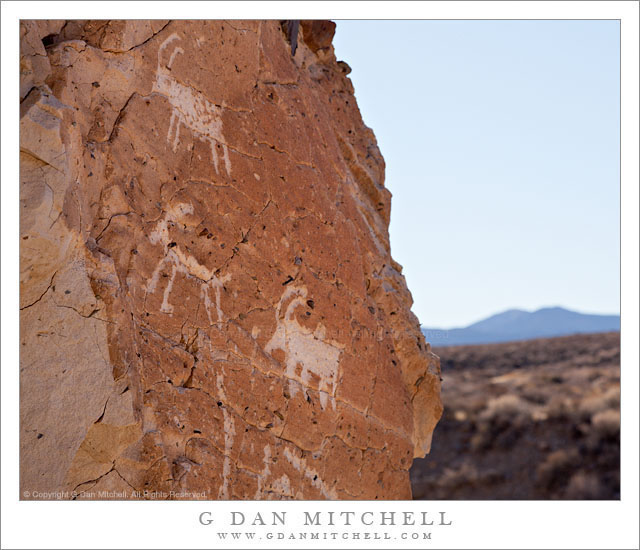
Petroglyphs on a rock face overlooking desert terrain.
Encountering these very old and very mysterious traces of people who lived in this desert terrain many, many years ago is always a special experience. Perhaps you have read the following story here before, but I think of it every time I encounter these things. Well over a decade ago I was camped in a place in Death Valley National Park that lies somewhere between popular and the anonymous wild spaces far out in the back areas of the park. I was with a group of other people. In the morning I wandered away from the place where we were camped. I crossed a wash and walked up onto the base of a great alluvial fan, found a suitable “sitting rock,” and just sat there for a while taking in the immense space and silence. I happened to look down at the rocky ground and I an oddly shaped rock caught my attention. I’m no expert on these things, but it seemed completely clear to me that this rock had been shaped by human hands. (I later came to understand that it was probably a “knife,” perhaps one designed for scraping.)
At the moment I saw and then picked up and held this rock, the place was transformed from a semi-wilderness of rock and scattered plants into a very different sort of thing – a place that had been the home of people, many years before I sat there on my rock. My thoughts turned from the landscape around me to try to imagine the person who had created and held this rock – who was this person? what was it like to live in such a place in such a time? what had happened to them? I returned the rock to the desert floor and walked back to my camp.
The petroglyphs in the photograph are located in another place in the park, and I have visited and photographed them more than once. These are perhaps the most precious and among the most fragile things in this desert, which is why I never write about the specifics of their locations. (I also have photographs of petroglyphs that have been defiled by thoughtless morons.) If you know where these are, let’s keep it to ourselves, OK?
The first time I photographed these examples of rock art, I simply shot them straight on so that the shapes were as clear and large as possible. Since then I had been thinking of trying to photograph them in a way that might reveal them in the context of the larger surroundings – perhaps as the person or people who made them might have seen the place.
G Dan Mitchell is a California photographer whose subjects include the Pacific coast, redwood forests, central California oak/grasslands, the Sierra Nevada, California deserts, urban landscapes, night photography, and more. Blog | About | Flickr | Twitter | Facebook | Google+ | 500px.com | LinkedIn | Email
Photographer and visual opportunist. Daily photos since 2005, plus articles, reviews, news, and ideas.
Manage Consent
To provide the best experiences, we use technologies like cookies to store and/or access device information. Consenting to these technologies will allow us to process data such as browsing behavior or unique IDs on this site. Not consenting or withdrawing consent, may adversely affect certain features and functions.
Functional
Always active
The technical storage or access is strictly necessary for the legitimate purpose of enabling the use of a specific service explicitly requested by the subscriber or user, or for the sole purpose of carrying out the transmission of a communication over an electronic communications network.
Preferences
The technical storage or access is necessary for the legitimate purpose of storing preferences that are not requested by the subscriber or user.
Statistics
The technical storage or access that is used exclusively for statistical purposes.The technical storage or access that is used exclusively for anonymous statistical purposes. Without a subpoena, voluntary compliance on the part of your Internet Service Provider, or additional records from a third party, information stored or retrieved for this purpose alone cannot usually be used to identify you.
Marketing
The technical storage or access is required to create user profiles to send advertising, or to track the user on a website or across several websites for similar marketing purposes.

 G Dan Mitchell is a California photographer whose subjects include the Pacific coast, redwood forests, central California oak/grasslands, the Sierra Nevada, California deserts, urban landscapes, night photography, and more.