Tag Archives: strata

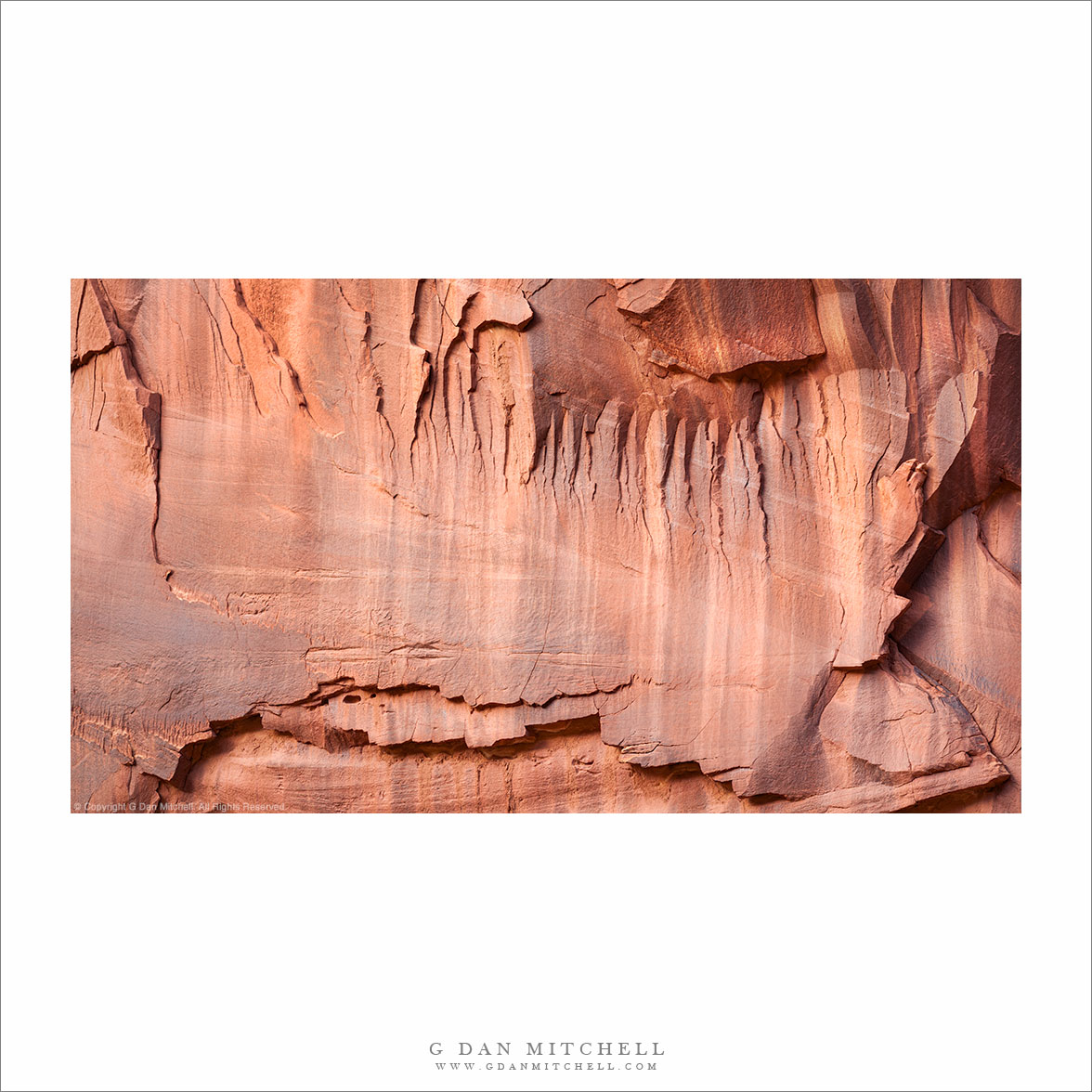
Sandstone Cliff Detail

Sandstone Cliff Detail
“Sandstone Cliff Detail” — A section of a sandstone cliff face featuring fracturing, strata, exfoliation, and water markings.

The textures, forms, colors, and patterns found in Utah sandstone walls amaze me. They can be so complex that I sometimes imagine that I see things like writing or images, but patterns formed naturally over the millennia. Here we can see layering at more than one angle, marks left by dripping and flowing water, the effects of exfoliation, and more.

This bit of wall might usually not get a lot of attention. If I recall correctly (it has been a decade) I found it in an odd corner of a canyon at Capitol Reef — not in a particularly iconic location within the park. Because it was later in the day the high canyon walls blocked the direct sunlight, allowing the softer light to fill that shadows a bit and reveal more details.


Leave a comment or question using the form. (If you are reading this on the home page, click the article title to see the full article and the comment form.

G Dan Mitchell is a California photographer and visual opportunist. His book, “California’s Fall Color: A Photographer’s Guide to Autumn in the Sierra” (Heyday Books) is available directly from him. Blog | Bluesky | Mastodon | Substack Notes | Flickr | Email

All media © Copyright G Dan Mitchell and others.
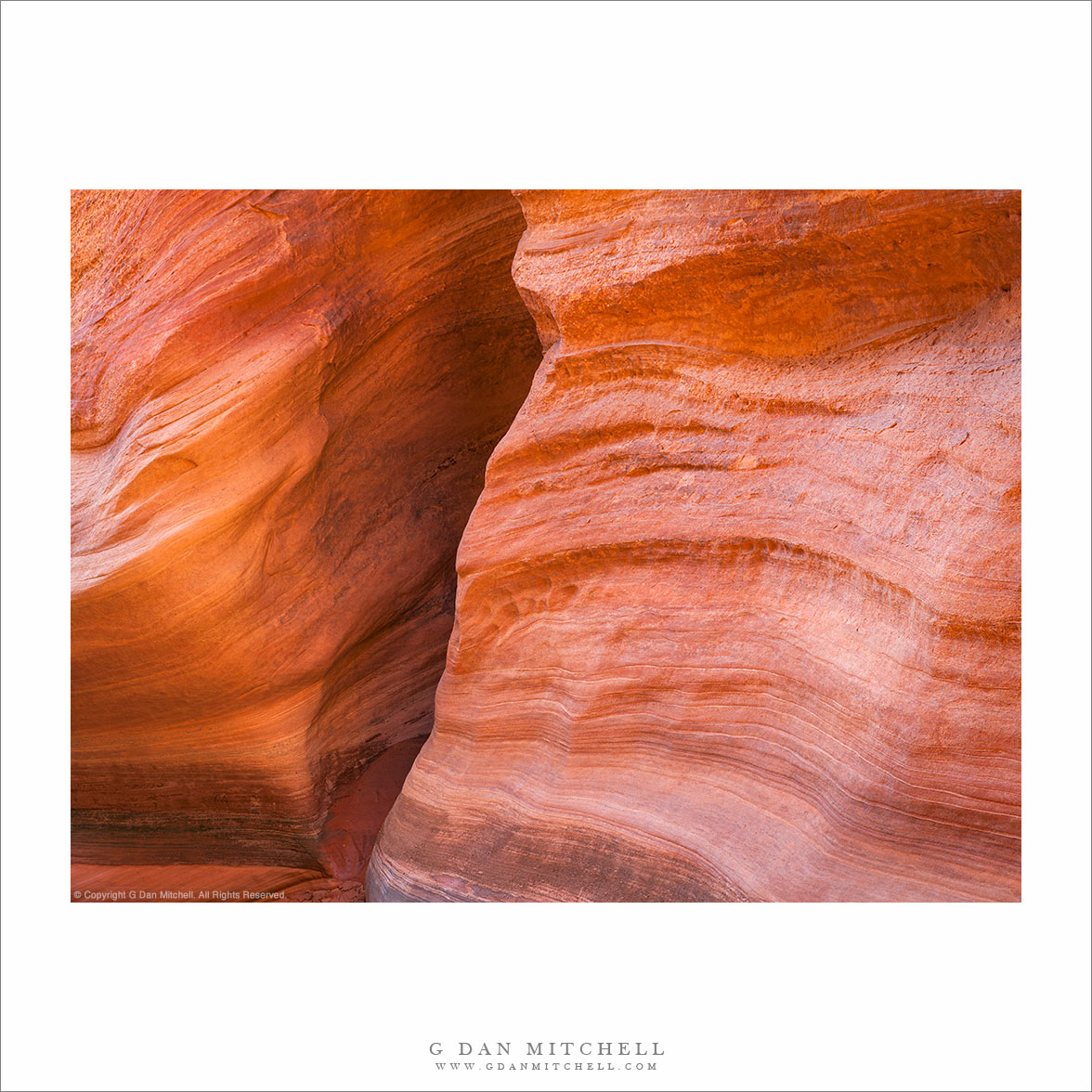
Slot Canyon Detail

Slot Canyon Detail
“Slot Canyon Detail” — Details of the wall of a Utah slot canyon, illuminated by reflected light.

There is a lot I could write about this photograph, the circumstances of making it, and how it ended up here today. First off, it is an older photograph, made years ago. I periodically revisit my old raw file archives, and I always discover photographs that I left behind. In this case, someone else’s photograph from the Southwest triggered me to review my older work from Utah, much of which is over a decade old. So far, I’ve rediscovered about twenty interesting Utah images from that period. Stay tuned!

The photograph came from a productive expedition to Utah during the autumn of 2014. I started out traveling and photographing solo, but eventually joined up with others as I worked in the southern part of the state for weeks. Early on that trip I almost randomly ended up at this location. I drove down a dirt road that looked interesting, found a place to park, and started walking down a shallow stream bed. The route entered a canyon that soon narrowed and turned into a slot canyon. It was only later that I discovered that I had been in a bit of a special place.


Leave a comment or question using the form. (If you are reading this on the home page, click the article title to see the full article and the comment form.

G Dan Mitchell is a California photographer and visual opportunist. His book, “California’s Fall Color: A Photographer’s Guide to Autumn in the Sierra” (Heyday Books) is available directly from him. Blog | Bluesky | Mastodon | Substack Notes | Flickr | Email

All media © Copyright G Dan Mitchell and others.
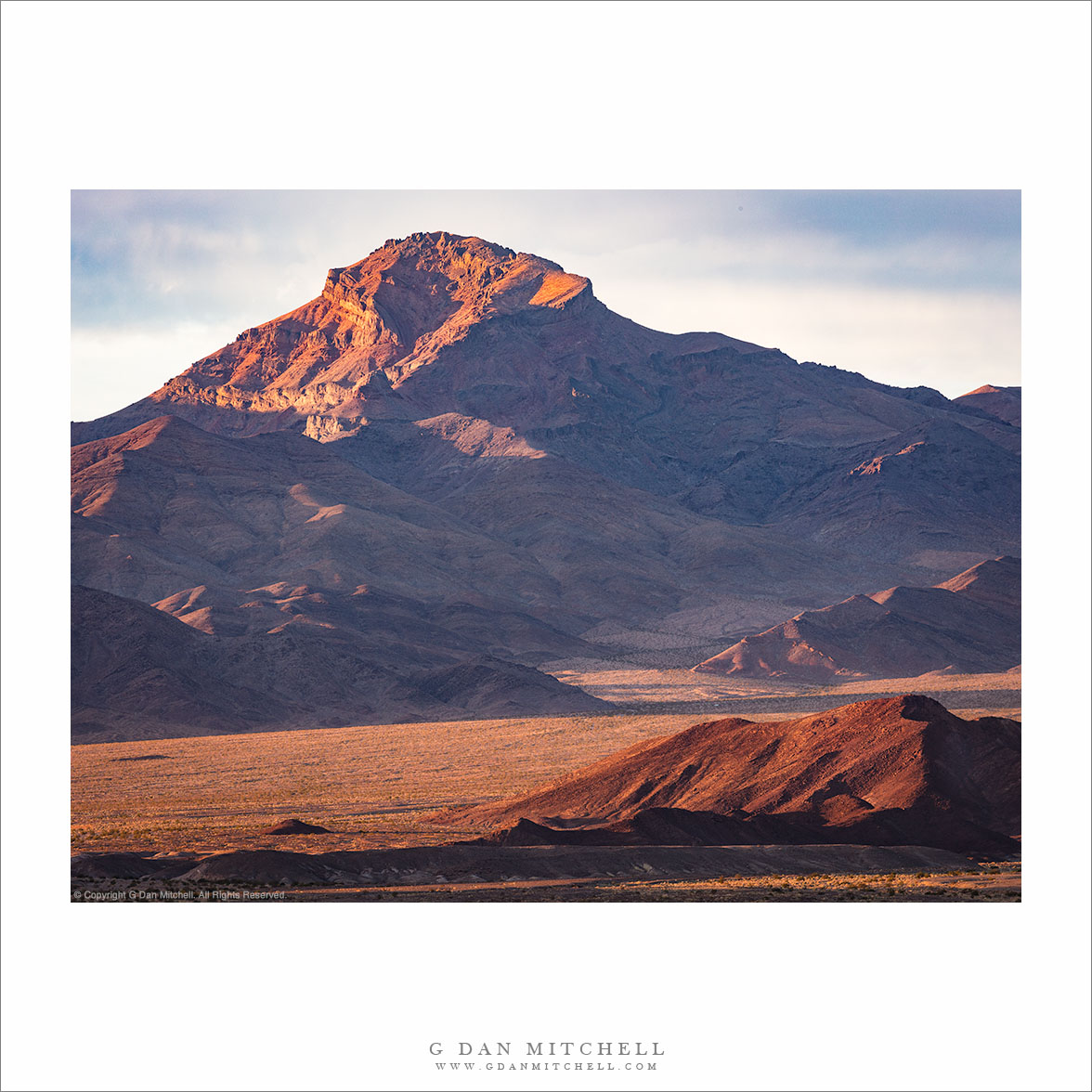
Corkscrew Peak, Evening

Corkscrew Peak, Evening, Death Valley
“Corkscrew Peak, Evening” — Evening light on the giant alluvial plain leading up towards Corkscrew Peak.

This peak has long intrigued me — along with the entire ridge that it lies on. Perhaps the name first caught my attention when I was trying to identify landmarks in photographs I took from out in the Valley. Hint: it does not really look much like a corkscrew, though I can see how the tilted rock layers that seem to run around it inspired the name.

I photographed this on my first evening in Death Valley back in February. After a very long drive from the Bay Area I set up camp, rested a bit, and then it was time to go find something to photograph. Since it was late in the day I wanted to keep it somewhat simple, so I headed to this spot along a road leading out of the Valley, arriving just in time to photograph the day’s last light.

G Dan Mitchell is a California photographer and visual opportunist. His book, “California’s Fall Color: A Photographer’s Guide to Autumn in the Sierra” (Heyday Books) is available directly from him. Blog | Bluesky | Mastodon | Substack Notes | Flickr | Email

Join the discussion — you are welcome to leave a comment or question. (Comments are moderated and may not appear immediately.)

This site uses Akismet to reduce spam. Learn how your comment data is processed.

(All media © Copyright G Dan Mitchell and others.)

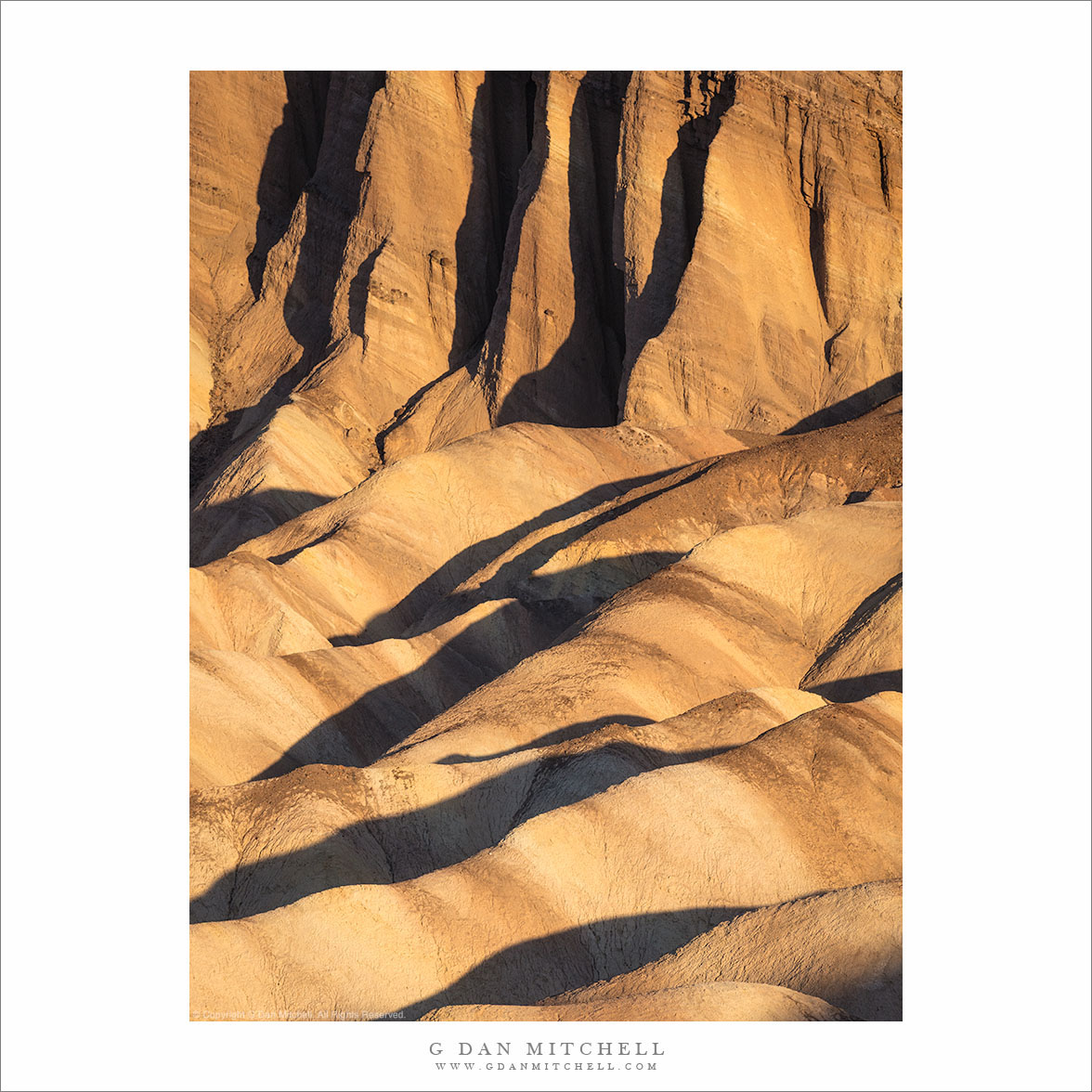
Base of the Red Cliffs

Base of the Red Cliffs. Death Valley
“Base of the Red Cliffs” — Gullies, folds, strata, and morning shadows at the base of the Red Cliffs.

The title says “Red Cliffs,” but you might be thinking, “They don’t look very red to me!” In more neutral light the formations in the upper part of the photograph, and even more so the formations above the margins of the photograph, do have the familiar red rock quality — though it would be fair to say that they are as much brown as red. But in this stark early morning light, just after sunrise, the colors are warmed so much that they are more yellow or orange.

In many ways the geology of Death Valley produces a blank canvas for photographers who want to work with varied light. For the most part, Death Valley’s colors are subtle. The lighter portions of the formations in this photograph are a sort of muted tan in midday light. But as with so many other subjects here, this muted, neutral quality allows them to pick up the colors of sunrise/sunset, twilight, colorful clouds, and reflections from nearby formations.

G Dan Mitchell is a California photographer and visual opportunist. His book, “California’s Fall Color: A Photographer’s Guide to Autumn in the Sierra” (Heyday Books) is available directly from him. Blog | Bluesky | Mastodon | Substack Notes | Flickr | Email

2 responses to “Base of the Red Cliffs”

  1. Charlie Colladay Avatar
    Charlie Colladay

    Hi Dan,
    Here I am, wasting some time on a Sunday afternoon and I came back to this photo of yours. It has not lost any of the intrigue that originally caught my eye and led me to post a comment. Forgive me for diving deeper still into the details of the lighting, that for me, is the strength of this photo. Again, forgive me, but I have to take some issue with a comment of your’s re: the light falling on the foreground.

    You say…”The foreground light is coming from behind and above my camera position — a combination of more reflected light and light from the open sky.”
    I’ll accept that open sky is supplying some over all fill light, but it is much weaker than the main, semi-hard light coming from the left. The evidence of this can be seen in the delineation of the vertical striations on the rock face at the left side of the frame. Each individual striation has a highlight at its peak then a shadow in the depression to the right, in a repeating pattern. Whatever the source of illumination, the bulk of its directional quality can’t be coming from above and behind the camera position. That would produce a much flatter light than what is seen here. The result then would be the foreground rock’s striations being less textural, less visible, more boring without the contrast of the highlight/shadow repeating pattern.

    On that same foreground rock, the upper left and the lower right (the ankle and the toes of the “giant’s foot”) are both darker and flatter, the result of being lit only by the open sky, providing an omnidirectional, flatter and lower level of illumination.

    The overall, bottom line still exists…I love this shot! The above details are just an explanation of why it works so well for me. Thank you, Dan!

    1. G Dan Mitchell Avatar
      G Dan Mitchell

      Charlie,

      Thanks for taking the time to write a long post on this photograph. But I must admit that I’m a bit confused by your comment.

      You wrote:

      ”You say…”The foreground light is coming from behind and above my camera position — a combination of more reflected light and light from the open sky.

      But when I look at the text I wrote to accompany this photograph, in the post you replied to, I do not see that I wrote anything like that there. I wonder if you were looking at a different photograph than the one you commented on?

      In the photograph on this page — “Base of the Red Cliffs” — the sun is definitively behind and above my camera position. It is not straight behind me, but is coming from a slight angle over my right shoulder, which is why the shadows stretch towards the left.

      Let me know if you can figure out why your comment doesn’t seem align with this photograph or its descriptive text.

      Dan

Join the discussion — you are welcome to leave a comment or question. (Comments are moderated and may not appear immediately.)

This site uses Akismet to reduce spam. Learn how your comment data is processed.

(All media © Copyright G Dan Mitchell and others.)