
Tag Archives: telescope

Lick Observatory

Lick Observatory
Lick Observatory

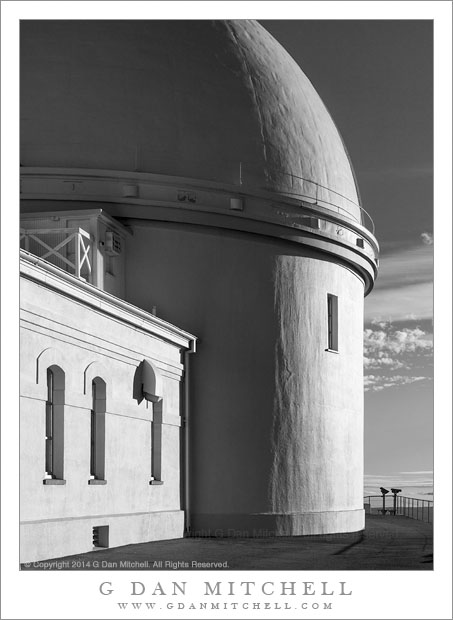
Lick Observatory. Mount Hamilton, California. December 14, 2014. © Copyright 2014 G Dan Mitchell – all rights reserved.

Lick Observatory, on the summit of Mount Hamilton

This could be a very long post, but I’ll try to keep it short. The Lick Observatory, constructed in the 1800s, sits on the highest peak within sight of my home — both the home I grew up in and the one I live it now. When I was young, one of the greatest adventures was a trip up there, especially when it snowed on the 4000’+ summit of Mount Hamilton. Years later, when I was an avid cyclist, I used to ride up to the summit at least once per month, and today I still know the road like the proverbial back of my hand.

I ended up there by accident on this late mid-December afternoon. My day started before dawn out in the Central Valley, where I had gone to photograph migratory birds. For various reasons (including the absence of geese from wildlife area where I ended up) I left the Valley earlier than usual and decided to take the longest and most isolated back-road back to the San Francisco Bay Area — and that is the 75 mile narrow road between Patterson and San Jose. The high point — quite literally — of this drive is the summit of Mount Hamilton, so I stopped there briefly to make a quick visit inside, take in the tremendous panorama of the south San Francisco Bay, and make a few photographs, including this shot of the historic observatory building.


G Dan Mitchell is a California photographer and visual opportunist whose subjects include the Pacific coast, redwood forests, central California oak/grasslands, the Sierra Nevada, California deserts, urban landscapes, night photography, and more.
Blog | About | Flickr | Twitter | FacebookGoogle+ | 500px.com | LinkedIn | Email

Text, photographs, and other media are © Copyright G Dan Mitchell (or others when indicated) and are not in the public domain and may not be used on websites, blogs, or in other media without advance permission from G Dan Mitchell.
First Light, Base of Tucki Mountain and the Panamint Range

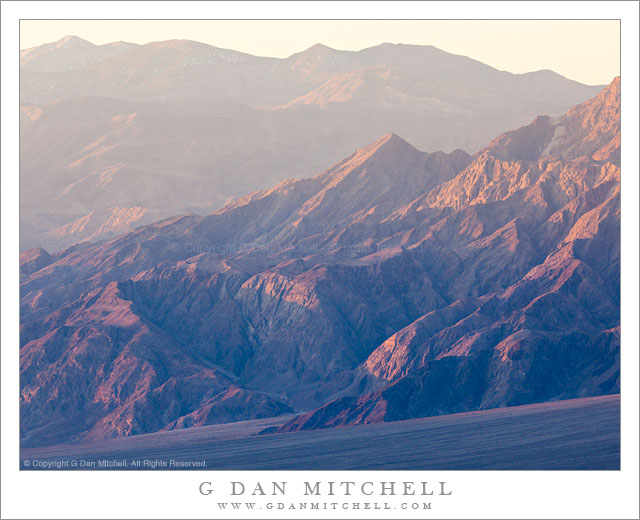
First Light, Base of Tucki Mountain and the Panamint Range - First morning light on the rugged landscape of the base of Tucki Mountain and the Panamint Range, Death Valley National Park, California
First morning light on the rugged landscape of the base of Tucki Mountain and the Panamint Range, Death Valley National Park, California

First Light, Base of Tucki Mountain and the Panamint Range. Death Valley National Park, California. January 3, 2012. © Copyright 2012 G Dan Mitchell – all rights reserved.

First morning light on the rugged landscape of the base of Tucki Mountain and the Panamint Range, Death Valley National Park, California

This photograph was made from a location a ways up from the bottom of Death Valley, from which I could look directly across at the lower slopes of gigantic Tucki Mountain as the first morning light worked its way down toward the lower ridges and the huge alluvial fan at the base of the mountain. At the moment I made the exposure the light was just beginning to fill this slanting area below the rugged mountains, and the light was softened by morning haze.

Tucki Mountain is a huge peak that almost seems to me to be large enough to count as its own minor mountain range. It rises above Stovepipe Wells, and extends a great distance east, south, and west of there. It is laced with deep canyons and its lower slopes are heavily eroded to reveal tilting and twisting strata. Another large valley lies on beyond the foreground spur ridge in this photograph, and beyond that the Panamint Range rises to its crest at 11,000+’ Telescope Peak.

G Dan Mitchell is a California photographer whose subjects include the Pacific coast, redwood forests, central California oak/grasslands, the Sierra Nevada, California deserts, urban landscapes, night photography, and more.
Blog | About | Flickr | Twitter | FacebookGoogle+ | 500px.com | LinkedIn | Email

Text, photographs, and other media are © Copyright G Dan Mitchell (or others when indicated) and are not in the public domain and may not be used on websites, blogs, or in other media without advance permission from G Dan Mitchell.
Rhyolite Ghost Town, Amargosa Valley and Mountains

Rhyolite Ghost Town, Amargosa Valley and Mountains
“Rhyolite Ghost Town, Amargosa Valley and Mountains” — The ruins of the ghost town of Rhyolite, Nevada stand above the Amargosa Valley, with the Amargosa Range and Death Valley National Park in the distance.

While there can be some moments of beautiful and colorful sunrise light at the ghost town of Rhyolite, Nevada – and I was there for it – this early morning light from a short time later probably gives a more true sense of what the place tends to look like during the winter months. (Even here, the high, thin clouds soften the scene a bit – it is often quite cloudless.)

From what I understand, Rhyolite sprang up in the very early 1900s after gold was discovered nearby. During the short life of the town, measured in no more than decades, it was reportedly the second largest city in southern Nevada. It featured banks (two of which are seen in this photograph), a railroad station (abandoned but still present and located behind my camera position), newspapers, an impressive school house, and thousands of residents. It was all largely abandoned in the first half of the 1900s and most of the buildings are gone, though traces of them and the old roads they lined can still be found here and there. A few large buildings in the center of the town still more or less stand, in varying states of decay. The building on the right was the Cook Bank. Another bank was located where the white walls are a bit further in the distance. The town school house is the furthest building. The whole town overlooked the Amargosa Valley, where the current boundary of Death Valley National Park lies. Beyond that, an inside the park, are the Amargosa Range and in the far distance the ridge of the Panamint Range and the summit of 11,000+’ Telescope Peak.


G Dan Mitchell is a California photographer and visual opportunist. His book, “California’s Fall Color: A Photographer’s Guide to Autumn in the Sierra” (Heyday Books) is available directly from him.

G Dan Mitchell: Blog | Bluesky | Mastodon | Substack Notes | Flickr | Email


All media © Copyright G Dan Mitchell and others as indicated. Any use requires advance permission from G Dan Mitchell.

Desert Pool, Panamint Range, Morning

Desert Pool, Panamint Range, Morning

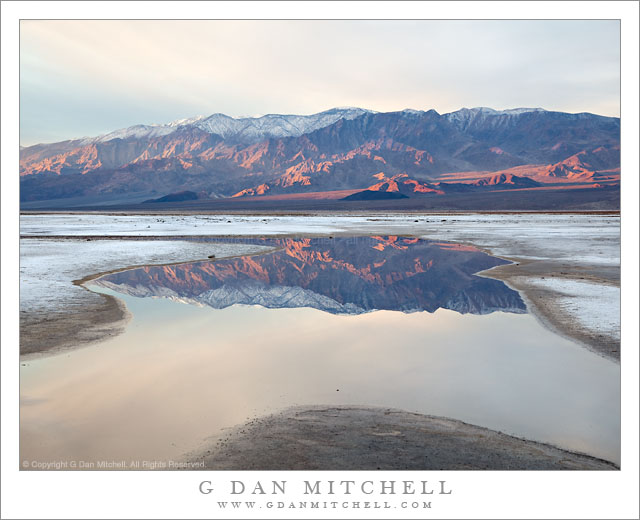
Desert Pool, Panamint Range, Morning. Death Valley National Park, California. February 21, 2011. © Copyright G Dan Mitchell – all rights reserved.

A salt spring pool on the salt flats in Death Valley reflects winter dawn light on the east face of the Panamint Range.

Sometimes I hear people describe how they think or imagine that landscape photography is done, and I wonder where they get their ideas. I will acknowledge that there are many ways to shoot landscape, ranging from working very slowly and carefully to produce a single image, to shooting like crazy and seeing what you end up with. But often people dismiss approaches closer to the latter and assume that the former is the “right way” to shoot landscape.

In my experience it isn’t quite that simple. Sometimes the experience is like certain others in which long stretches of time during which one seemingly accomplishes nothing or perhaps just looks and thinks are suddenly followed by quick and intense spurts of work that come almost as a surprise and may be over as quickly as they begin. This little morning shoot in Death Valley along the edge of a the salt/mud flats where the water from a small salt spring spreads across the flats and forms shallow pools was one of these. Very early in the morning, well before dawn, it was difficult to know what the best shooting option might be. There were clouds in the sky that promised to block the dawn light and everything seemed gray and flat. I wandered a bit, not sure where or what to shoot, and finally, more or less by chance, ended up at this spot that I had visited earlier on this trip. It occurred to me that even if the light wasn’t great I could possibly find a photograph that included this water. So I stopped and began to unpack in no particular hurry.

As I walked across the wash toward the area of the spring, much to my surprise it began to appear that there might be some interesting dawn light after all. I quickened my pace and headed toward the area of the shallow pools, and when I arrived there a moment later I could see some color on the top of the Panamint range. I quickly found a decent foreground pool and as the surprising light worked its way down the front of the range I began photographing. I first made several exposures at much shorter focal lengths, including a larger portion of the sky and the foreground. Then I quickly moved the tripod to place this pool in the center of the frame and hold the reflection of the range. I had little time to contemplate as the light was changing very quickly. I had just enough time to find my composition and make a few exposures, and within moments the light was gone.

G Dan Mitchell Photography | Flickr | Twitter | Facebook | Email
Text, photographs, and other media are © Copyright G Dan Mitchell (or others when indicated) and are not in the public domain and may not be used on websites, blogs, or in other media without advance permission from G Dan Mitchell.