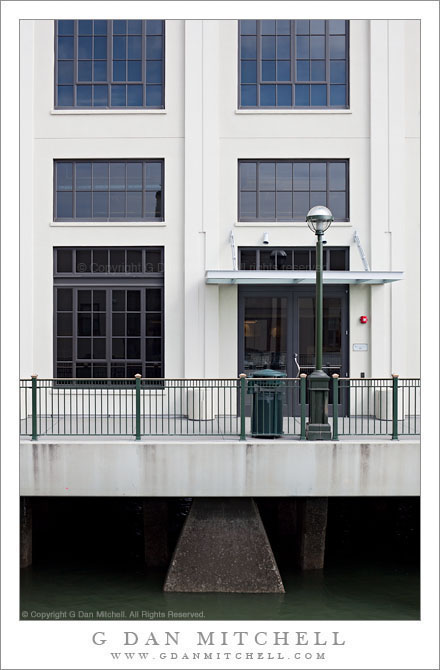
A sidewalk with a lamp next to a white waterfront building in San Francisco, California.
This is another in the series of wandering-the-streets photographs from San Francisco last July. At one point I was wandering along the Embarcadero – the road and nearby areas that front the shoreline along the Bay between about Fishermans Wharf and ATT Park. I walked through here slowly, poking about in odd little alleys and walkways, and occasionally finding myself in spots that were not very crowded. Here I had walked into an area of new construction to find new and refurbished buildings over the water and surrounded by walkways. At just this point the fog clouds were beginning to thin out a bit – you can see a hint of blue sky reflected in the upper windows and shadows were starting to appear. Certain shape, color, and texture features drew me to this little scene.
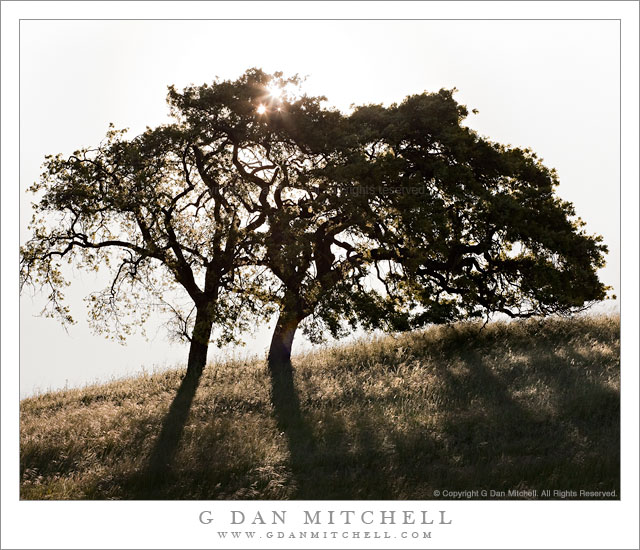
The springtime morning sun shines through a pair of oak trees in the Calero Hills south of San Jose, California.
On the final day of April and for the first time this season, I found to go for a hike at my favorite local park, a place where I have walked just about every available trail (and invented a few routes of my own) and photographed for a number of years. The park would not seem like anything all that special by comparison to some of the other places I visit, but it is close and I’ve gotten to know it in a way that makes it more special. The place is called the Calero County Park, part of the Santa Clara County Parks system.
The entrance to the park is in a broad valley that is largely occupied by stables. (Or, used to be – it looks like the stables must have closed since last season.) Rising from this valley are the typical grass-covered hills of central and northern California, with oaks and other trees scattered around and, in places, thicker trees and brush. At this time of year, the hills turn what I call “impossibly green” – and if you have seen them on a late-winter or early spring morning you know what I mean.
I started this hike a bit after dawn, so the golden hour light was more or less gone. I had a general idea of photographing some wildflowers (which didn’t happen – it was too windy) and some oak trees that grow alone or in small groups on the grass-covered hills. I passed a small lake – where a single egret often hangs out, but not on this morning – and topped a rise and descended into a small valley from which I have made quite a few photographs of oaks. It didn’t look too promising at first, but at the far end of this area I noticed that a pair of trees were still obscuring the sun and that I might be able to shoot straight into the sun with the trees blocking its disk, and get a photograph including the tree shadows on the hillside grasses.
This turned out to be another of those all-too-common ephemeral photographs in that the sun was starting to rise above the top branches of the tree and would soon be “out in the open,” making it much too bright for what I had in mind. So I worked quickly to set up tripod and camera and select a lens, then frame a composition, focus, and make a series of exposures that might be needed to deal with the huge dynamic range between direct sun and backlit tree trunks. By the time I had everything set up and was ready to shoot the sun had already risen above the upper branches, so I ended up looking for a slightly better shadow and putting the tripod down very low – and this gave me must enough time to make the series of exposures I figured I would need.
In the end, I got lucky. One single shot somehow managed to not blow the sun out too badly yet hold enough detail in the grass that a bit of work in post could bring it back. With all of the potential for lens flare – which I had to some extent in every shot – this one only had two small bits of it, and they were easily dealt with.
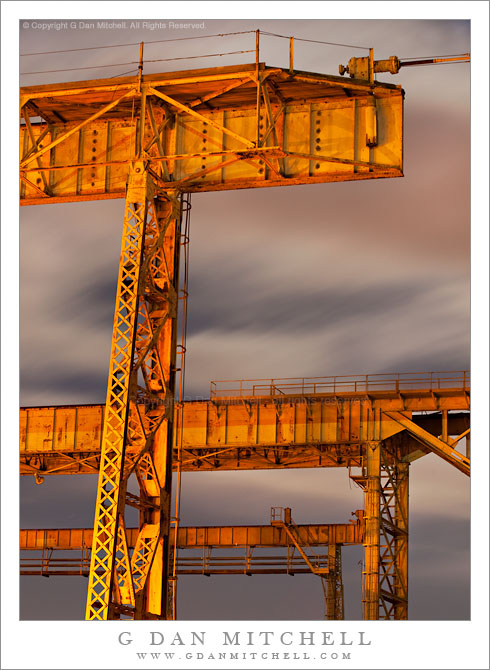
Massive steel towers stand against the night sky at Mare Island Naval Ship Yard.
This is a vertical format photograph of the same series of overhead ship yard structures that I posted in horizontal format recently. As in the other, the illumination comes from very warm (verging on orange-yellow) light from nearby security lights in the shipyard. As a result the extremely hot colors of the metal structures are juxtaposed with the relatively cooler colors of moonlit night sky on this full moon night.
The structures, along the shoreline at the historic Mare Island Naval Ship Yard, were apparently used to move heavy ship components between nearby shops and ships along the waterfront. As I understand it, the yard has been out of commission for about a decade and a half at this point, and the huge mechanical/industrial structures are showing the effects via peeling paint and rust.
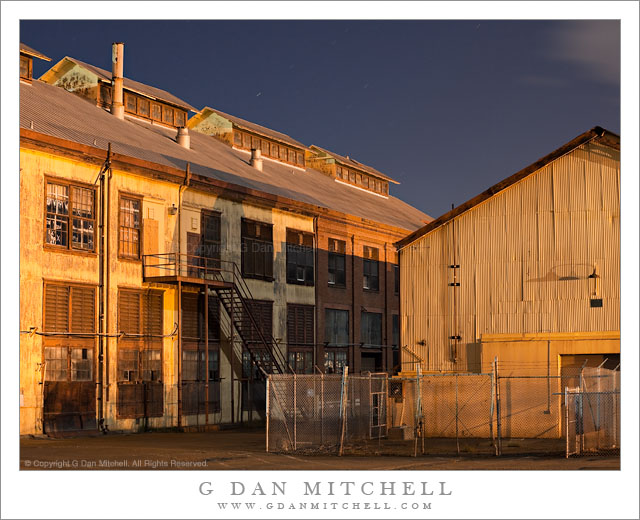
Night photograph of abandoned industrial buildings from the historic Mare Island Naval Ship Yard.
The building on the left is sometimes known as the “UFO Building” – not because of anything that might be stored inside, but because of a shadow in the shape of a “flying saucer” that forms on one of its walls. I thought it was the only one until I took this photo in which you might spot another saucer-shaped shadow on the wall of the building at the right.
This scene is not a particularly unusual one at the historic Mare Island Naval Ship Yard, a place that is full of old industrial buildings left over from the long ship-building history on this island. Many of the old buildings are now in a state of somewhat arrested development, but they certainly show the signs of age and lack of care – lots of boarded up buildings, peeling paint, warnings about hazards of various kinds, and so forth.
Most of the light in this photograph comes from a bank of strong security lights on the exterior of a more modern nearby building, and the yellow color is a result of the type of lighting that is used. There is also a bit of full moon light in the shadows and on the bit of cloud at the upper right, and this also explains the lighter coloration of the sky. When making night photographs in a place like this, I feel comfortable about not really trying to “capture” an objective reality of the place. To be blunt, that is pretty much impossible. First of all, it is actually so dark in many of these places that it takes a while for your eyes to get used to it. Secondly, there are so many varied light sources with so many different colorations that it is essentially impossible to “color correct” the scene – though I’m not even quite certain what it would mean to do that in a scene that we really can’t “see” with our own eyes.
The idea in my night photography is not often to capture the scene as it “is,” but instead to reflect the way “the camera sees,” a way of seeing that is quite different from our native modes of seeing. Things that occur over long periods of time (exposures measured in minutes) appear in a single frame, sometimes objects lose their definition as shadows move and wind blows, stars create streaks in the sky and passing clouds blur, and the colors are far from “natural.”
Photographer and visual opportunist. Daily photos since 2005, plus articles, reviews, news, and ideas.
Manage Consent
To provide the best experiences, we use technologies like cookies to store and/or access device information. Consenting to these technologies will allow us to process data such as browsing behavior or unique IDs on this site. Not consenting or withdrawing consent, may adversely affect certain features and functions.
Functional
Always active
The technical storage or access is strictly necessary for the legitimate purpose of enabling the use of a specific service explicitly requested by the subscriber or user, or for the sole purpose of carrying out the transmission of a communication over an electronic communications network.
Preferences
The technical storage or access is necessary for the legitimate purpose of storing preferences that are not requested by the subscriber or user.
Statistics
The technical storage or access that is used exclusively for statistical purposes.The technical storage or access that is used exclusively for anonymous statistical purposes. Without a subpoena, voluntary compliance on the part of your Internet Service Provider, or additional records from a third party, information stored or retrieved for this purpose alone cannot usually be used to identify you.
Marketing
The technical storage or access is required to create user profiles to send advertising, or to track the user on a website or across several websites for similar marketing purposes.