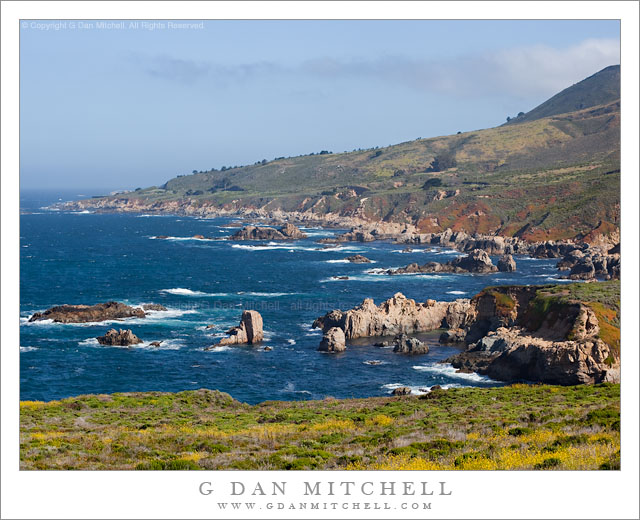
A sunny spring morning along the Big Sur Coast at Soberanes Creek, with fog above the coastal mountains.
This is a spot that is probably familiar to many who have driven down this section of the Big Sur coastline south of Monterey and Carmel, California. To the right, and out of the photograph, is Soberanes Canyon which ascends steeply toward the ridges above Pacific Ocean. A creek flows down the canyon, underneath the coast highway, and then into the ocean.
The foreground bluff looks inviting with its green color and spring flowers. However, I picked up one of the worst cases of poison oak I’ve had on one occasion when I walked across this meadow to photograph the sea stacks and coastline at dusk!
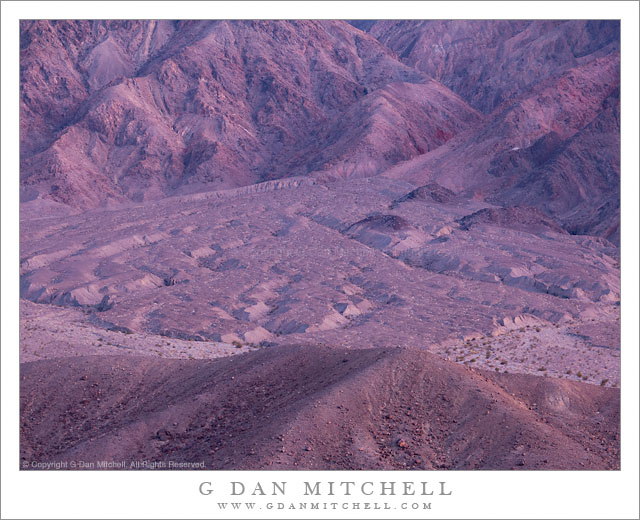
Soft rose-colored dusk light illuminates an alluvial fan below a canyon at the base of Tucki Mountain, Death Valley National Park.
This is one of several photographs from the recent Death Valley trip that beg the question, “Is that color real?!”*
Yes, this really is the color of the light from this scene.
I learned quite a while ago that the interesting light most definitely does not end at sunset – often the best and most interesting light comes after the sun has set. Sunset on this evening had been quite interesting, but a few minutes after the sun set the last brilliant red light struck high clouds overhead and lit up the entire scene with this lurid and intense wash of color.
The scene is a large desert gravel wash where a drainage canyon spills out into Death Valley at the base of Tucki Mountain and forms a huge alluvial fan. I had climbed to the top of a low hill to shoot late afternoon and sunset light, so I had a good vantage point to view this wash beyond intervening hills. Tucki Mountain itself is a massive lump of a mountain that rises above Stovepipe Wells – what it lacks in terms of an impressive and jagged summit peak in makes up for by means of its sheer bulk. It constitutes a large spur off of the Panamint Range and almost seems like a small sub-range all by itself.
*After I originally wrote the text to this post I made a 12″ x 16″ test print of this photograph. As I often do, I put the print out on a table in our living room so that I can see it in a context other than that of my small studio. My wife, who is a very perceptive viewer and who has seen the results of, uh, printer errors (for real fun, print on the back side of your paper by accident some time…) looked at these colors and said, “Is something wrong with your printer?” Ah, I love critics! ;-)
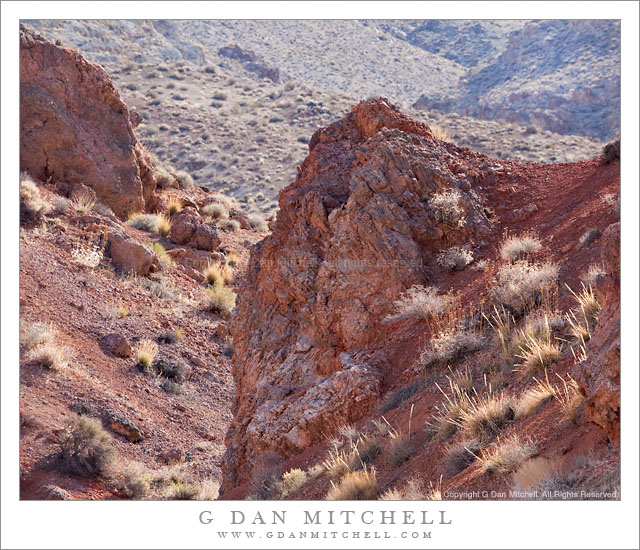
A red rock gully among the desert hills of the Panamint Range, Death Valley National Park.
This is anything but an iconic image, but I think that it is emblematic of a certain type of scene that is often seen in Death Valley National Park once you get out of the main Valley and up into the hills, especially during the brief spring season when the light can be a bit softer and the plants a bit (relatively speaking!) greener.
The photograph looks up a broad valley that is visible from along the road that rises from the main road through the Valley and climbs toward the Wildrose Canyon area. Here the elevation is high enough that the dry, sun-baked flat land of the Valley is nowhere to be found. Instead this is a country of large valleys and plateaus, cut in places (mostly at the bottom of canyons) but rocky outcroppings and gullies. This red rock gully is easily visible from the road, though the odds are that most people just drive right by. I had seen it on several drives past this spot before I thought to stop and photograph it, and I was fortunate to be there when the light seemed just right.
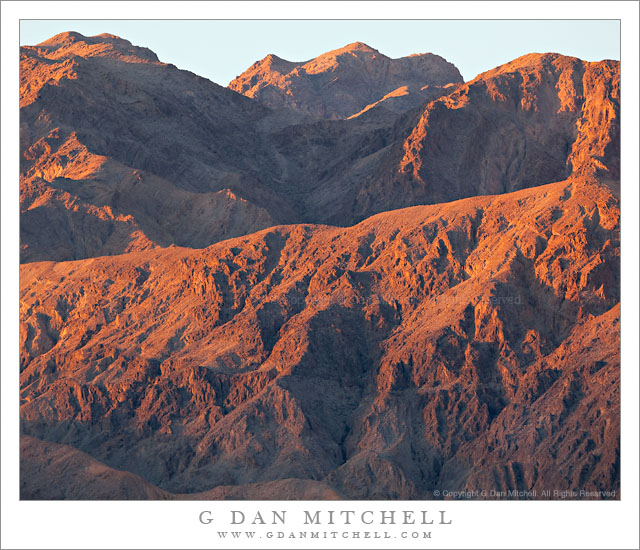
Dawn light on the faces and gullies of the lower slopes of Tucki Mountain, Death Valley National Park.
On the final morning of my recent (March, 2011) visit to Death Valley I decided to go to a spot not far from my campsite at Stovepipe Wells where I know of a bit of raised terrain that provides large-scale views of big chunks of this part of the Valley. I arrived before dawn and lugged my gear to the top of this rise with the primary plan of using a long lens to photograph across the Mesquite Dunes toward the Cottonwood Mountains at sunrise.
However, when standing in a spot like this one there are so many interesting effects of light all around that it is impossible, for me anyway, to just shoot that one thing. Far up the Valley to the north light starts to hit the highest peaks of several mountain ranges, to the east the light comes through and illuminates morning haze and layers of low hills, and to the southwest of my position the light began to reach the top of Tucki Mountain. So, between photographs of my intended subject to the west, I swung the camera though the entire 360 degrees to photograph many of these other subjects.
Tucki Mountain has fascinated me since I “discovered” it one morning while shooting on the “back side” of the Mesquite Dunes. At dawn I had been photographing the low dunes and other features on the side of the dunes that cannot be seen from the usual roadside viewpoints. As the light changed I worked my way up into the dunes a bit to photograph the shapes and textures of the sand, and I saw a composition that included this massive mountain to the south with it dark and jagged features. It was only later that I found out that it was Tucki Mountain. (If you have visited Stovepipe Wells, you have been right below the mountain.) It is a huge, sprawling peak – almost more of its own small range than a simple peak, or so it seems to me.
On this morning I first saw a big of the deep red first dawn light hitting the top of the peak and noticed lower ridges starting to pick up traces of this light. I swung that tripod head around to point this direction and decided to tightly frame some images of the overlapping ridges and valleys ascending toward the peak as the light worked its way down toward the Valley floor.
Photographer and visual opportunist. Daily photos since 2005, plus articles, reviews, news, and ideas.
Manage Consent
To provide the best experiences, we use technologies like cookies to store and/or access device information. Consenting to these technologies will allow us to process data such as browsing behavior or unique IDs on this site. Not consenting or withdrawing consent, may adversely affect certain features and functions.
Functional
Always active
The technical storage or access is strictly necessary for the legitimate purpose of enabling the use of a specific service explicitly requested by the subscriber or user, or for the sole purpose of carrying out the transmission of a communication over an electronic communications network.
Preferences
The technical storage or access is necessary for the legitimate purpose of storing preferences that are not requested by the subscriber or user.
Statistics
The technical storage or access that is used exclusively for statistical purposes.The technical storage or access that is used exclusively for anonymous statistical purposes. Without a subpoena, voluntary compliance on the part of your Internet Service Provider, or additional records from a third party, information stored or retrieved for this purpose alone cannot usually be used to identify you.
Marketing
The technical storage or access is required to create user profiles to send advertising, or to track the user on a website or across several websites for similar marketing purposes.