Tag Archives: grass

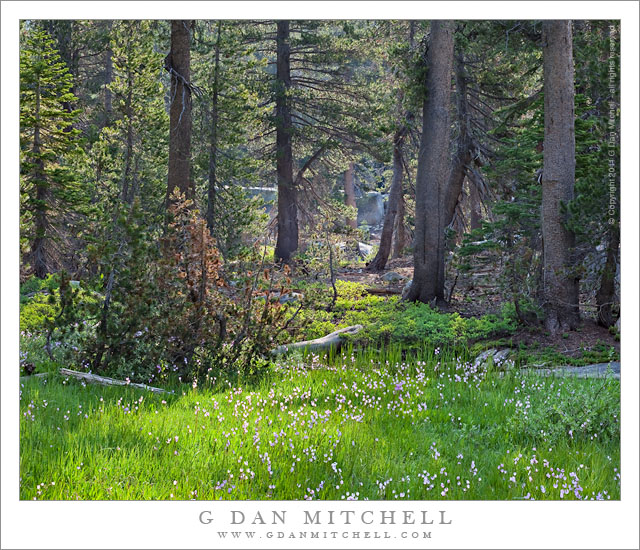
Young Trees and Meadow, Tioga Pass

Young Trees and Meadow, Tioga Pass

Young Trees and Meadow, Tioga Pass. Yosemite National Park, California. July 22, 2010. © Copyright G Dan Mitchell – all rights reserved.

Young trees grow along the edge of subalpine meadows at Tioga Pass, Yosemite National Park.

This meadow, right below Tioga Pass – which is among the trees in the saddle in the upper part of the photograph – is something of a magical spot in the Sierra. It is, of course, the highest point that you can drive to in the park, and it sits right on top of the crest of the Sierra Nevada. At just slightly less than 10,000′ of elevation it is verging on the true alpine zone. Because of elevation and location, it is only open for a few months each year between roughly the end of spring and generally some time in November. (For those of us who think of this as it looks in summer, it is sobering to remember that during the majority of the year it is a cold and snow-covered place.) Once you pass over Tioga you begin to descend into the very different world of the high deserts east of the crest. Yes, it still feels like the high country for a while, but within miles you are in hot dry places that are not at all like this alpine terrain.

Oddly, while a thin band of trees crosses the saddle at the pass, much of the area on either side is meadow. This section is on the “Yosemite side,” and is an extension of the many meadows along the Dana Fork of the Tuolumne River which drains this area around Mount Dana. As if to reinforce the idea that this is not as gentle a place as it may appear in the summer, parts of the meadow are filled with the bleached remains of trees struck down by avalanches from the ridge that is out of this photograph to the left. The trail to the summit Mt. Dana, of the second-highest peak of Yosemite (being a few feet shorter than Mt. Lyell), begins by crossing this meadow.

Although I drive over this pass with some frequency, I virtually always stop and get out of the car and look around for at least a moment. On this late-July visit I stayed more than a moment, spending a good portion of an afternoon wandering about the meadow and photographing these young trees, small streams and ponds, fallen trees, some of the more distant mountains, and much else.

G Dan Mitchell Photography | Flickr | Twitter (follow me) | Facebook (“Like” my page) | LinkedIn | Email
Text, photographs, and other media are © Copyright G Dan Mitchell (or others when indicated) and are not in the public domain and may not be used on websites, blogs, or in other media without advance permission from G Dan Mitchell.

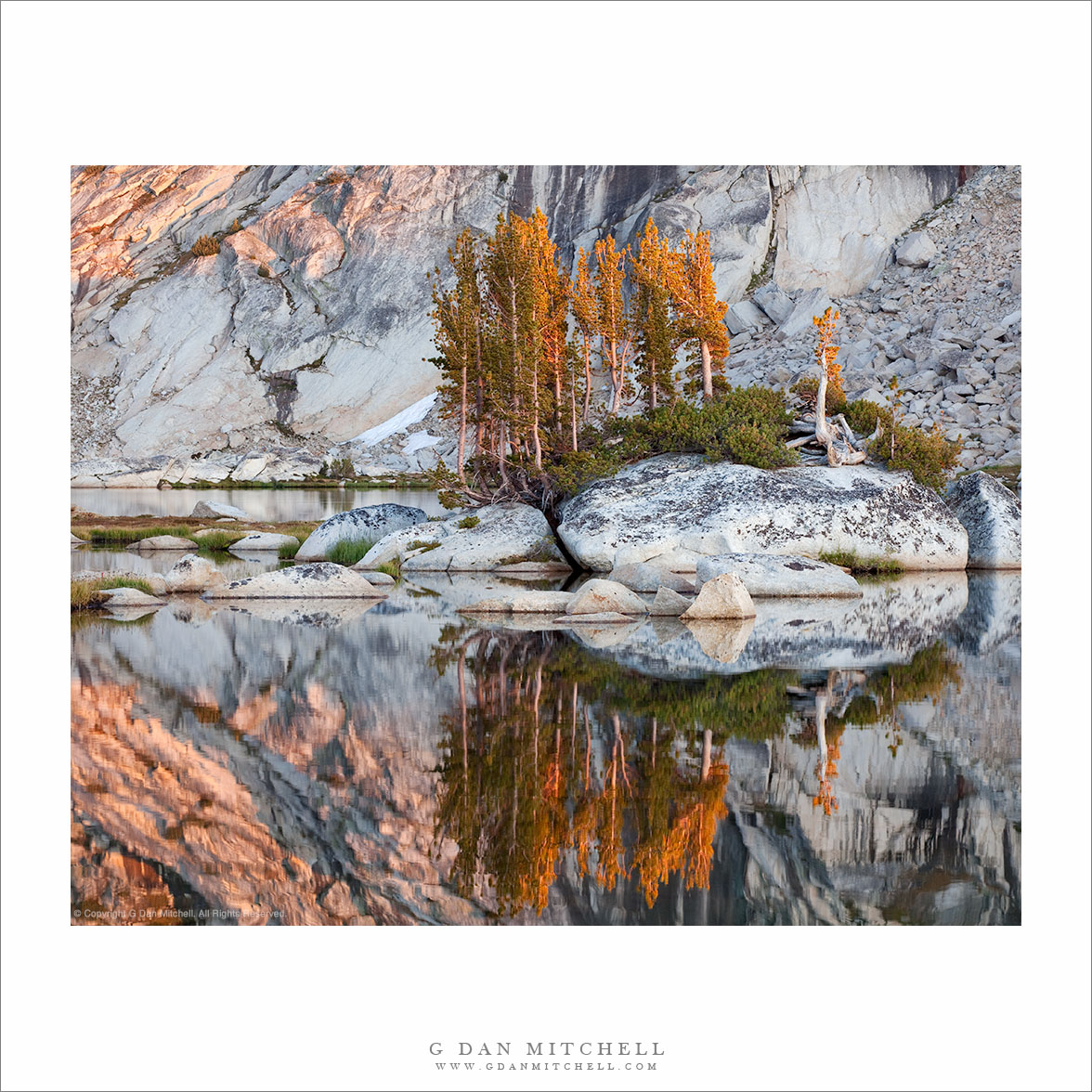
Alpenglow, Mammoth Peak

Alpenglow, Mammoth Peak

Alpenglow, Mammoth Peak. Yosemite National Park, California. July 22, 2010. © Copyright G Dan Mitchell – all rights reserved.

Alpenglow lights the face of Mammoth Peak beyond a small tarn near the summit of Tioga Pass, Yosemite National Park.

This was very close to the last exposure I made on this productive late-July day last year. After photographing for a few hours in the vicinity of Tioga Pass, I ended up right at the pass as the day came to an end. Braving hordes of mosquitos – comes with the territory! – I worked the area around the pass itself, building compositions out of juxtapositions of the water in the small meltwater ponds, shoreline meadow and boulders, grasses growing along the edge of the water, the surrounding pine forests, and the more distant peaks of Kuna Crest. In this photograph, what is very nearly the very last direct light of the day is bathing the slopes of Mammoth Peak, which still had a fair amount of snow on its flanks even in late July.

This scene posed a few technical challenges. First, there is obviously a great distance between the foreground granite boulder and the very distance mountain. I wanted the foreground to be in optimal sharpness, so I used a relatively small aperture to maintain sufficient sharpness on the far ridge. There was also a fairly large dynamic range in the scene, ranging from soft but direct light on the snow fields of the peak to the dark areas within the forest on the other side of the pond. I wasn’t certain that I’d be able to handle the full dynamic range in one exposure, so I made three – one longer exposure to get a bit more light from the shadows and another shorter one on the dark side to avoid blowing out the brighter areas of the sky. In post, I discovered that there was enough detail in the shadows that I could get everything I needed from a single exposure, though I had to do some work with curves to get create an image the conforms more closely to the way I saw the scene at the time.

G Dan Mitchell Photography | Flickr | Twitter (follow me) | Facebook (“Like” my page) | LinkedIn | Email
Text, photographs, and other media are © Copyright G Dan Mitchell (or others when indicated) and are not in the public domain and may not be used on websites, blogs, or in other media without advance permission from G Dan Mitchell.

Three Elk, Point Reyes

Three Elk, Point Reyes

Three Elk, Point Reyes. Point Reyes National Seashore, California. May 30, 2011. © Copyright G Dan Mitchell – all rights reserved.

Three tule elk grazing on hills above Drakes Beach at Point Reyes National Seashore, California.

This is one more – and possibly the last – in the series of tule elk photographs that I made at the Point Reyes National Seashore on Memorial Day. A group of perhaps eight or ten bull elk were grazing along the top of the hills above Drakes Bay when we encountered them in beautiful late afternoon light. As soon as I got out with my camera they moved just a bit further away, but still well within photography range.

There is a typical sequence in how I usually photograph creatures such as these. Because I never know how long they will stick around, I begin my just shooting them in any way that seems even somewhat interesting, perhaps muttering to myself, “At least I have tule elk shots in my portfolio now!” But after getting a few “insurance” shots right off the bat, I start to be more selective and more observant. Initially, I’m looking for a variety of interesting individual shots. These might include a single animal separate from the group, perhaps the full group, and perhaps sub-groups of two or three. I also pay a lot of attention to their positions, watching to make sure that faces are visible. (In this shot, the leftmost elk is partially obscured, but because his eyes are still visible and because of the way his antlers align with those of the front animal, on balance I don’t think this is a big problem.) I also watch for distracting elements, and may stop shooting if they are present. For example, the rear end of an elk is bright white and, uh, not the most photogenic part of the beast – so I wait until an animal presenting its backside to the camera either moves out of the frame or rotates into a better position.

I also try to think the same way I think when photographing a group of people. Their faces and eyes are the most important things, with the relationships their positions create among them being a very close second. Here two of the elk are looking almost at me, but slightly past my left shoulder. The third animal seems to be looking more toward the other two, creating a different sort of relationship among the animals. These things are so fleeting that I sometimes don’t see them until they have happened, so I have learned to not be conservative about exposing a lot of frames!

To the extent that I have control over such things, I also like to think about the angle of the light on the subjects. Sometimes you have no choice – you simply have to shoot from where you are. However, with these elk I did have some range of options. They were along a road, and I chose to stop a bit before their position because the light coming from the left would light them in a more dramatic and interesting fashion than if I had gotten closer and shot them with the light right behind me. In addition, I try to look beyond the animals themselves and be aware of how they position themselves against background subjects. This particular shot isn’t a great example, but in others I might wait for the moving animals to position themselves in a place where the background elements relate to them in some interesting way.

With all of this detail, you might get the idea that I’m standing there making a series of careful and logical calculations about how to shoot these guys. That’s not really what happens at all. Much of it turns out to happen in a quick and intuitive and almost subconscious manner “in the moment.” I’ve probably written here before about my belief in the important of “practice” (something I learned from my musical background) when it comes to being able to work and see quickly and effectively.

G Dan Mitchell Photography | Flickr | Twitter (follow me) | Facebook (“Like” my page) | LinkedIn | Email
Text, photographs, and other media are © Copyright G Dan Mitchell (or others when indicated) and are not in the public domain and may not be used on websites, blogs, or in other media without advance permission from G Dan Mitchell.

Bull Tule Elk, Point Reyes

Bull Tule Elk, Point Reyes

Bull Tule Elk, Point Reyes. Point Reyes National Seashore, California. May 30, 2011. © Copyright G Dan Mitchell – all rights reserved.

A bull tule elk grazes among the grassy hills near Drakes Bay, Point Reyes National Seashore.

The group of bull tule elk that I encountered at Point Reyes National Seashore on Memorial Day was large and tended to stick together very closely. Most of the photographs that I shot include multiple animals. However, this fellow paused for a moment as the others moved to the right and I had a chance to make a few photographs containing only a single elk. He was even thoughtful enough to pose in front of the rolling green hills rising above Tomales Bay in the distance!

The elk were apparently native to Point Reyes – and much of the rest of California – but were decimated in the 1800s as a result of hunting and displacement by cattle. As I understand it, a small group was reintroduced to Point Reyes in the 1970s or thereabouts. Eventually they were so successful that the herd began to expand to other areas of the park, and the area has now reached it normal carrying capacity for these animals. This specimen and the group it was part of were along the top of the rolling hills above Drakes Bay.

G Dan Mitchell Photography | Flickr | Twitter (follow me) | Facebook (“Like” my page) | LinkedIn | Email
Text, photographs, and other media are © Copyright G Dan Mitchell (or others when indicated) and are not in the public domain and may not be used on websites, blogs, or in other media without advance permission from G Dan Mitchell.