
Tag Archives: light

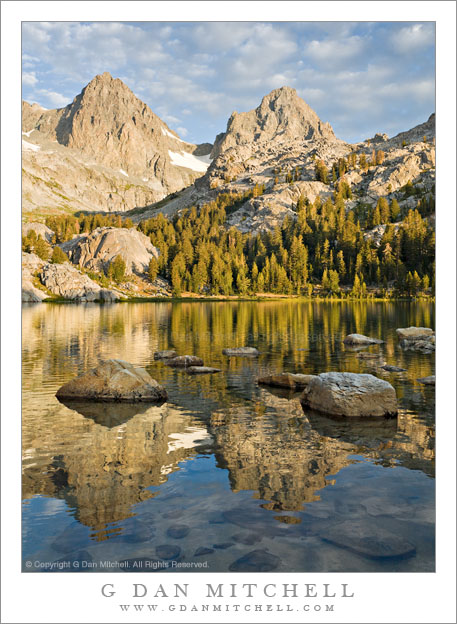
Ediza Lake, Morning

Ediza Lake, Morning
Ediza Lake, Morning

Ediza Lake, Morning. Sierra Nevada, California. © Copyright 2007 G Dan Mitchell – all rights reserved.

Broken clouds cover the sky as morning light comes to Ediza Lake and surrounding peaks, Sierra Nevada.

This is a photograph from about four years ago, when I made a several-day trip into the area around the Minarets and travelled slowly between Ediza Lake and Thousand Island Lake. I was on the trail with my brother’s family, so we took it fairly easy and stayed at Ediza and then Thousand Island for several days. This provide plenty of time for photography, unlike some of my “traditional” trips on which I tended to move every day.

We had “interesting” weather on this trip, in all senses of the word “interesting.” In fact, the conditions really were quite good for photography, ranging from perfectly clear dawns to afternoon thunder showers and everything in between. On one memorable late morning I had hiked up from Ediza to the some higher lakes closer to the Minarets. When I left it was perfectly clear, but by the time I arrived at my destination (or perhaps my new, closer destination once I saw the weather) it became clear that it wasn’t going to remain clear for long. Being a bit too trusting of the earlier clear weather, I had gone out with no rain gear, and by the time I got close to camp very large rain drops were starting to fall.

This photograph was made in the morning from the shoreline of Ediza Lake. It looks back over the lake toward Mount Ritter and Banner Peak, whose two large summits dominate this whole area.

G Dan Mitchell Photography
About | Flickr | Twitter | FacebookGoogle+ | 500px.com | LinkedIn | Email

Text, photographs, and other media are © Copyright G Dan Mitchell (or others when indicated) and are not in the public domain and may not be used on websites, blogs, or in other media without advance permission from G Dan Mitchell.

(Basic EXIF data may be available by “mousing over” large images in posts. Leave a comment if you want to know more.)
Eroded Gullies at Zabriskie Point, Morning

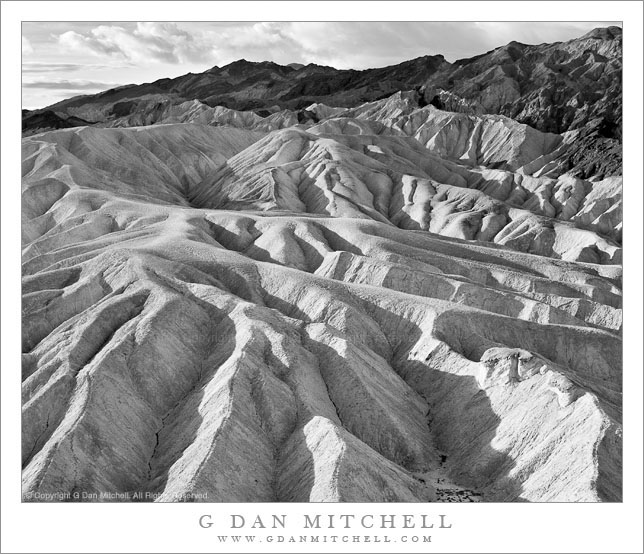
Eroded Gullies at Zabriskie Point, Morning

Eroded Gullies at Zabriskie Point, Morning. Death Valley National Park, California. April 6, 2006. © Copyright 2011 G Dan Mitchell – all rights reserved.

Low angle morning light illuminates a tortured landscape of eroded gullies at Zabriskie Point, Death Valley National Park.

I recently “rediscovered” this photograph while undertaking a major review of the past eight years of my raw files. (And, yes, that task is just about as much fun as you might imagine. It would actually be pretty unbearable except that every so often I find some photographs that I had perhaps forgotten or overlooked, and I also come across images that remind me of experiences that took place some time ago.)

This photograph was made, as virtually anyone who has visited the spot recognizes, by pointing my camera about 90 degrees to the left of the classic Zabriskie Point views. Timing was important, as the early light is just skimming across the tops of these tortuously eroded gullies, picking out the ridges between them but leaving the lower sections in shadow. But good fortune also played a role here. Death Valley is usually a clear blue sky kind of place, but on this morning I had clouds! At dawn, if I recall correctly, the clouds actually interfered with the light a bit. But as the sun rose the clouds provided a more dramatic background than plain blue sky and created some softer and diffused light that gave just the right sort of dynamic range for photographs.

On a technical note, if you are viewing this in the right web browser you can mouse over the image and see a summary of basic EXIF data. (Sorry, but this feature only works in web browsers – if you are viewing email, etc. you’ll need to visit the version at my blog to see the EXIF.) If you do check the EXIF you might notice that this photograph was made with a very humble example of photographic technology, the Canon Digital Rebel XT. This camera is a 8MP cropped sensor “consumer” camera that I acquired when I first tested the waters of DSLR photography. (I had actually used digital cameras back in the 1990s, but not for serious photographic work.) Those who wonder which of today’s current DSLRs might enable them to produce interesting and effective images might consider what could be done with such a humble camera. ;-)

G Dan Mitchell Photography
About | Flickr | Twitter | FacebookGoogle+ | 500px.com | LinkedIn | Email

Text, photographs, and other media are © Copyright G Dan Mitchell (or others when indicated) and are not in the public domain and may not be used on websites, blogs, or in other media without advance permission from G Dan Mitchell.

(Basic EXIF data may be available by “mousing over” large images in posts. Leave a comment if you want to know more.)

Tuolumne Meadows Trees, Sunset

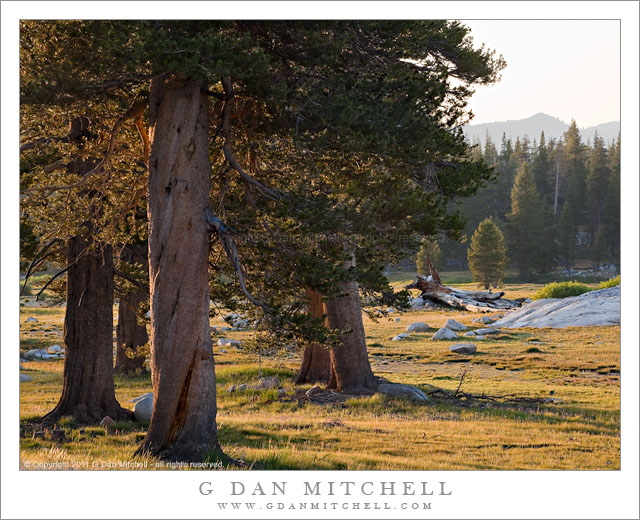
Tuolumne Meadows Trees, Sunset

Tuolumne Meadows Trees, Sunset. Yosemite National Park, California. July 27, 2010. © Copyright 2011 G Dan Mitchell – all rights reserved.

Trees standing at the edge of Tuolumne Meadows in sunset light, Yosemite National Park.

After first shooting in another location a few miles away late in the day – and being chased back to my car by the worst clouds of mosquitoes I have encountered in recent memory – I found myself with a bit of extra time at the start of the “golden hour,” so I headed up to Tuolumne to see what I could find involving trees and the meadows and perhaps some of the surrounding mountains as the day came to an end. It was not long before the light left the meadow when I arrived, so I kept my eyes open for any subject that might look good in this warm light. I spotted these trees right alongside the roadway, pulled over, set up my tripod, and made a few exposures just before the light started disappearing from the west end of the meadow.

To me, this image has virtually all of the elements that say “Tuolumne Meadows” – the scattered trees in the meadow, the golden evening light on the July grasses, rock outcroppings here and there, and the surrounding forest with higher peaks beyond.

G Dan Mitchell Photography
About | Flickr | Twitter | FacebookGoogle+ | 500px.com | LinkedIn | Email

Text, photographs, and other media are © Copyright G Dan Mitchell (or others when indicated) and are not in the public domain and may not be used on websites, blogs, or in other media without advance permission from G Dan Mitchell.

(Basic EXIF data may be available by “mousing over” large images in posts. Leave a comment if you want to know more.)

Fractured Granite Ledges

Fractured Granite Ledges

Fractured Granite Ledges. Yosemite National Park, California. July 27, 2011. © Copyright 2011 G Dan Mitchell – all rights reserved.

Exfoliated and fractured granite ledges form patterns in late afternoon light, Yosemite National Park.

While this particular spot happens to be in the neighborhood of Tenaya Creek, similar features may be found throughout Yosemite and in many other parts of the Sierra. These rocks have probably been eroded in just about every way possible. They have been broken away from the underlying rock via exfoliation. The area was obviously glaciated. No doubt freezing water helped to widen the patterns of cracks and break up the rocks.

I made the photograph in late afternoon light when the sun was just barely above a low ridge beyond the upper edge of the photograph. The zoom was cranked out as wide as it goes in order to capture a good width and density of these wonderfully broken up rocks and the trees and other plants that somehow manage to live on and among them.

G Dan Mitchell Photography
About | Flickr | Twitter | FacebookGoogle+ | 500px.com | LinkedIn | Email

Text, photographs, and other media are © Copyright G Dan Mitchell (or others when indicated) and are not in the public domain and may not be used on websites, blogs, or in other media without advance permission from G Dan Mitchell.

(Basic EXIF data may be available by “mousing over” large images in posts. Leave a comment if you want to know more.)