
Tag Archives: ridge

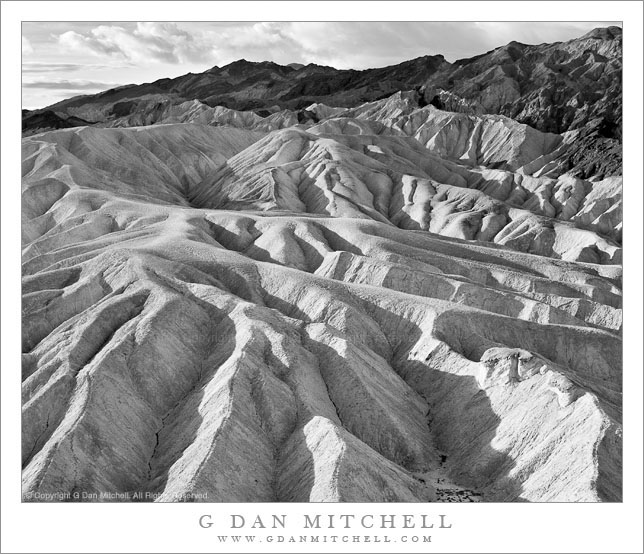
Eroded Gullies at Zabriskie Point, Morning

Eroded Gullies at Zabriskie Point, Morning

Eroded Gullies at Zabriskie Point, Morning. Death Valley National Park, California. April 6, 2006. © Copyright 2011 G Dan Mitchell – all rights reserved.

Low angle morning light illuminates a tortured landscape of eroded gullies at Zabriskie Point, Death Valley National Park.

I recently “rediscovered” this photograph while undertaking a major review of the past eight years of my raw files. (And, yes, that task is just about as much fun as you might imagine. It would actually be pretty unbearable except that every so often I find some photographs that I had perhaps forgotten or overlooked, and I also come across images that remind me of experiences that took place some time ago.)

This photograph was made, as virtually anyone who has visited the spot recognizes, by pointing my camera about 90 degrees to the left of the classic Zabriskie Point views. Timing was important, as the early light is just skimming across the tops of these tortuously eroded gullies, picking out the ridges between them but leaving the lower sections in shadow. But good fortune also played a role here. Death Valley is usually a clear blue sky kind of place, but on this morning I had clouds! At dawn, if I recall correctly, the clouds actually interfered with the light a bit. But as the sun rose the clouds provided a more dramatic background than plain blue sky and created some softer and diffused light that gave just the right sort of dynamic range for photographs.

On a technical note, if you are viewing this in the right web browser you can mouse over the image and see a summary of basic EXIF data. (Sorry, but this feature only works in web browsers – if you are viewing email, etc. you’ll need to visit the version at my blog to see the EXIF.) If you do check the EXIF you might notice that this photograph was made with a very humble example of photographic technology, the Canon Digital Rebel XT. This camera is a 8MP cropped sensor “consumer” camera that I acquired when I first tested the waters of DSLR photography. (I had actually used digital cameras back in the 1990s, but not for serious photographic work.) Those who wonder which of today’s current DSLRs might enable them to produce interesting and effective images might consider what could be done with such a humble camera. ;-)

G Dan Mitchell Photography
About | Flickr | Twitter | FacebookGoogle+ | 500px.com | LinkedIn | Email

Text, photographs, and other media are © Copyright G Dan Mitchell (or others when indicated) and are not in the public domain and may not be used on websites, blogs, or in other media without advance permission from G Dan Mitchell.

(Basic EXIF data may be available by “mousing over” large images in posts. Leave a comment if you want to know more.)
Owens Valley Sky

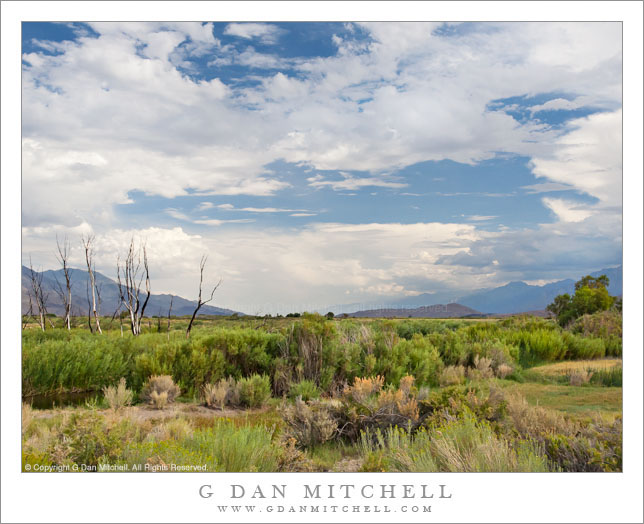
Owens Valley Sky
Owens Valley Sky

Owens Valley Sky. Owens Valley, California. August 6, 2005. © Copyright 2011 G Dan Mitchell – all rights reserved.

Dramatic thunderstorms begin to build above Owens Valley, flanked by the White Mountains and the eastern Sierra Nevada range.

If there is any good news about starting to run out of space on my hard drive, it might be that it encourages me to begin the process of reviewing my tens of thousands of archived raw image files, and that leads me to look through files that I haven’t revisited in a long time – and during this process I find photographs that I had forgotten about. Not only is it worthwhile to rediscover these photographs that ended up buried in the archive, but it is also a chance to recall some of the trips on which the photographs were made.

This photograph is yet another (of many!) that wouldn’t have happened at all if it were not for a whole unpredictable series of events and circumstances. I’ll make the story as short as I can, but it is still a bit involved. Almost every summer I share a long pack trip with a group of my friends. In 2005 we had come up with a 14-day trip along a good portion of the John Muir Trail between roughly the Ediza Lake area and Bishop Pass, which included one of the very few sections of the JMT that I had not hiked. We started at Agnew Meadow, headed up past Shadow Lake, turned south on the JMT, stopped at Reds Meadow, continued on to the Duck and Purple Lakes area… where I started to feel like I might be coming down with some sort of bug. Discretion being the better part of valor and all that, I decided that the prudent thing was to bail out of the trip and exit to Mammoth Lakes since the idea of getting sick on the fourth day of a 14-day hike with a large group was not appealing.

So I hiked out. Ironically, once I crossed the pass to head down to the Mammoth area, I recovered – but it was now too late to rejoin my group since they would be two days ahead of me on the trail at this point. Since I was back at my car now and feeling just fine I figured that I might as well do something else before heading home, so I decided to drive up into the White Mountains and visit the Bristlecone Pine forest. On the way back down from the Whites I just happened to pull out at this spot where the high desert terrain was extra green around a creek, on an afternoon when monsoon conditions were leading to a buildup of afternoon clouds above the Sierra, the Whites, and Owens Valley between the two ranges.

G Dan Mitchell Photography
About | Flickr | Twitter | FacebookGoogle+ | 500px.com | LinkedIn | Email

Text, photographs, and other media are © Copyright G Dan Mitchell (or others when indicated) and are not in the public domain and may not be used on websites, blogs, or in other media without advance permission from G Dan Mitchell.

(Basic EXIF data may be available by “mousing over” large images in posts. Leave a comment if you want to know more.)
Eastern Sierra Nevada Near June Lake

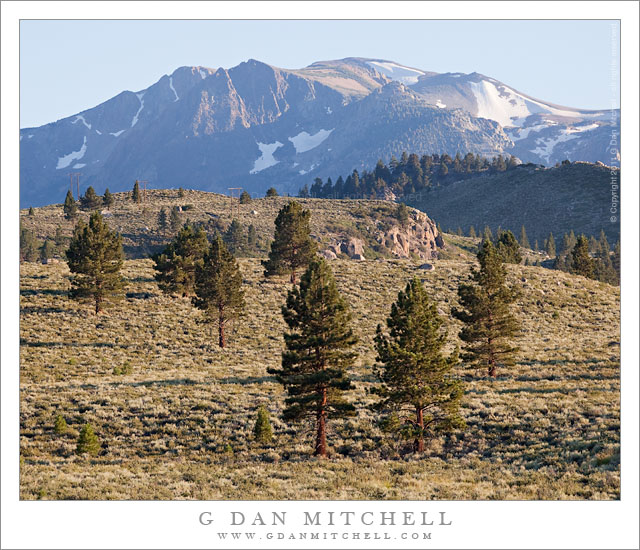
Eastern Sierra Nevada Near June Lake

Eastern Sierra Nevada Near June Lake. Mono County, California. August 10, 2011. © Copyright 2011 G Dan Mitchell – all rights reserved.

Trees ascend sage-covered hills toward the Sierra Nevada crest near June Lake, California.

Near highway 395 in Mono County, the main north-south route east of the Sierra crest, these open stands of large conifers ascend from the high desert sagebrush country towards the peaks of the Sierra crest, which rise much more abruptly on this side of the range than on the gentle west side. The tall ridge is above the June Lakes resort area between Mammoth Lakes and Lee Vining.

While my primary goal on this trip was to photograph in the Yosemite high country along Tioga Pass Road, smoke from a wildfire near Glacier Point in the park was drifting over the Tuolumne area and creating a lot of very non-photogenic haze. I had a hunch that by dropped over to the east side of the range I might be able to get away from the smoke or at least find areas where it wasn’t so thick. The smoke was still affecting the light near Lee Vining, but I didn’t have to drive too far south to get out of its path, though even here there is a bit of haze increasing the effect of atmospheric recession.

G Dan Mitchell Photography
About | Flickr | Twitter | FacebookGoogle+ | 500px.com | LinkedIn | Email

Text, photographs, and other media are © Copyright G Dan Mitchell (or others when indicated) and are not in the public domain and may not be used on websites, blogs, or in other media without advance permission from G Dan Mitchell.

(Basic EXIF data may be available by “mousing over” large images in posts. Leave a comment if you want to know more.)

Sunset and Moonrise, Kuna Crest

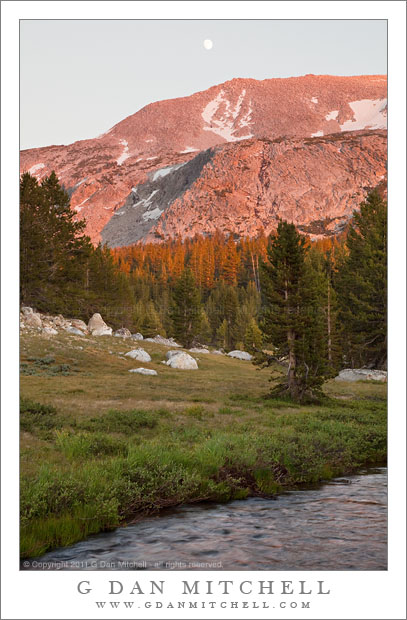
Sunset and Moonrise, Kuna Crest

Sunset and Moonrise, Kuna Crest. Yosemite National Park, California. August 10, 2010. © Copyright 2011 G Dan Mitchell – all rights reserved.

The nearly- full moon rises above the sunset light on Kuna Crest, Yosemite National Park.

Kuna Crest runs up Lyell Canyon between the Lyell and Dana forks of the Tuolumne River with the Sierra crest at one end and Mammoth Peak at the other. (Mammoth Peak is the large peak straight in front of you as you top Tioga Pass entering Yosemite National Park.) This ridge can catch great sunset light during the summer, and as I came down from the pass, heading back toward my camp at Porcupine Flat, and saw the almost full moon appearing over the shoulder of the ridge I decided to quickly stop and make a few exposures as the last light was about to leave the forest and soon after the peaks.

If you have tried photographing a scene that includes the moon in the early evening you know that the exposure is a tricky thing. The moon is lit by daylight, so it isn’t too surprising that the “correct” exposure for the moon is close to a normal daytime exposure. But that is not the right exposure for the rest of the scene, which turns out to be quite a bit darker than daylight at this time of day. In this scene things were even more complicates as the very saturated red colors on the ridge were quite “hot,” while the foreground meadow and forest was in shade and both darker and cooler in color. Basically, the dynamic range between the moon and the foreground was too large for a single exposure… so I made several.

At the time of exposure I thought that I might need as many as three component images in the final photograph – they would be one exposed for the bright ridge and sky, one exposed for the rather dark and shadowed foreground, and possibly a third that correctly exposed the moon. To be on the safe side I bracketed four exposures. When I began to work on the image I figured out that in this case I could construct a final “believable” image from two exposures if I was careful and could make some additional adjustments during post.

This is an example of a shot in which the use of a graduated neutral density filter could have been problematic, but where exposure blending could work very well. (“Exposure blending” is one term for the process of manually combining two component exposures using masked layers in Photoshop. No, it is not the same thing as HDR photography.) One of the things that would have been quite tricking using graduated neutral density filters is that the division between the brighter upper half and the darker lower half is not linear. Instead, the roughly follows the curved boundary between the lower meadow and dark trees and the still sunlit trees and the peak and sky.

G Dan Mitchell Photography
About | Flickr | Twitter | FacebookGoogle+ | 500px.com | LinkedIn | Email

Text, photographs, and other media are © Copyright G Dan Mitchell (or others when indicated) and are not in the public domain and may not be used on websites, blogs, or in other media without advance permission from G Dan Mitchell.

(Basic EXIF data may be available by “mousing over” large images in posts. Leave a comment if you want to know more.)