Tag Archives: sunset

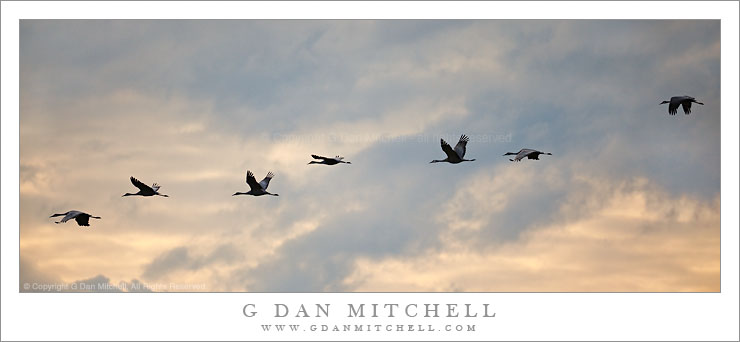
Seven Sandhill Cranes in Flight

Seven Sandhill Cranes in Flight

Seven Sandhill Cranes in Flight. Merced National Wildlife Reserve, California. February 21, 2011. © Copyright G Dan Mitchell – all rights reserved.

Panoramic photograph of seven sandhill cranes in flight above the Merced National Wildlife Area against a sky full of clearing evening storm clouds.

As I wrote when I posted the first in this series recently, on my return drive from Death Valley to the San Francisco Bay Area I realized that I had enough time to stop at the Merced National Wildlife Reserve just before sunset, so I altered my route so that I could drive out on Sandy Mush Road (I still love writing that road name!) to the Reserve and do a little bit of photography. Although I’ve done a bit of wildlife photography, it isn’t my main thing and this is the first year that I’ve headed out to the migratory bird areas of California’s Great Central Valley – so this is a relatively new experience for me.

I had seen video and photographs of the morning “fly out” and evening “fly in” at several locations in the Valley and was hoping that I might get to witness something like this. That didn’t happen, though at one point I saw and heard the event taking place at pond a ways north of the road I had stopped on. I’m getting the impression that this experiences probably requires some persistence and repeat visits. However, I did find a field that was filled with scores of sandhill cranes. I quietly stopped my car, grabbed the camera with a long lens, and got out on the side away from the field and watched quietly. Even these attempts at quiet weren’t enough as the birds began to edge a ways away from the roadside edge of the field before they quieted again and went about their business.

Before long a few small groups began to take flight. I was fortunate that a storm had just passed through and the remnant clouds were beginning to clear in the west, both providing a dramatic background in that direction and allowing a bit of colorful light to strike clouds directly above and to my east. This brings up an observation about photographing birds – admittedly from a photographer who isn’t quite an expert on this but who likes to try to learn… thinking about what is behind and around the birds is often as important as getting the birds themselves into the frame. I like to say that in this series I was thinking about the clouds almost as much as I was thinking about the birds. As I continue to practice and learn how to photograph these animals in flight, I find that I can begin to simultaneously think about keeping them framed in the viewfinder in interesting ways and remain aware of what else is in the frame as I pan.

Special thanks to my friend Tom Clifton for helping me identify some of the other birds I photographed on this visit.

G Dan Mitchell Photography | Flickr | Twitter | Facebook | Email
Text, photographs, and other media are © Copyright G Dan Mitchell (or others when indicated) and are not in the public domain and may not be used on websites, blogs, or in other media without advance permission from G Dan Mitchell.

Canon EOS 5D Mark II (at B&H)
Canon EF 100-400mm f/4.5-5.6 L IS USM at 400mm (at B&H)
ISO 400, f/5.6, 1/3200 second


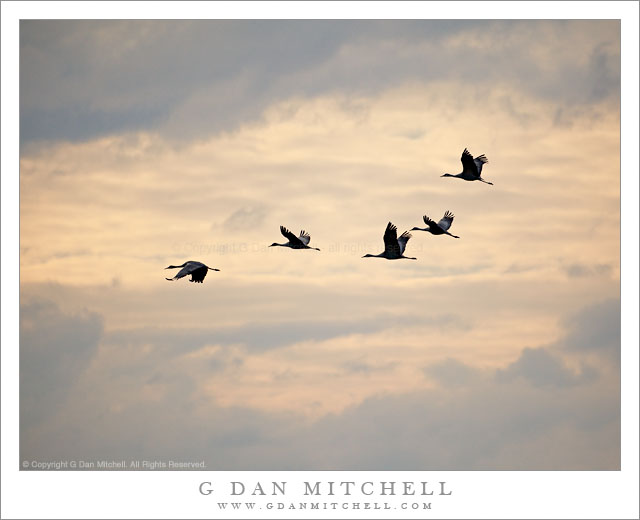
Sandhill Cranes in Flight, Evening

Sandhill Cranes in Flight, Evening

Sandhill Cranes in Flight, Evening. Merced National Wildlife Area, California. February 21, 2011. © Copyright G Dan Mitchell – all rights reserved.

Five sandhill cranes take flight above the Merced National Wildlife Area in evening light.

Migratory birds have always been a subject that I’ve been aware of, but that I haven’t really paid enough attention to. Intellectually I know of their amazing travels between arctic and more temperate regions and I had heard about their appearance in California each winter season. I recall one magical evening a few years back when I began a long drive from the San Francisco Bay Area to Seattle late on a winter day, and as I travelled up the Sacramento Valley at twilight I saw huge flocks of birds and thought that I’d like to try to photograph this scene. I’ve seen and photographed a few interesting birds such as egrets and pelicans. But I somehow managed to mostly remain uninformed about their presence not far from where I live.

This season several things came together, seemingly by chance, to encourage me to actually make the effort to get out into California’s Great Central Valley to see (and hear!) the birds. The first was a chance meeting with one of my colleagues in front of the college espresso stand one morning. We were having a casual conversation and she mentioned that she had been out in the Cosumnes River area looking for birds recently. We talked a bit more and I asked her for more information. Being a librarian, she provided me with lots of information, including details of how to find some interesting places out there. A day or two later I found my way out to that part of the Valley and saw, for the first time close-up, the flocks of winter birds… and I was hooked. Within a few weeks I saw posts on the Chuq 3.0 blog where Chuq wrote about his photography of these birds. Then I saw a couple videos at Michael Frye’s blog that captured the “fly in” and “fly out” phases at the Merced National Wildlife Area. (This place is located out on a road that has to have my all-time favorite Central Valley road name: Sandy Mush Road ;-)

Fast forward a week or two and I was returning from shooting for four days in Death Valley, and driving into the Central Valley near Bakersfield. I looked at my watch and realized that I could probably make a small detour and be at the Merced National Wildlife Area before sunset. So I headed up highway 99 (rather than the more usual route up highway 5), found the turn off to Sandy Mush Road, and arrived at the area an hour or so before sunset on an evening when the clouds from a departing cold front lingered. I basically had no idea where I was going, since I had done literally no prior research other than finding the location via my iPhone. As I arrived in the general area I found a large field filled with what seemed like several hundred sandhill cranes. Slowly and quietly I stopped my car and got out on the side away from the birds and began to watch. I never did get to see the fly-in up close (though I could see a huge cloud of birds landing at a pond north of my position) but some of these cranes did depart from time to time, and I was able to photograph this group of the magnificent birds against the clouds in the western sky.

G Dan Mitchell Photography | Flickr | Twitter | Facebook | Email
Text, photographs, and other media are © Copyright G Dan Mitchell (or others when indicated) and are not in the public domain and may not be used on websites, blogs, or in other media without advance permission from G Dan Mitchell.

Sunset Avalanche, Half Dome

Sunset Avalanche, Half Dome

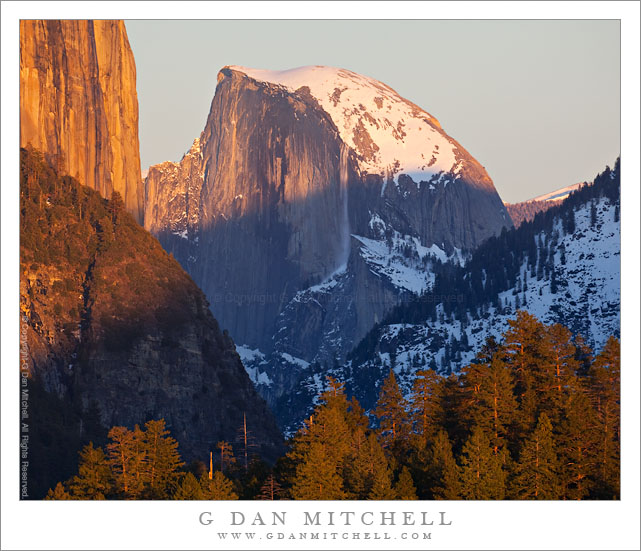
Sunset Avalanche, Half Dome. Yosemite National Park, California. January 16, 2011. © Copyright G Dan Mitchell – all rights reserved.

An avalanche breaks loose from the edge of Half Dome as sunset light falls over Yosemite Valley.

Sometimes timing is everything. But, to be honest, luck often plays a bigger part! :-)

On my way out of The Valley on a mid-January weekend, I made this spot my last stop, thinking that I wanted a photograph from this angle at sunset with snow on Half Dome. (I have a number of photographs of this location, but mostly from the warmer months of the year. ) I know this spot well enough at this point that I know pretty much exactly where to be and when to be there, and this was no exception. On the way up here I first stopped to photograph some trees on a ridge across the Valley, something I worked on more than once during this trip. When the last light left those trees I headed on up the road to this overlook and arrived perhaps a full half hour before the start of the real light show. I hung out a bit, ate a snack, and eventually set up.

I never know exactly what will happen here, believe it or not, even though I understand the process pretty well. The foreground right ridge first falls into shadow, then the shadow line begins to creep up toward the face of Half Dome and rise up the rocky slope in front of El Capitan at the left. But what the sky will do during this transition is quite variable. Sometimes the sunset simply dies out with a whimper. On other evenings the light goes through a remarkable sequence of transitions. That is what finally happened on this evening. Eventually I’ll share some of the other photographs from this evening, but for now I’ll just share a hint or two. The color of the sky behind Half Dome transitioned from blue to pink and purple and finally to a deep blue that verged on purple.

But the real surprise – and one I did not realize I had captured it until I got home and looked closely at my raw files – was that one of the images contained a sort of “Yosemite Fall” that I had never seen before, namely the “snow fall” created as a large piece of the snow field near the edge of Half Dome let loose after a day of warm sun and cascaded down the right face of the mountain… just as sunset light split the dome! I suppose this provides yet another opportunity to quote Ansel, who apparently once said, “Sometimes I do get to places just when God’s ready to have somebody click the shutter.”

This photograph is not in the public domain and may not be used on websites, blogs, or in other media without advance permission from G Dan Mitchell.

G Dan Mitchell Photography
FlickrTwitter (follow me) | Facebook (“Like” my page) | LinkedInEmail

Text, photographs, and other media are © Copyright G Dan Mitchell (or others when indicated) and are not in the public domain and may not be used on websites, blogs, or in other media without advance permission from G Dan Mitchell.


Twilight Surf

Twilight Surf
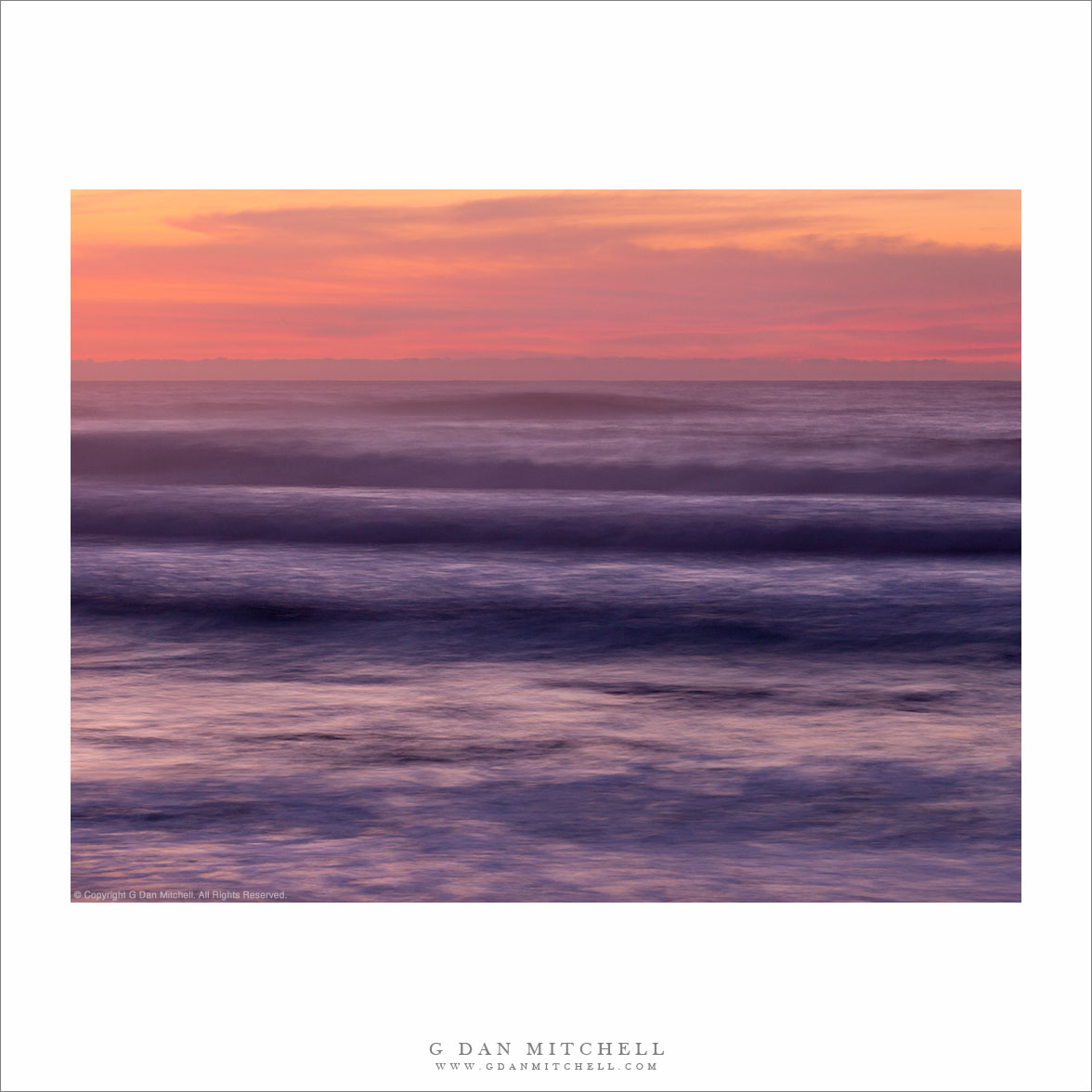
“Twilight Surf” — Long exposure of shoreline surf in twilight, Pacific Grove

Many times the most interesting late-day light comes after the sun set, and I have learned to stick around as long as I can in these situations. The colors can become more intense as the details become softer, especially when the low light allows me to use longer exposure times with moving subjects in the very low light. By the time I made this photograph my exposure time was up to four seconds. (Shortly after this it was too dark to continue shooting – I could hardly see my camera any more!)

This image falls into my “minimalist seascape” category, without any particular central subject – though there are some points in the scene that do, I think, draw a bit more attention. There is a certain element of chance in these photographs since, obviously, I cannot control the waves. However, by watching their patterns and thinking about how their sharply defined shapes might form more diffused shapes over the longer exposures, I can make some reasonable guesses about when to trip the shutter release. Besides the sky, there are three things in the water portion of this scene that “worked” for me: the single darker wave just below the horizon, the row of three parallel waves in the middle of the frame, and the blurred and reflective area closest to the shore.


G Dan Mitchell is a California photographer and visual opportunist. His book, “California’s Fall Color: A Photographer’s Guide to Autumn in the Sierra” (Heyday Books) is available directly from him.

G Dan Mitchell: Blog | Bluesky | Mastodon | Substack Notes | Flickr | Email


All media © Copyright G Dan Mitchell and others as indicated. Any use requires advance permission from G Dan Mitchell.