
Tag Archives: winter

Silhouettes, Flock of White Faced Ibises

Silhouettes, Flock of White Faced Ibises

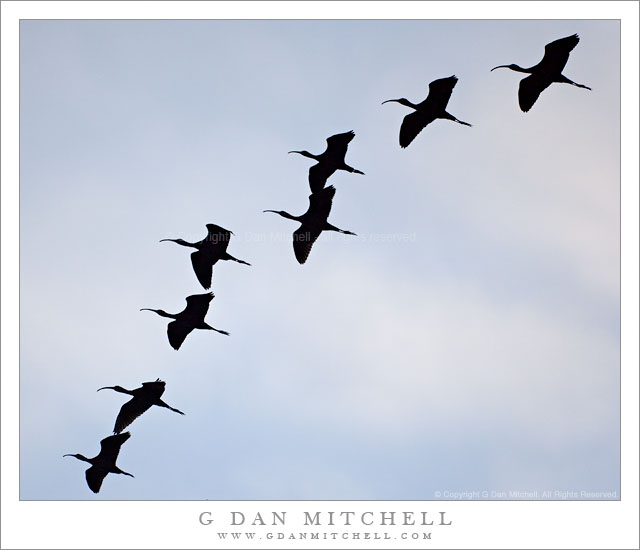
Silhouettes, Flock of White Faced Ibises. Merced National Wildlife Refuge, California. February 21, 2011. © Copyright G Dan Mitchell – all rights reserved.

A flock of white-faced ibises is silhouetted against evening blue sky and clouds above the Merced National Wildlife Refuge.

On this winter evening I visited, for the first time, the Merced National Wildlife Reserve on a detour I took while returning home from a few days photographing in Death Valley. This winter I have (finally!) started to become aware of the amazing annual influx of migratory birds in California’s Central Valley and I managed to get out there a couple of times to view and photograph the magnificent flocks of birds. Being new at this, I have been working at figuring out just how to photograph this subject, and I’ve come up with a few approaches that seem to work, though I have a lot to learn. In this case, I had figured out that if I just picked a spot and waited that eventually flocks would fly over my position, and that I would have a chance of photographing them against the evening sky and clouds. Being almost completely ignorant when it comes to identifying these birds – but no less impressed with them because of this – I had virtually no idea what I was photographing in the moment when I tracked the birds and made the exposures. In fact, it wasn’t until later that I noticed the wonderful curved bills of these birds and then found out from my friend Tom Clifton (who does know how to identify these critters) what they were.

As the birds approach I work to synchronize my camera motion with the speed and direction of their flight. I try to keep them in the frame, and preferably in the frame in a way that might create an interesting composition. And while I do that I try to keep some attention on the background against which they fly and some small remaining bit of my attention on the technical matter of keeping at least one of them under an autofocus point in the camera’s viewfinder. As a flock approaches, things seem to start out fairly slowly and it may seem like the birds are taking a long time to arrive. But as they get closer – especially when shooting with a 400mm focal length and double-especially when they are as close as this flock – the action speeds up, and as they pass overhead it is all I can do to keep them centered in the viewfinder as I let the camera’s burst mode do its job at the right moment.

There are things about the experience that the camera cannot capture. The cold and damp of a Central Valley winter evening might be evoked by the right sort of landscape photograph, but not by a photograph like this one – yet this is an integral part of the experience. Even more than that, the sound of these birds, alone or in huge groups, sticks in my mind as much or more than the visual image. If you have been there and heard it, perhaps a photograph may cause you to recall it.

G Dan Mitchell Photography | Flickr | Twitter | Facebook | Email
Text, photographs, and other media are © Copyright G Dan Mitchell (or others when indicated) and are not in the public domain and may not be used on websites, blogs, or in other media without advance permission from G Dan Mitchell.
Last Light on Desert Plants, Death Valley

Last Light on Desert Plants, Death Valley

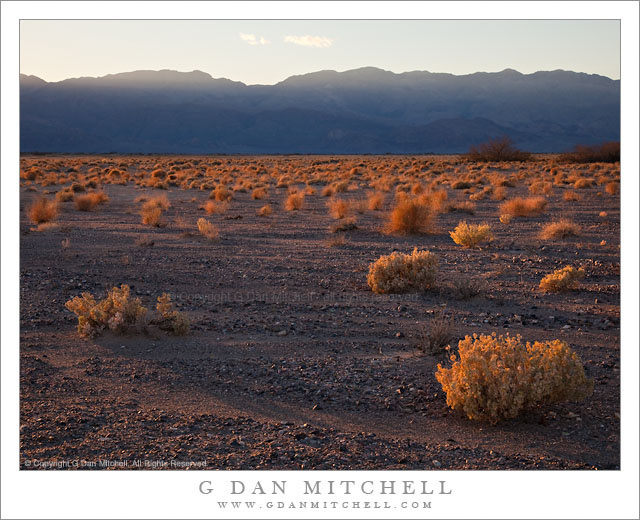
Last Light on Desert Plants, Death Valley. Death Valley National Park, California. February 20, 2011. © Copyright G Dan Mitchell – all rights reserved.

The last light of a winter day lights the plants at the edge of a wash in Death Valley National Park, California.

On this afternoon I drove a bit up the east side of the Valley past the turnoff to Beatty looking for subjects to shoot along the hills that parallel the valley. I did not initially have a specific shot in mind, since this isn’t an area that I know very well – I’ve mostly driven past it on my way to some other place. I was generally thinking of a couple of possibilities. One was an early evening photograph looking up into one of the very large canyons, probably include the massive washes that spill out of them and aiming for a very rugged looking image. I looked for a few such places and played around a bit with the idea of shooting one or two, but it wasn’t quite working for me.

I have included some low hills along this area called, I believe, the Kit Fox Hills, in some photographs that I have made of this area from way over near Mesquite Dunes. These hills which sit just above the road toward Scotty’s Castle have intrigued me, so I had also looked at them. As I passed them earlier in the afternoon I made a mental note to come back and check out one particular spot in better light, and when the canyon idea didn’t seem to work out I decided to head back there. I was probably a bit late in settling on this subject, but I arrived while the sun was still (just barely) above the tops of the ridges on the opposite side of the Valley. I grabbed equipment and went to a spot where I thought I could use a particular mesquite plant as foreground to a shot of these low hills, but then this backlit expanse of the floor of the Valley filled with these small, rugged plants caught my attention. I decide to photograph them before turning my attention back to the mesquite and hills. As I shot a few frames the sun began to drop behind the far hills much sooner than I expected, and this was close to the last photograph I made before I was in shadow.

All seriousness aside, someone just suggested that an alternate title for this photograph might be “Sea of Tribbles!” ;-)

G Dan Mitchell Photography | Flickr | Twitter | Facebook | Email
Text, photographs, and other media are © Copyright G Dan Mitchell (or others when indicated) and are not in the public domain and may not be used on websites, blogs, or in other media without advance permission from G Dan Mitchell.
Two Sandhill Cranes, Winter Sky

Two Sandhill Cranes, Winter Sky

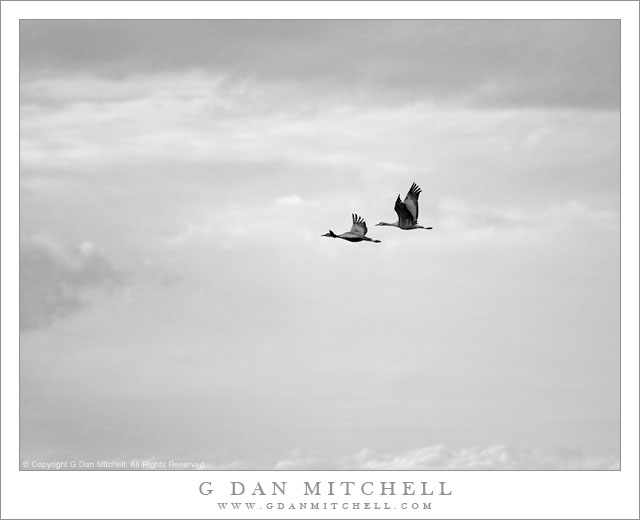
Two Sandhill Cranes, Winter Sky. Merced National Wildlife Reserve, California. February 21, 2011.© Copyright G Dan Mitchell – all rights reserved.

Black and white photograph of two sandhill cranes taking to the air against a cloud-filled winter sky above the Merced National Wildlife Reserve.

This is another photograph from my detour to the Merced National Wildlife Reserve as I returned from my February trip to Death Valley. I arrived late in the day as a winter storm was just beginning to clear, and at times the migratory birds flew in front of a cloud-filled sky that ranged from dark and ominous to being colorfully lit by sunset light.

I chose to render this photograph in black and white for several reasons. First, to be quite honest, I wasn’t very fond of the particular coloration of the clouds behind these birds! However, in black and white the shapes and glowing quality of the sky seem to work better in this case. And from this distance the sandhill cranes’ coloration is subtle enough that I don’t feel that much is lost by going to monochrome.

I think I have mentioned earlier that when I photograph birds like these in flight I try to keep my eye not only on the birds but also on the background. I don’t have any control at all over what appears behind them, but I do have control over when I press the shutter – and as they pass in front of clouds and other background elements I try to time shots to place the birds in interesting compositions relative to these subjects. Every so often I like to think that I actually succeed! :-)

G Dan Mitchell Photography | Flickr | Twitter | Facebook | Email
Text, photographs, and other media are © Copyright G Dan Mitchell (or others when indicated) and are not in the public domain and may not be used on websites, blogs, or in other media without advance permission from G Dan Mitchell.

Desert Pool, Panamint Range, Morning

Desert Pool, Panamint Range, Morning

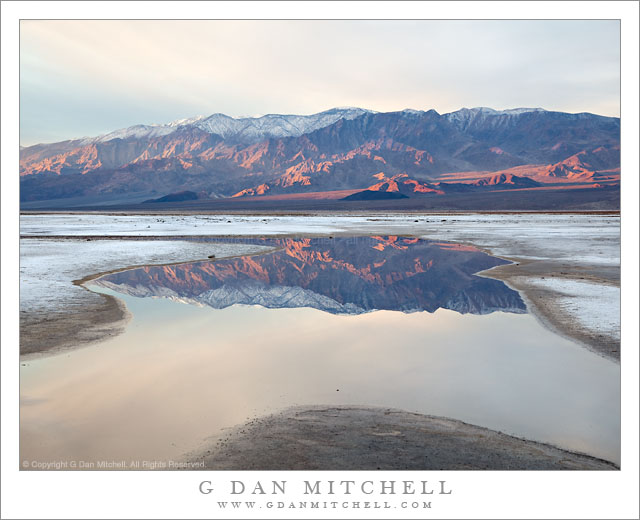
Desert Pool, Panamint Range, Morning. Death Valley National Park, California. February 21, 2011. © Copyright G Dan Mitchell – all rights reserved.

A salt spring pool on the salt flats in Death Valley reflects winter dawn light on the east face of the Panamint Range.

Sometimes I hear people describe how they think or imagine that landscape photography is done, and I wonder where they get their ideas. I will acknowledge that there are many ways to shoot landscape, ranging from working very slowly and carefully to produce a single image, to shooting like crazy and seeing what you end up with. But often people dismiss approaches closer to the latter and assume that the former is the “right way” to shoot landscape.

In my experience it isn’t quite that simple. Sometimes the experience is like certain others in which long stretches of time during which one seemingly accomplishes nothing or perhaps just looks and thinks are suddenly followed by quick and intense spurts of work that come almost as a surprise and may be over as quickly as they begin. This little morning shoot in Death Valley along the edge of a the salt/mud flats where the water from a small salt spring spreads across the flats and forms shallow pools was one of these. Very early in the morning, well before dawn, it was difficult to know what the best shooting option might be. There were clouds in the sky that promised to block the dawn light and everything seemed gray and flat. I wandered a bit, not sure where or what to shoot, and finally, more or less by chance, ended up at this spot that I had visited earlier on this trip. It occurred to me that even if the light wasn’t great I could possibly find a photograph that included this water. So I stopped and began to unpack in no particular hurry.

As I walked across the wash toward the area of the spring, much to my surprise it began to appear that there might be some interesting dawn light after all. I quickened my pace and headed toward the area of the shallow pools, and when I arrived there a moment later I could see some color on the top of the Panamint range. I quickly found a decent foreground pool and as the surprising light worked its way down the front of the range I began photographing. I first made several exposures at much shorter focal lengths, including a larger portion of the sky and the foreground. Then I quickly moved the tripod to place this pool in the center of the frame and hold the reflection of the range. I had little time to contemplate as the light was changing very quickly. I had just enough time to find my composition and make a few exposures, and within moments the light was gone.

G Dan Mitchell Photography | Flickr | Twitter | Facebook | Email
Text, photographs, and other media are © Copyright G Dan Mitchell (or others when indicated) and are not in the public domain and may not be used on websites, blogs, or in other media without advance permission from G Dan Mitchell.