Images

Three Parisiens

Three Parisiens
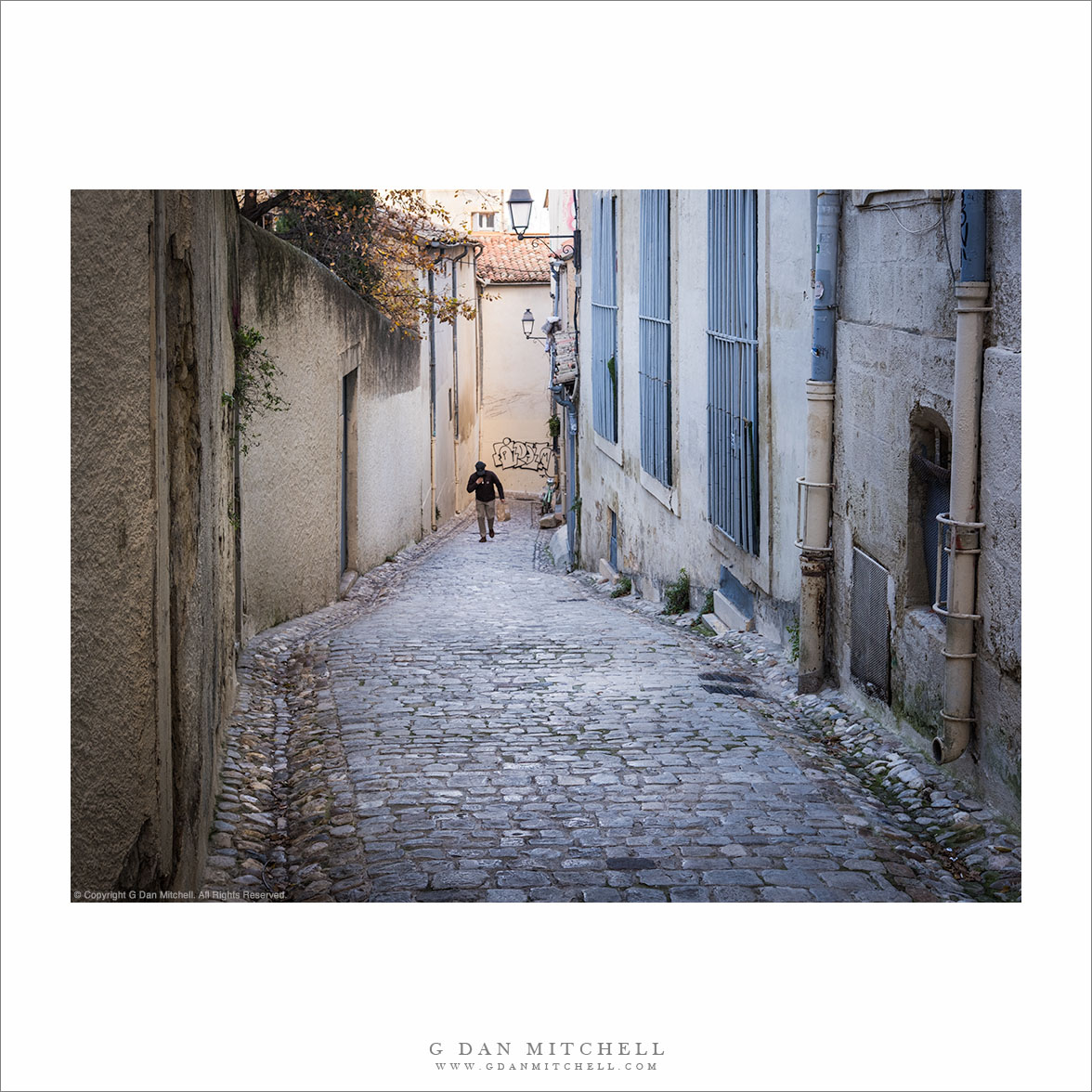
“Three Parisiens” — Three people walk along a street in Le Marais, Paris.

There is a story about this wall that I’ll share in the second paragraph. The photograph comes from the Le Marais district of Paris, where we were out for a walk in early December. It uses one of the classic approaches to street photography, namely finding an interesting street landscape and waiting for people to walk into the frame and populate it. This can lead to a lot of photos of the sides of people, but here it helps that the person in the lead has glanced in my direction.

About that story… This wall is the location of one of my favorite photographs that I have made in Paris. It features three (likely related) women in front of this wall… back when it was covered by some fascinating street art. (You can find the photo by searching for “je suis bleu” on my website.) This reinforces how transitory street subjects can be. Not only do people come and go, forming visual relationships that may last only an instant, but the street landscape itself changes over the seasons.


G Dan Mitchell is a California photographer and visual opportunist. His book, “California’s Fall Color: A Photographer’s Guide to Autumn in the Sierra” (Heyday Books) is available directly from him.

G Dan Mitchell: Blog | Bluesky | Mastodon | Substack Notes | Flickr | Email


All media © Copyright G Dan Mitchell and others as indicated. Any use requires advance permission from G Dan Mitchell.

Reader Question: Fujifilm X100vi, XPro2, or…

From time to time folks contact me with photography questions. If the question seems like it might be of interest others I like to answer here. Today I will respond to one of those questions.

“PJ” writes:

I mentioned that I’ve followed you on the FM site and have had a look at your website. 

I know you are/were a big fan of the X-Pro2. I have one with a 35mm f1.4 which I use to toss in the backpack or take on a walk around town. For heavy lifting, I have a full set of Nikon gear. 

I may have a case of GAS, as I’ve been seriously considering replacing the X-pro with a Fuji x100vi. Advantages seem to be a smaller, lighter camera, 40mp sensor, IBIS and newer technology. I guess I could get a pancake lens for the x-pro to make it smaller but I’d lose some of the advantages of the x100vi.  I’m not so interested in a new camera with interchangeable lenses, which would rule out some of the other Fuji offerings. 

My original message to you was to pick your brain and see what suggestions/advice you might have and if you have any opinions on the x100vi. 

Look forward to hearing back from you. 

I’m glad to share some thoughts on that question, PJ.

Bottom Line Up Front

The Fujifilm X100vi is a very attractive camera, as long as its pluses and minuses align with your needs and expectations — and it has technologies found in other newer Fujiflm cameras. The X-Pro2, though a few ears old, is arguably the best camera in Fujfilm’s X-Pro series and is more adaptable. There are also some other options if you want something the same size with updated features and flexibility.

A Slightly Longer Summary

As I see it, there are three options, each with its own set of pluses and minuses.

The X-Pro2 is still a good camera. While its sensor is a bit older and has less resolution, my experience tells me that it can make great 20″ x 30″ prints. It is a full-featured camera that accepts interchangeable lenses, giving more options if you want to use something other than (or in addition to) your current 35mm f/1.4 lens.

The X100vi is an appealing camera that strikes a chord with users who like the old fixed-lens, manual control aesthetic and appreciate its small size and very good image quality. It also has image stabilization, which can help when shooting with longer shutter speeds in low light. It has been updated with other newer Fujifilm features and technologies: 40MP sensor, IBIS, and other functional improvements. To get those things you sacrifice some flexibility.

Other cameras could be good compromises, too. I like the XT5 with its small size (about that of the X-Pro2), ability to use any Fujifilm lens, upgraded 40MP sensor, image stabilization, and other functional improvements. The tiny XE4 (if you can find one!) equipped with the 27mm f/2.8 pancake lens is as small and light as the X100vi, and it accommodates any Fujifilm lens.

All of these are attractive options that can make fine photographs. The trick is matching each option’s pluses and minuses to your own circumstances. (My choice was to move from the X-Pro2 to the XT5 for the higher-resolution, small size, access to more lens options and various other improvements.)

The Full Story

This will be a bit long. The question opens up related questions: is a fixed lens camera the right thing? Is an older camera still sufficient? Are there alternatives to both of those options to consider?

I’ll start with some background for readers who may not be as familiar with these cameras as PJ is.

Continue reading Reader Question: Fujifilm X100vi, XPro2, or…

At the Edge of the Salt Flats

At the Edge of the Salt Flats, Death Valley National Park.
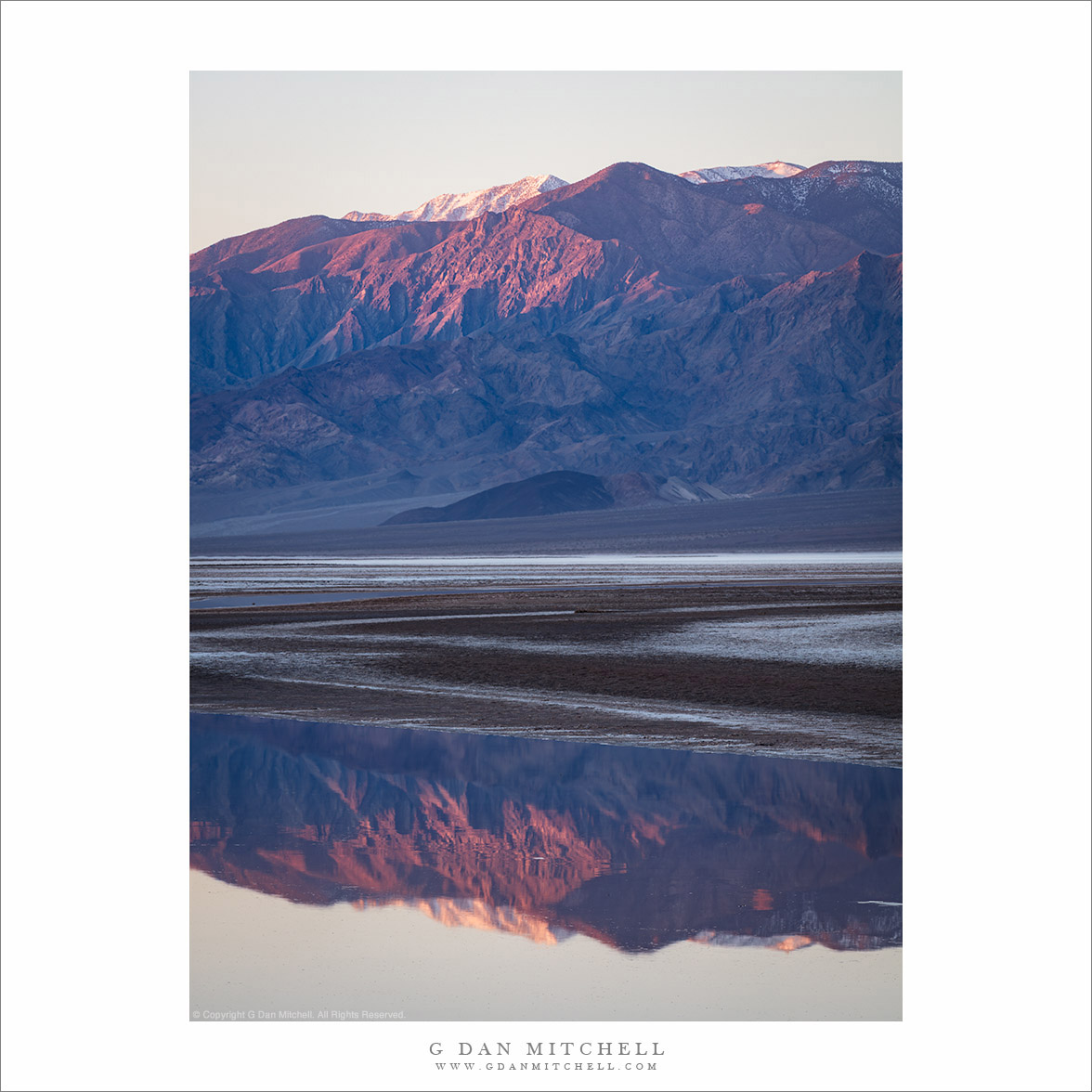
“At the Edge of the Salt Flats” — Panamint mountains tower above as a small wash runs to the edge of the salt flats, Death Valley.

During my late-February visit to Death Valley National Park I spent two early mornings photographing this location. It is generally most interesting at dawn, when the morning light shines on the distant Panamint Mountains, so I was there well before sunrise. In order to find ideal locations here you really have to scout ahead of time. On the first of the two visits I slightly missed my target location in the darkness. I still got photographs, but before my return on the last morning of my trip, I checked it one more time and determined that following this runoff gully would get me where I needed to be.

There was another benefit from following the little gully. The soil on the higher ground to either side is quite soft and walking on it leaves obvious footprints. In many places the bottom of the gully is covered with small rocks, and it is easier (on me and the landscape1) to walk on this harder surface. Distances here are deceiving. If you started at sunrise (and could find a route) it would take you an entire, long day just to get the base of those mountains.


G Dan Mitchell is a California photographer and visual opportunist. His book, “California’s Fall Color: A Photographer’s Guide to Autumn in the Sierra” (Heyday Books) is available directly from him.

G Dan Mitchell: Blog | Bluesky | Mastodon | Substack Notes | Flickr | Email


All media © Copyright G Dan Mitchell and others as indicated. Any use requires advance permission from G Dan Mitchell.

Adriatic Coast, Dubrovnik

Adriatic Coast, Dubrovnik
“Adriatic Coast, Dubrovnik” — dubrovnik, Croatia and its famous wall on the Adriatic coast, see from Fort Lovrijenac.

During the summer of 2023 we went on a very long trip in Europe. Over a 10-week period we were in France, Portugal, Spain, Italy, Kosovo, and Croatia — with very brief visits/transits in Germany, Hungary, Serbia, Albania, and Montenegro. Many of the photographs from the trip sat in my raw file archive since then, never being worked up into final versions. (I suspect that in some cases I didn’t quite “see” them at first, and in some I moved on to other projects, intending to return.) This week I’ve been going through photographs from the Balkans.

We drove directly from Kosovo to Dubrovnik. I really liked Kosovo on a number of levels, perhaps more so because we stayed in the home of people who live there and who have a family connection. But there are few contrasts greater than that between Kosovo and the walled city of Dubrovnik, which has become quite the hot travel destination. (Evidence: many prices there are surprisingly close to those in the US.) Dubrovnik is a remarkable city, sitting on the beautiful Adriatic coast. The old city is completely surrounded by impressive walls, and much of the city is constructed of stone.


G Dan Mitchell is a California photographer and visual opportunist. His book, “California’s Fall Color: A Photographer’s Guide to Autumn in the Sierra” (Heyday Books) is available directly from him.

G Dan Mitchell: Blog | Bluesky | Mastodon | Substack Notes | Flickr | Email


All media © Copyright G Dan Mitchell and others as indicated. Any use requires advance permission from G Dan Mitchell.