
Tag Archives: ridge

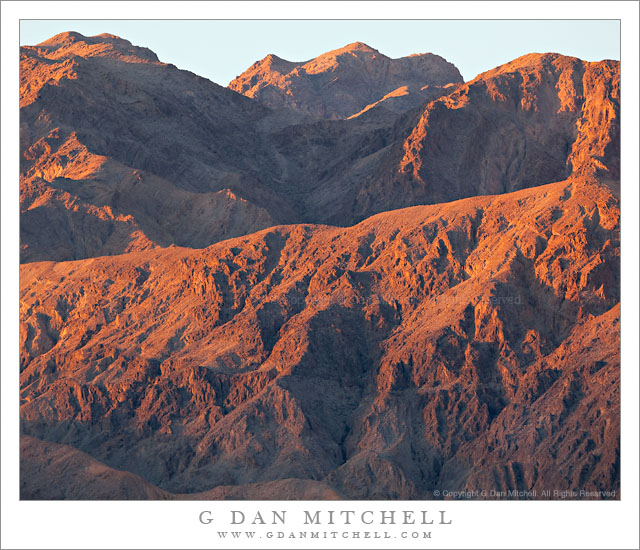
Red Cliffs, Dawn

Red Cliffs, Dawn
Red Cliffs, Dawn

The Red Cliffs (also called the “Red Cathedral”) are close to the famous spire of Manly Beacon at Zabriskie Point, and off the right a bit from the typical vantage points. The light was quite special – at least when not blocked by the clouds! – on this morning. These interesting clouds against the pastel blue sky first caught my attention, and were actually my primary interest in making this photograph. While the early light was on the clouds, some soft light also filtered through low clouds to the east and created a subtle glow on the face of this feature.

The Red Cliffs are really an amazing feature, though are often overlooked in favor of the more prominent and iconic Manly Beacon. The cliffs can often can be difficult to photograph – at least for me! When more direct light hits them the large dynamic contrasts between the areas in the light and the much darker shadows are tricky to handle, so this cloud-softened light seemed like just the right thing.

And, yes, I was at Zabriskie Point. It is a long story, but I have mentioned before that I have a personal project to photograph things other than the iconic scenes of Zabriskie. (Which is not to say that I won’t point my camera at those while I’m there it it turns out to be worth it!)


Leave a comment or question using the form. (If you are reading this on the home page, click the article title to see the full article and the comment form.

G Dan Mitchell is a California photographer and visual opportunist. His book, “California’s Fall Color: A Photographer’s Guide to Autumn in the Sierra” (Heyday Books) is available directly from him. Blog | Bluesky | Mastodon | Substack Notes | Flickr | Email

All media © Copyright G Dan Mitchell and others.

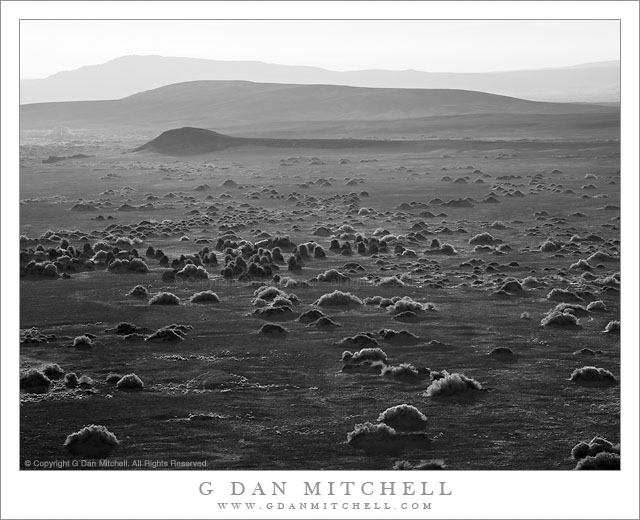
Mesquite Dunes and Cottonwood Mountains, Morning

Mesquite Dunes and Cottonwood Mountains, Morning

Mesquite Dunes and Cottonwood Mountains, Morning. Death Valley National Park, California. March 31, 2011. © Copyright G Dan Mitchell – all rights reserved.

Early morning light on Mesquite Dunes and the Cottonwood Mountains, Death Valley National Park.

This is one of the images I had in mind on the most recent late-March trip to Death Valley. When I visited earlier this year in February I started thinking about photographing the dawn light on the lower slopes of the Cottonwood Mountains along the west side of upper Death Valley. I had (and still have!) in mind several locations from which to explore this interesting terrain and light, but among them were a few that placed the Mesquite Dunes (a.k.a. “Death Valley Dunes”) in the foreground. (Why didn’t I shoot this subject back in February, you ask? The weather did not cooperate! There was rarely good light in the morning and, in fact, I had to deal with rain and snow on that visit!)

Besides finding a location from which to line up the elements of the shot, the other keys are having a long enough lens and, well, being there at the right time! And, as I was reminded in February, a bit of luck with the weather doesn’t hurt either. Although it had snowed and rained right before my arrival on this visit, this time the weather ended up being clear for the most part and was even turning downright hot by the time I left later on the day that this photograph was made.

G Dan Mitchell Photography | Flickr | Twitter | Facebook | Email
Text, photographs, and other media are © Copyright G Dan Mitchell (or others when indicated) and are not in the public domain and may not be used on websites, blogs, or in other media without advance permission from G Dan Mitchell.
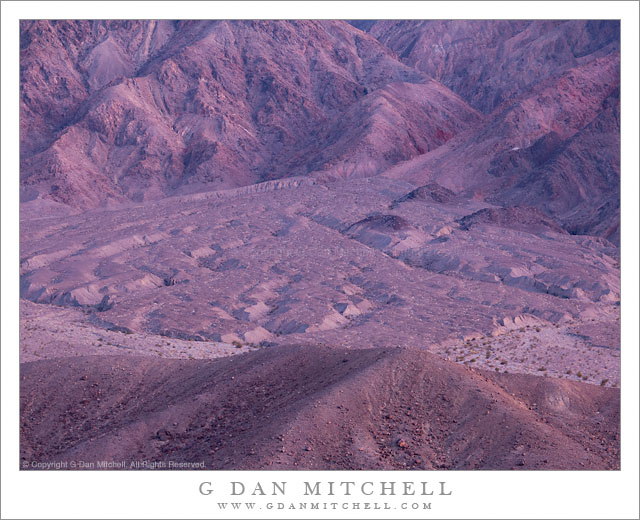
Dawn Light, Base of the Cottonwood Mountains

Dawn Light, Base of the Cottonwood Mountains

Dawn Light, Base of the Cottonwood Mountains. Death Valley National Park, California. March 29, 2011. © Copyright G Dan Mitchell – all rights reserved.

Dawn light on the based of the Cottonwood Mountains at the edge of Death Valley.

This is (yet another) one of those photographs that is the result of some odd combination of “planning” and serendipity. When I travel somewhere to do photography I often, though not always, have some ideas about certain types of subjects I would like to photograph or about ways I’d like to photograph them. On this visit to Death Valley I had a few such ideas in mind – one of them had to do with scenes that filled the frame with the rugged and forbidding and seemingly lifeless mountains and valleys and ridges of the place. Another had to do with photographing in the early light along the west side of the Valley, something I thought about but didn’t really try on my previous visit. This photograph and a few others like grew out of those ideas.

On the other hand, I wouldn’t have been in this spot at this moment if I had not had an electrical problem with my car! The night before I had returned to the campground from a bit of late shooting, parked the car, and went about my “camp business” before crawling into the tent and setting my alarm for an appropriate pre-dawn hour so that I could arrive at a particular location before the sun came up. The alarm went off at the appointed time, and a few minutes later I emerged from my tent and got into my car. It wouldn’t start. I soon realized that the car was electrically “dead” – no interior lights, etc. Since it was still completely dark, the idea of doing auto repair outside the tents and RVs of lots of other sleeping campers was out of the question, so I went back into my tent and speculated uncomfortably about the potential costs of towing and automobile repair in Death Valley.

Later, as the sky began to lighten, I heard other campers stirring. I got up – again – and opened the engine compartment to find that one of the battery cables had come off, perhaps as I drove a rather rough road the previous day! Relieved to find that this was something that I could fix, I reattached the cable, quickly got in the car, and figured I would see what I could salvage of the morning shoot. I headed west across the Valley toward Towne Pass, thinking about photographing some snow that was high on the ridge. As I drove I saw that the first light had still not quite reached the Valley floor along the base of the Cottonwood Range. I quickly found a slight rise along the road where the view wasn’t obstructed by desert plants, pulled over, put on the long lens, and made a few photographs as this beautiful light worked its way down the face of the range and began to work its way out across the giant wash along the edge of the Valley.

G Dan Mitchell Photography | Flickr | Twitter | Facebook | Email
Text, photographs, and other media are © Copyright G Dan Mitchell (or others when indicated) and are not in the public domain and may not be used on websites, blogs, or in other media without advance permission from G Dan Mitchell.
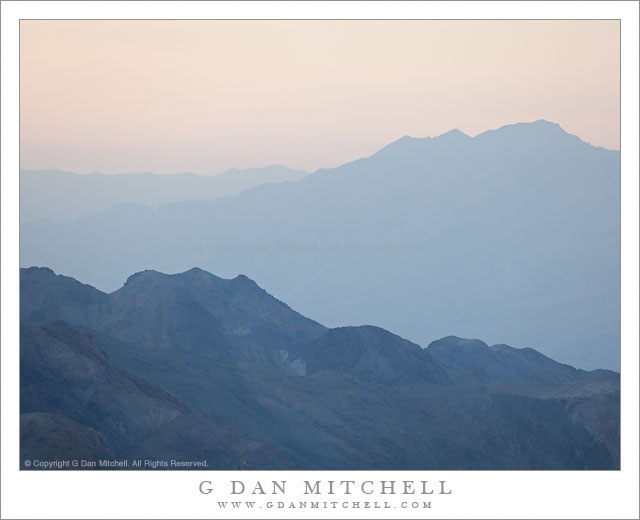
From the Panamints to the Sierra, Evening

From the Panamints to the Sierra, Evening

From the Panamints to the Sierra, Evening. Death Valley National Park, California. March 30, 2011. © Copyright G Dan Mitchell – all rights reserved.

The Sierra Nevada in evening light as seen from Aguereberry Point in Death Valley National Park’s Panamint Range.

I made this photograph from Aguereberry Point shortly before sunset. Aguereberry Point is a lonely prominence over 6000′ above Death Valley, high in the Panamint Mountain range, a place of astonishing panoramic views – and often some significant winds. As I drove the gravel road to the point late in the afternoon I saw three or four other vehicles heading the other direction, but when I arrived at the point a bit more than an hour before sunset no one else was there.

Having photographed here a few times previously, I am becoming more familiar with the challenges and the opportunities of shooting here. One of the challenges – as is the case in many spots in Death Valley – is that certain subjects seem to be “photographable” at very specific times and only for short intervals. One of the most interesting views from Aguereberry is southeast down into Trail Canyon and on to the lower slopes of Wildrose Peak beyond. This is wild, rugged, austere terrain. However, because it lies on the east side of this range the light changes quickly from a washed out blast of daytime sun to sudden deep shadows as the sun drops behind the higher ridges of the Panamints. (Trail Canyon is not seen in this photograph.)

Another challenge is that, impressive and overwhelming as the scale of this grand scene is, it can be difficult to pull interesting compositions out of it. I tend to work with longer lenses here, both to isolate smaller areas out of the huge landscape and to compress distance. In this photograph, the silhouetted crest of the highest part of the Sierra Nevada range is on the horizon, with the intervening ridges of the Panamint Range and others probably including the Inyo Mountains and the ridge just west of Panamint Valley.

And, since I tend towards those large and long lenses… wind is an issue! And on top of Aguereberry Point there is nothing to stop the often strong winds of Death Valley. On this evening the winds were howling, so I found a spot below some rocks where it was a bit less windy and then spent a lot time waiting for momentary lulls in the wind when I could make photographs.

G Dan Mitchell Photography | Flickr | Twitter | Facebook | Email
Text, photographs, and other media are © Copyright G Dan Mitchell (or others when indicated) and are not in the public domain and may not be used on websites, blogs, or in other media without advance permission from G Dan Mitchell.