
Tag Archives: rocks

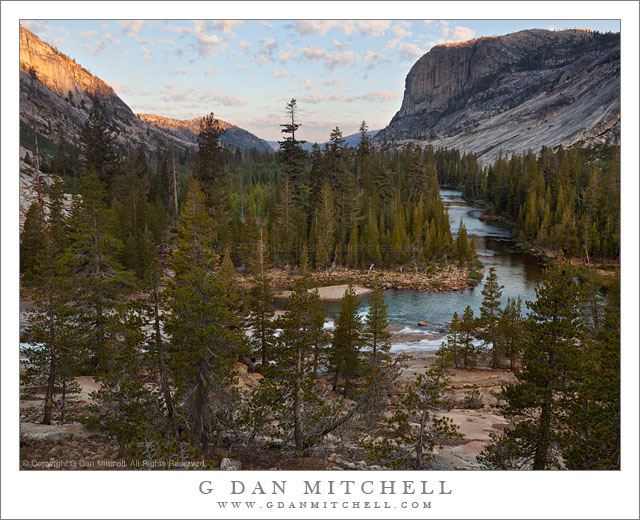
Tuolumne River Below Glen Aulin, Morning

Tuolumne River Below Glen Aulin, Morning

Tuolumne River Below Glen Aulin, Morning. Yosemite National Park, California. September 16,2011. © Copyright 2011 G Dan Mitchell – all rights reserved.

Early light on morning clouds above the Tuolumne River Canyon below Glen Aulin, Yosemite National Park.

This is the same bend in the Tuolumne River, located below Glen Aulin and before the river descends toward Waterwheel Falls and eventually the abomination of Hetch Hetchy Reservoir, that was shown in a photograph of late afternoon light that I posted here a few days ago. This time it was early morning. We had been up well before sunrise and had wandered off in various directions to find early morning photographic subjects. My main goals were the cascading water along the edge of this section of the river (a bit of which is visible in the lower portion of the frame) and a granite bowl to the right of this view. As I came over the rise above this area before descending I saw the beautiful sparse clods to the west, probably extending to the edge of the Sierra and still with pastel colors from dawn light.

A technical observation about this photograph. This scene presented a technical challenge in the form of an extremely wide dynamic range between the bright and red-saturated first direct sunlight on the ridge at upper left and the much darker areas of forest in shade along the river and in the foreground. With a digital exposure, in a scene like this one, the primary rule for me is “don’t blow out the highlights.” If I had overexposed the sky the clouds would have turned into pure white, texture-free blotches and that bit of early sun on the rocks would have lost detail and taken on a very strange coloration. However, an exposure that protects the highlights in a scene like this one can leave the shadows nearly black. While it is possible to “fix” that a bit in post, the result is not necessarily very good when the dynamic range is very large. One “traditional” solution would have been to use a graduated neutral density filter (or “GND”) that blocked some of the brightest areas at the top of the frame while not affecting the lower 2/3 or so. But I don’t use them, and in this case the result would not have been totally wonderful since the same filtering that would reduce sky brightness would also make the large granite dome at the right end up nearly black at the top.

So instead of filtering at the time of exposure, I decided that I would use the roughly comparable, but more flexible, “exposure blending” techniques in post. With that in mind I made several photographs at different exposures – some at shorter shutter speeds to avoid the blown out highlights and others at increasingly slower shutter speeds to reveal the shadow detail that my eyes could see but which the camera otherwise could not. During the post-production phase, I selected two of the exposures, one that was as bright as possible but without blowing out the sky and sunlight, and the other two stops lighter to reveal that shadow detail in a way that seemed consistent with what I recall the scene actually looked like. The two source images were carefully adjusted during raw conversion and their two layers carefully aligned. With the darker image (the one with the “good” sky) on the top, I began to “paint” out the mask to reveal the details of the foreground forest, river, and rocks. (In answer to the expected question, this is not the same as HDR. That is a more or less automated process that works in a different way. Exposure blending is typically a manual process that relies a great deal on the photographers judgment and recall of the actual scene.)

G Dan Mitchell is a California photographer whose subjects include the Pacific coast, redwood forests, central California oak/grasslands, the Sierra Nevada, California deserts, urban landscapes, night photography, and more.
Blog | About | Flickr | Twitter | FacebookGoogle+ | 500px.com | LinkedIn | Email

Text, photographs, and other media are © Copyright G Dan Mitchell (or others when indicated) and are not in the public domain and may not be used on websites, blogs, or in other media without advance permission from G Dan Mitchell.
Trees and Granite Bowl

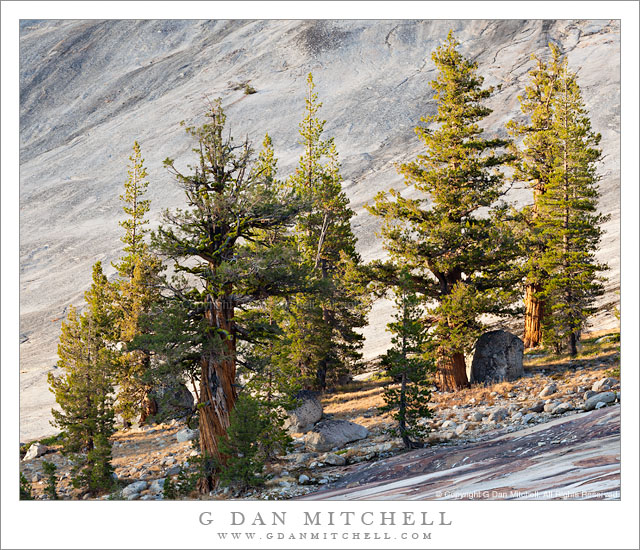
Trees and Granite Bowl

Trees and Granite Bowl. Yosemite National Park, California. September 15, 20110. © Copyright 2011 G Dan Mitchell – all rights reserved.

A variety of trees grow on a shallow layer of sandy soil in the middle of a large granite bowl, Yosemite National Park.

While the small, stunted and contorted trees that grow in impossibly small and barren cracks in the granite are amazing examples of how life can thrive with minimal support and against all odds, in some ways these groves of larger trees are at least as surprising. This group includes some very large and old specimens, yet they are growing in what cannot be much more than a foot or so of sandy soil washed down the surface of this glaciated granite slab – which elsewhere within its area supports nothing this extensive. In what must be the lowest part of the descending surface of the bowl, where perhaps more moisture is found and more sand and gravel transported, this “soil” – largely sand mixed with rocks and boulders – has collected and somehow these trees have managed to put down roots that allow them to grow and fill out a small grove.

I made the photograph in the very late afternoon as the sun was heading toward real evening light. The light is coming in at a low angle from the left and is just beginning to take on the warm coloration of evening. Because it was partly cloudy, I waited until the shadow from a thin cloud muted the light on the granite surface of the bowl in the background.

G Dan Mitchell is a California photographer whose subjects include the Pacific coast, redwood forests, central California oak/grasslands, the Sierra Nevada, California deserts, urban landscapes, night photography, and more.
Blog | About | Flickr | Twitter | FacebookGoogle+ | 500px.com | LinkedIn | Email

Text, photographs, and other media are © Copyright G Dan Mitchell (or others when indicated) and are not in the public domain and may not be used on websites, blogs, or in other media without advance permission from G Dan Mitchell.
Evening Fog, Autumn

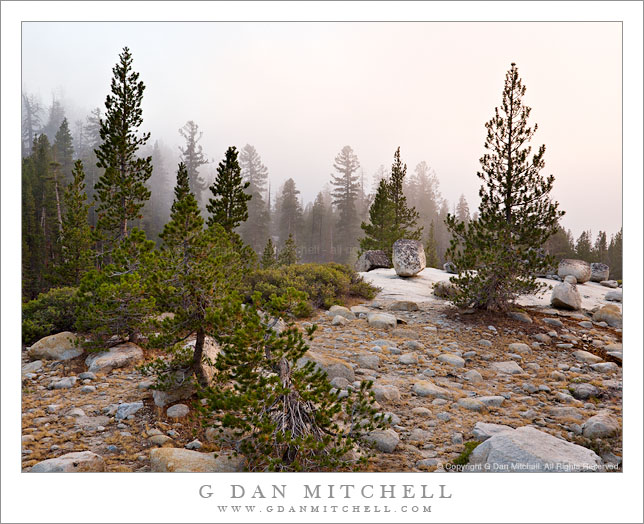
Evening Fog, Autumn
Evening Fog, Autumn

Evening Fog, Autumn. Yosemite National Park, California. October 5, 2008. © Copyright 2008 G Dan Mitchell – all rights reserved.

Evening fog forms on an autumn evening above a ridge near Olmsted Point, Yosemite National Park.

I made this photograph on a memorable evening back in 2008 while returning to the SF Bay Area from several days of autumn aspen photography on the east side of the Sierra. After shooting aspen subjects like crazy for several days, I more or less thought that my photography for this trip was finished as I ascending Tioga Pass to enter the park on my way home. In fact, I didn’t really do much photography around the pass or at Tuolumne. But as I drove I noticed that low clouds were forming over peaks and ridges, created by condensation in very moist post-rain air as the temperature dropped quickly as sunset approached. Now this was starting to seem a bit interesting!

As I came to Olmsted Point the clouds were so thick that I couldn’t really see a thing. You never know for sure how these atmospheric conditions are going to develop, and while part of me was disappointed that perhaps there would not be a photography opportunity, another part of me (the tired part!) was almost a bit relieved that I could perhaps get on with task of driving home. But as I rounded the very next bend, where the road rises to a high point just west of Olmsted, things opened up just a bit and light from a clear area a bit further to the west was making the fog glow a bit. So, with a combination of reluctance and excitement, I pulled over, hoisted my gear, and walked off into the forest and granite landscape to make this photograph.

(After making this one, I was certain that my work was done, as the light was fading fast. As fate would have it, a mile or two further on there was a tremendous view of the fog filled valley below, in soft dusk light and with Clouds Rest looming above. Yup, had to stop one more time for that one, too…)

G Dan Mitchell Photography
About | Flickr | Twitter | FacebookGoogle+ | 500px.com | LinkedIn | Email

Text, photographs, and other media are © Copyright G Dan Mitchell (or others when indicated) and are not in the public domain and may not be used on websites, blogs, or in other media without advance permission from G Dan Mitchell.

(Basic EXIF data may be available by “mousing over” large images in posts when this page is viewed on the web. Leave a comment if you want to know more.)

Sunrise, Ediza Lake, Minarets, and Mounts Ritter and Banner

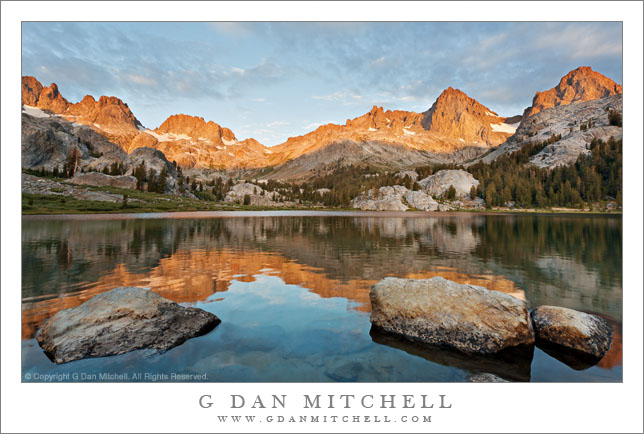
Sunrise, Ediza Lake, Minarets, and Mounts Ritter and Banner

Sunrise, Ediza Lake, Minarets, and Mounts Ritter and Banner. Sierra Nevada, California. July 25, 2007. © Copyright 2007 G Dan Mitchell – all rights reserved.

First sunrise light on the Minarets, Mount Ritter, and Banner Peak above Ediza Lake, Sierra Nevada, California.

I made this photograph during a long and leisurely pack trip into the Minarets area of the Sierra Nevada near Mammoth Lakes. It was leisurely because I accompanied my brother and his family – and the fact that some kids were on the trip contributed to the slower hiking pace… as did the fact that both he and I wanted to make photographs.

This is a popular and accessible area of the Sierra, and also one that is a bit unusual. Typically the highest peaks of the range are found on the actual crest, but here the Sierra crest is further to the east and rather low, being right about where the Mammoth Ski Area is located. Across an intervening valley – a valley that holds Devils Postpile National Monument – loom the high and jagged peaks of the Minarets, a series of impressive spires, and the summits of Mount Ritter and Banner Peak. While in most of the Sierra the areas to the east of the highest peaks descend rapidly to the high desert, here the areas below these peaks remain very high and provide a different view of the eastern faces of the peaks.

The photograph was made very early in the morning along the shoreline of Ediza Lake on a day when clouds were already starting to build even at this early hour. Yes, there was rain later on!

G Dan Mitchell Photography
About | Flickr | Twitter | FacebookGoogle+ | 500px.com | LinkedIn | Email

Text, photographs, and other media are © Copyright G Dan Mitchell (or others when indicated) and are not in the public domain and may not be used on websites, blogs, or in other media without advance permission from G Dan Mitchell.

(Basic EXIF data may be available by “mousing over” large images in posts. Leave a comment if you want to know more.)