All posts by G Dan Mitchell

G Dan Mitchell, photographer and visual opportunist focusing on the Pacific coast, the Sierra Nevada, redwood forests, California oak/grasslands, California deserts, urban landscapes, night photography and more. Posting daily photographs since 2005, along with articles, reviews, news, and ideas.

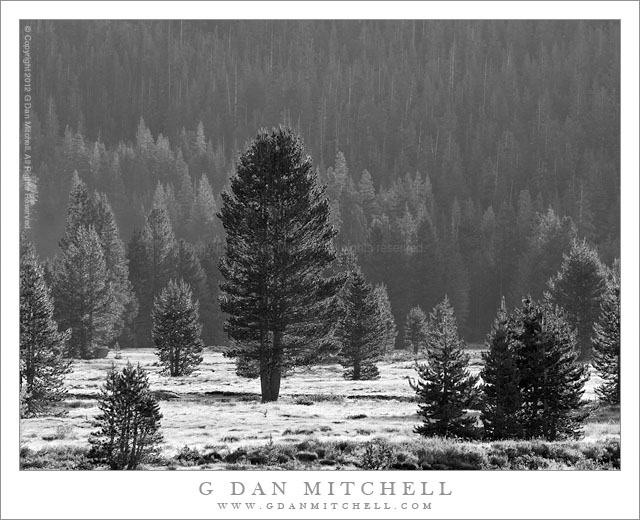
Morning, Tuolumne Meadows

Morning, Tuolumne Meadows - Trees of Tuolumne Meadows in morning light, with forest ascending background slopes, Yosemite National Park
Trees of Tuolumne Meadows in morning light, with forest ascending background slopes, Yosemite National Park

Morning, Tuolumne Meadows. Yosemite National Park, California. July 12, 2012. © Copyright 2012 G Dan Mitchell – all rights reserved.

Trees of Tuolumne Meadows in morning light, with forest ascending background slopes, Yosemite Naitonal Park.

As a photographer, I am often up and off to shoot some interesting subject well before dawn. When I am car-camping, as I was during my mid-July visit to Tuolumne Meadows this year, I have a loose ritual that I usually follow. The night before I come up with one or more subjects that I would like to photograph in morning light. Based on where those are – driving or walking distance, and closer or further away – I set an alarm for a much earlier time than I want to. Then I have everything ready for a quick and fairly brainless early start – anything I’ll need to take from the tent sits by the end of the zipper I’ll grab to open the tent, and other things are already in the car. The alarm goes off – way too early for my brain, of course! – and I try to sit up so that I won’t go back to sleep and then put on whatever clothes I need for the morning weather. On a good day, I’m out of the tent and in the car in 5 minutes. On a bad day it might take 15. (On a really bad day, I have been known to just go back to sleep! Hey, it happens… but not very often.) I get in the car and try to drive out of the campground as quickly and quietly as possible.

You may have noticed that something was missing from that routine – breakfast! Indeed, I usually don’t bother with breakfast before shooting, preferring instead to get to work while the light is good. As hard as it can be to get started, it usually doesn’t take too long to find some site so special and compelling that I forget how hard it was to get up so early. In fact, once I get going I am often surprised to find so few others out and about at this time of the most beautiful light. Frequently I may see only a few hikers and perhaps another photographer or two, and even a couple of hours later, as the best light begins to transition into the “blah” daytime light, many people are apparently still in their sleeping bags.

I didn’t have far to go on this morning. Tuolumne Meadows is just across Tioga Pass Road from the main campground. The early light was a bit hazy, and as the backlight lit up the meadow and fringed the many trees, this haze enhanced the sense of distance between the closer trees and the forest leading up the more distant hillside.

G Dan Mitchell is a California photographer whose subjects include the Pacific coast, redwood forests, central California oak/grasslands, the Sierra Nevada, California deserts, urban landscapes, night photography, and more.
Blog | About | Flickr | Twitter | Facebook | Google+ | 500px.com | LinkedIn | Email

Text, photographs, and other media are © Copyright G Dan Mitchell (or others when indicated) and are not in the public domain and may not be used on websites, blogs, or in other media without advance permission from G Dan Mitchell.

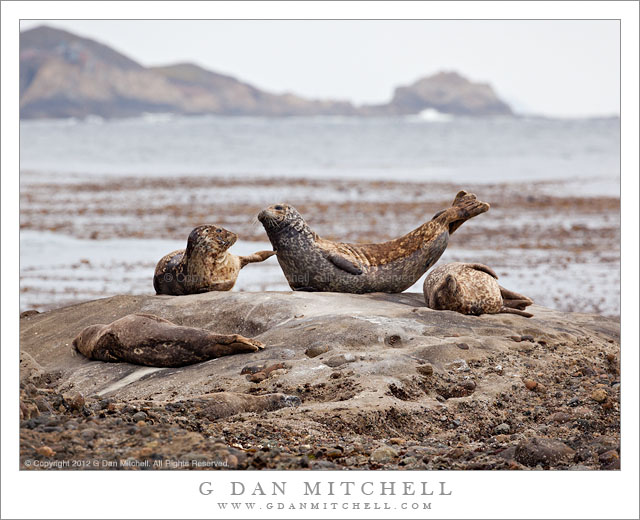
Harbor Seals, Point Lobos

Harbor Seals, Point Lobos - California harbor seals interacting on a haul-out rock at the Point Lobos State Reserve.
California harbor seals interacting on a haul-out rock at the Point Lobos State Reserve.

Harbor Seals, Point Lobos. Point Lobos State Reserve, California. July 16, 2012. © Copyright 2012 G Dan Mitchell – all rights reserved.

California harbor seals interacting on a haul-out rock at the Point Lobos State Reserve.

The harbor seals are found in many areas of the California cost and elsewhere. These were lounging about on a haul-out rock at the Point Lobos State Reserve just south of Carmel and at the northern end of the Big Sur coastline. I have been going to Point Lobos for many years, and this particular rock is one I usually check out since it is quite close to the shoreline and there are often harbor seals about. Indeed, on this day there were perhaps a dozen of the critters on this rock, and more were hanging around nearby.

On one hand, it seems like a pretty lazy life they lead, especially on a calm summer day like this one. Haul out of the water and lounge about on rocks for hours. If they get hungry, the water is only a few feet away. But I suspect that the reality is much different. I have also gone to see them in the winter when the surf here can be astonishingly wild, and the ocean must be a very dangerous place. As I watched this group – which is sometimes an experience close to watching paint dry – eventually the middle seal decided to turn around and face the smaller one to the left. As it did so it arched its body to pivot around and the smaller one reached out with a flipper, suggesting a sort of friendly pat to the those with anthropomorphic tendencies.

G Dan Mitchell is a California photographer whose subjects include the Pacific coast, redwood forests, central California oak/grasslands, the Sierra Nevada, California deserts, urban landscapes, night photography, and more.
Blog | About | Flickr | Twitter | Facebook | Google+ | 500px.com | LinkedIn | Email

Text, photographs, and other media are © Copyright G Dan Mitchell (or others when indicated) and are not in the public domain and may not be used on websites, blogs, or in other media without advance permission from G Dan Mitchell.

Photographic Myths and Platitudes: New DSLR? Why You Do NOT Need a 50mm Prime

(Note: This article has been slightly revised and updated since it was originally posted in 2012.)

From time to time I share here my response to a question that I fielded somewhere else. In this case, the subject concerned whether or not a beginner getting a new DSLR should start out with a “normal” 50mm prime lens. Here is a slightly edited version of what I wrote.

Every so often a beginning photographer buying their first DSLR, typically a cropped sensor model, will be advised to “get a 50mm prime,” either as their only lens or as an adjunct to the “kit zoom” that likely comes with most entry-level DSLRs. Some say you should do this because you must learn to shoot with a prime before you are ready for a zoom. (This is nonsense, in my opinion.) Others suggest that folks should get the prime because good and inexpensive versions are available – which is true, but not a reason to buy one.

I’m here to say that there is little or no good reason for a beginning DSLR photographer to get a 50mm prime—especially a 50mm prime—with their new camera. Get the kit zoom and start making photographs.

The advice to get a 50mm prime comes from a very different set of circumstances and a very different time. When 35mm film SLRs first became available some decades ago, decent zoom lenses were not available at prices that beginners would contemplate paying, if they were even available at all. (Those shooting 35mm rangefinder cameras found even more impediments to the idea of using a zoom.) In fact, photographers generally didn’t use them. “Zoom or prime?” was not the question at all – primes were the only realistic option.

The general feeling was that something in the 50mm focal length range or thereabouts could be the ideal starter “normal” lens on a 35mm film camera. (This was not a universally held viewpoint – some preferred lenses a bit wider and some of the standard primes came in longer focal lengths such as 55mm.) A 50mm +/- prime was the first lens that most folks got with their new film SLR, and there were lots of fine and inexpensive options. You got your camera and you got your 50mm prime. In fact, if you got a SLR “kit,” it was camera plus a 50mm or so prime, probably a f/2 or f/1.8 version. The fact that we still have lenses like Canon’s EF 50mm f/1.8 at such a low price is a result of that history.

In reality, the valid advice back then was to “get a 50mm prime and learn to shoot it before buying more lenses.” The source of this advice had nothing at all to do with a zoom versus prime question. Primes were the only option. The implication actually was don’t get sucked into buying a bunch of lenses before you know what you are doing or what you need. (We are all aware of how tempting it can be to allow gear acquisition syndrome to supplant photography.) In other words, get a first lens, shoot a lot with it, learn a lot from doing so, and only then start to consider what your experience tells you about the need for (maybe) getting other lenses.

That warning still holds true, but keep in mind that it is a actually warning against rushing out and buying lots of stuff. Today, the better, and far more likely, first lens choice is going to be a zoom. There are excellent, inexpensive options available today that have supplanted the old-school inexpensive 50mm prime as the logical first lens. Every manufacturer has at least one fine and inexpensive “kit” zoom lens. The more accurate modern update of the old “buy a 50mm prime, learn to shoot before you buy more lenses” is actually:

Get the kit zoom, and learn to shoot before you invest in more lenses.

(In fact, a logical extension of this advice is to shoot a lot with your kit zoom before getting sucked into buying… a 50mm prime!”)

Among those “other lenses” you can wait to acquire are primes. A person starting out with a cropped sensor DSLR almost certainly does not need to get an additional lens at first, any more than the beginning 35mm film SLR buyer needed to buy a set of three primes “back in the day.” It is true that the new photographer may eventually travel a photographic path on which owning a prime is useful, but before that happens he or she can shoot at this same focal length on the 18-55mm kit zoom and find out.

Secondly, and to repeat the obvious, a 50mm prime on a cropped sensor DSLR does not even provide the same functionality as the 50mm prime on the 35mm film SLR. IF you accept the notion that shooting a prime is important at first—though I emphatically do not—it would not be a 50mm prime, but the angle-of-view equivalent for a cropped sensor camera. This would be a roughly 31mm lens for a 1.6x crop factor body. (If this were not the case, 80mm would have been the “normal” prime FL on those early film cameras. In short, it wasn’t.)

So, start out with kit zoom that is available for your new DSLR. Shoot a lot before you start buying a bunch of other lenses. See what happens. If it turns out that the kit lens really limits your photography, you’ll figure that out based on your experience with this lens – and you’ll also begin to more clearly understand the things that you might need in order to overcome any such limitations. Your interests and needs are likely to evolve in ways that you cannot accurately anticipate until you do a lot of shooting – a task for which the kit lens is perfectly suited.

As you do this, one of several things might happen. A very large percentage of those who start with the kit lens find that it is really all the lens they need, and they do not get anything else. Others discover that the kit lens works well but that perhaps they want more “reach” for some subjects, at which point they look for a suitable longer focal length lens. Others might discover that they need something wider. Yet another photographer might discover that he/she is shooting a lot at one particular focal length, needs a larger maximum aperture, and needs a smaller camera/lens package – in which case a prime at that favored focal length might be useful. And there are many other possibilities that I can’t list here.

There’s always time for that prime later on if you discover you need it. I’m betting that most beginners won’t, but that those who do will figure it out soon enough and make a much smarter decision by waiting.

(Note of clarification for those who may read too quickly: A few people have misconstrued this article as being anti-prime or suggesting that there is something wrong with a 50mm lens. A more careful reading of the article will confirm that this is not the case. The context is entirely about the beginning photographers getting his/her first DSLR. Depending upon what sort of photography one eventually ends up doing, primes including the 50mm focal length may turn out to be very useful. As a matter of fact, I own more primes than zooms… though I do use the zooms more than the primes. That is probably a subject for another article. ;-)


This article is part of my Photographic Myths and Platitudes series.


G Dan Mitchell is a California photographer and visual opportunist. His book, “California’s Fall Color: A Photographer’s Guide to Autumn in the Sierra” is available from Heyday Books and Amazon.
Blog | About | Flickr | Twitter | Facebook | Google+ | 500px.com | LinkedIn | Email


All media © Copyright G Dan Mitchell and others as indicated. Any use requires advance permission from G Dan Mitchell.

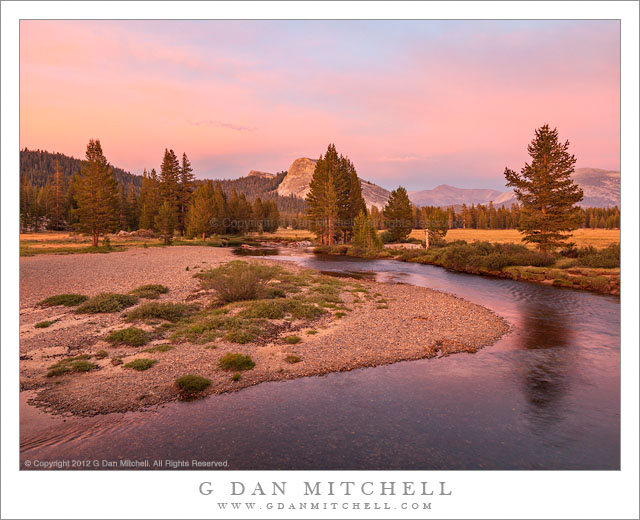
Tuolumne River, Alpenglow

Tuolumne River, Alpenglow - The Tuolumne River curves through Tuolumne Meadows as alpenglow colors that landscape, Yosemite National Park.
The Tuolumne River curves through Tuolumne Meadows as alpenglow colors that landscape, Yosemite National Park.

Tuolumne River, Alpenglow. Yosemite National Park, California. July 7, 2012. © Copyright 2012 G Dan Mitchell – all rights reserved.

The Tuolumne River curves through Tuolumne Meadows as alpenglow colors the landscape, Yosemite National Park.

I have written previously about several topics that connect to this photograph. For one, I have described a certain type of atmospheric condition in the Sierra that may bring astonishingly intense evening colors when clouds above the mountains end to the west of the range, allowing the final sunset light to illuminate the clouds from beneath. On this evening it looked like all the pieces were in place for such a show, but I know that while these conditions make the light possible, they do not guarantee it – and on this evening there was a wonderful, subtle glow just after sunset… but not the imagined overwhelmingly brilliant light.

For another, I have written about scoping out a shot ahead of time, sometimes earlier the same day and sometimes weeks, months, or even years earlier. Earlier on this day I decided to take a walk in the meadow without my camera gear, with precisely the task of “scoping out” in mind. I wandered around somewhat aimlessly, following my nose this way and that to investigate lots of interesting things and places that I might have passed by on a more purposeful hike. Before heading back to camp for an early dinner I had selected three possible subjects that I thought might work well.

I have also written about how little control we have over our subjects when shooting landscape. We can anticipate and guess and be fortunate enough to be in the right place at the right time with the right gear and the skill to know how to use it, along with the ability to see what is happening – but in the end, in many ways, we take what we can find and work with it. When I arrived back in the evening an hour or so before the time of interesting light, I had a feeling that the first subject I had seen earlier might be the most promising. This was a scene that placed Lembert Dome between a couple of groups of trees and a bit of the river when viewed from the middle of a footbridge crossing the Tuolumne. I arrived and set up and began the planned wait for what I hoped would be very interesting light. However, as sunset approached, I could see that the shot I had planned was not going to work in the light that I found myself working with. So, on the spur of the moment and acting essentially intuitively, I picked up the tripod and camera and moved to a nearby spot and rather than making a tightly focused shot of the dome, I zoomed way out to include a gentle curve in the Tuolumne, a sandbar, and a line of foreground trees, and I made this photograph of the much subtler-than-expected post sunset light.

G Dan Mitchell is a California photographer whose subjects include the Pacific coast, redwood forests, central California oak/grasslands, the Sierra Nevada, California deserts, urban landscapes, night photography, and more.
Blog | About | Flickr | Twitter | Facebook | Google+ | 500px.com | LinkedIn | Email

Text, photographs, and other media are © Copyright G Dan Mitchell (or others when indicated) and are not in the public domain and may not be used on websites, blogs, or in other media without advance permission from G Dan Mitchell.