
Tag Archives: gray

Oak, Laurel, and Granite

Oak, Laurel, and Granite

Oak, Laurel, and Granite. Yosemite Valley, California. May 7, 2011. © Copyright G Dan Mitchell – all rights reserved.

An oak tree and a laurel tree grow next to a granite face along the north side of Yosemite Valley, California.

I have visited this small, gnarled oak tree before. It grows right at the base of a granite face along the north side of Yosemite Valley, seems to face a pretty rugged life living beneath the shadow of the cliff and among fallen boulders. When I visited in early May the tree was just starting to get its new growth of leaves, though the laurel tree right next to it was already quite green.

The last time I photographed this tree it was autumn, and the leaves were also colorful then. It seems a bit odd that the leaves of this oak take on similar yellow and red colors at both the start and end of their season. (Though they do go more toward brown than yellow in the fall.)

The light was interesting on this day, which had started out clear. As the day wore on a weak Pacific weather front approached, and by evening things were pretty well socked in. But here, at perhaps 4:00 or 4:30, if I recall correctly, the incoming clouds were thing and broken enough to just soften the light without turning it completely gray.

G Dan Mitchell Photography | Flickr | Twitter (follow me) | Facebook (“Like” my page) | LinkedIn | Email
Text, photographs, and other media are © Copyright G Dan Mitchell (or others when indicated) and are not in the public domain and may not be used on websites, blogs, or in other media without advance permission from G Dan Mitchell.
Dusk, Death Valley Ridges

Dusk, Death Valley Ridges

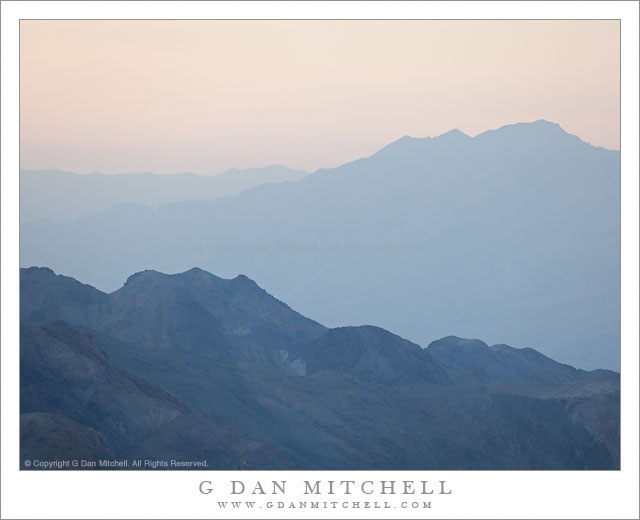
Dusk, Death Valley Ridges. Death Valley National Park, California. March 30, 2011. © Copyright G Dan Mitchell – all rights reserved.

Dusk light on ridges above Death Valley, California.

This photograph was made in the evening from Aguereberry Point, high in the Panamint Mountain Range along the west side of Death Valley. The point is a spectacular overlook with panoramic views in all directions. The number of visitors is relatively low since it is at the end of a gravel road and is a good long drive from most of the places where people tend to stay when they visit the park. It is also windy!

(Those who read the brief technical information about the photographs might wonder at my use of ISO 400 for a landscape photograph – but when shooting at 400mm in windy conditions, a lower ISO makes it darn near impossible to deal with camera vibrations.)

The range of lighting conditions and effects as the day comes to an end at Aguereberry Point is tremendous. To the west (roughly behind me and over my left shoulder as I shot this photograph) the sky is very bright as the sun drops towards the distant Sierra Nevada. Below the Valley and the canyons along the mountains on either side gradually dim and become hazy. As the sun drops and is blocked by intervening peaks and mountain ranges, even the higher peaks and ridges take on these subtle and pastel shadings. It probably isn’t too important to identify the specific ridges in this image, but they are to the northeast of the point. The nearer ridge is along the west side of the Valley (probably part of the Tucki Mountain complex) and the further ridges are a much greater distance to the northeast across the upper Valley.

G Dan Mitchell Photography | Flickr | Twitter | Facebook | Email
Text, photographs, and other media are © Copyright G Dan Mitchell (or others when indicated) and are not in the public domain and may not be used on websites, blogs, or in other media without advance permission from G Dan Mitchell.
Whalers Knoll, Point Lobos

Whalers Knoll, Point Lobos

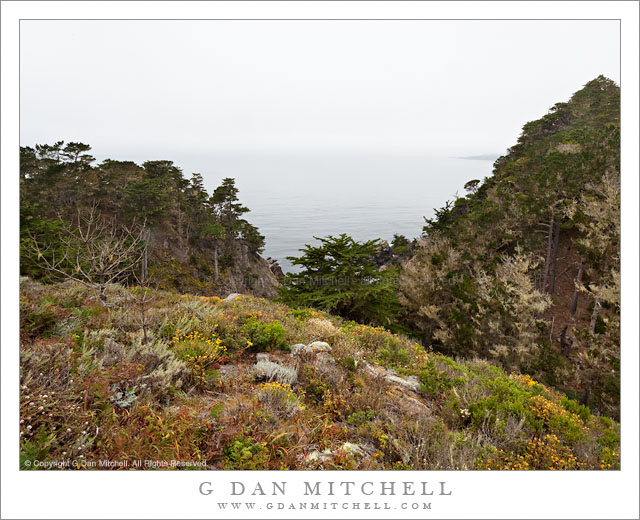
Whalers Knoll, Point Lobos. Point Lobos State Reserve, California. July 10, 2010© Copyright G Dan Mitchell – all rights reserved.

View of foggy Pacific Ocean from Whalers Knoll, Point Lobos State Reserve, California.

Whalers Knoll is yet another feature of Point Lobos named after “whalers” – Whalers Cove is another. Sometimes when I hike the trails along the north shore of the park I detour up a trail to the top of the knoll, from which there is a view of a larger expanse of landscape and seascape. But still, given the rough and rugged landscape of Point Lobos, there is no clear and unobstructed view – instead you can see the ocean between ridges and peaks and then only by looking for a spot where the Monterey Cypress trees are not as thick.

Although Point Lobos is a very popular park, it is usually possible to find some solitude by walking away from the most popular shoreline areas and hiking a bit. Since this trail is a bit out of the way and involves a climb, it isn’t unusual to be alone on at this lookout, especially on a foggy day when many visitors find the view from their cars to be sufficient!

G Dan Mitchell Photography | Flickr | Twitter | Facebook | Email
Text, photographs, and other media are © Copyright G Dan Mitchell (or others when indicated) and are not in the public domain and may not be used on websites, blogs, or in other media without advance permission from G Dan Mitchell.

Monterey Cypress Trees, Fog, Carmel Peninsula

Monterey Cypress Trees, Fog, Carmel Peninsula

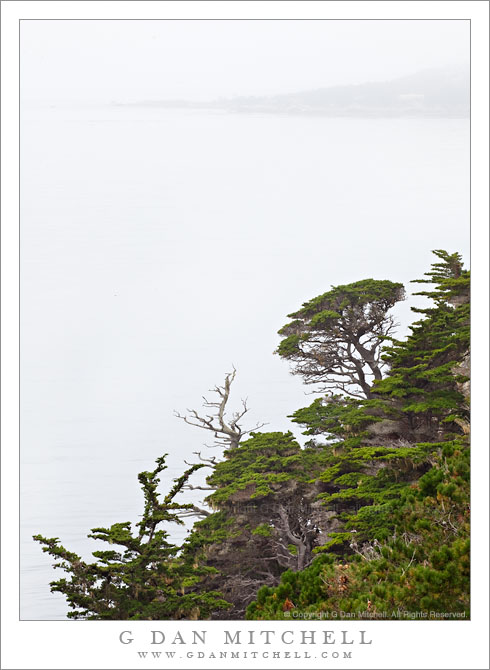
Monterey Cypress Trees, Fog, Carmel Peninsula. Point Lobos State Reserve, California. July 10, 2010. © Copyright G Dan Mitchell – all rights reserved.

Carmel Peninsula is barely visible though fog beyond Monterey Cypress trees along the north shore of Point Lobos State Reserve.

This was a typical summer day in coastal California – completely socked in by a thick, gray blanket of cold, wet fog! The light was somewhat dismal, so it wasn’t a day for typical “scenic” landscape or seascape photography, though the colors of the plants and trees were saturated by the soft light and the distant peninsula faded almost to monochrome though the fog across the bay.

These Monterey cypress trees grow along the tops of the rocky cliffs above this part of the Pacific Ocean, in some of the most exposed and precipitous locations imaginable. In some spots they are left exposed to the full force of the ocean winds and winter storms, and they grow close to the ground, following the contours of the rocky terrain in ways that remind me of trees growing in exposed locations near timberline in the Sierra. In other spots they are a bit more sheltered and they seem to be able to “stretch out” a bit, as these trees do along a section of the rocky cliffs that faces more into the bay than out to sea.

The bay holds the outlet of the Carmel River, and the peninsula visible across the water in the distance is the coastline of the town of Carmel. The foreground trees are within the boundaries of the Point Lobos State Reserve.

G Dan Mitchell Photography | Flickr | Twitter | Facebook | Email
Text, photographs, and other media are © Copyright G Dan Mitchell (or others when indicated) and are not in the public domain and may not be used on websites, blogs, or in other media without advance permission from G Dan Mitchell.