
Tag Archives: light

Cascade, Reflected Sunlight

Cascade, Reflected Sunlight

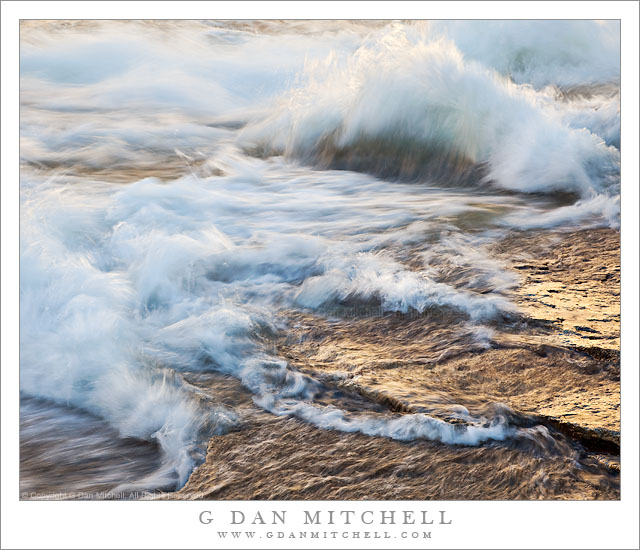
Cascade, Reflected Sunlight. Yosemite National Park, California. June 28, 2010. © Copyright G Dan Mitchell – all rights reserved.

Sunlight reflects on granite ledges next to cascades on Tenaya Creek.

In this iteration of the “blurry-fast-moving-water-in-Sierra-creek” photograph, I was looking to cram a variety of elements into the frame – as you can see, the entire photograph is not filled with water. There is a transition from white water with flashes of sunlit light at the tops of the waves, through the water with smaller areas of foam, to water reflecting the golden late afternoon light from a cliff face on the other side of the creek, to some bits of streamside granite slabs along the lower right edge of the frame. To me, these areas of shallow water and wet rock reflecting more distant light almost have a molten quality.

One of the trickiest things about this photograph for me was dealing with the strong contrast between very blue tones in the shaded parts of the water and the very warm tones of the reflections. As every photographer knows, the light in shade can be very blue, especially when the subject is supposed to be white and is lit almost entirely by the blue sky, as is the case in parts of the turbulent water. Adjustments are necessary in order to make it look realistic and conform with the colors that our eyes tell are are there. (Our vision system is remarkable… but it is not objectively accurate!) But adjustments to the blue water, if applied to the warm tones of the reflecting granite, can end up looking bizarre and overdone in the opposite direction!

G Dan Mitchell Photography | Flickr | Twitter | Facebook | Email
Text, photographs, and other media are © Copyright G Dan Mitchell (or others when indicated) and are not in the public domain and may not be used on websites, blogs, or in other media without advance permission from G Dan Mitchell.
Whitewater, Tenaya Creek

Whitewater, Tenaya Creek

Whitewater, Tenaya Creek. Yosemite National Park, California.June 28, 2010. © Copyright G Dan Mitchell – all rights reserved.

Turbulent whitewater flows through an area of steep granite along Tenaya Creek, Yosemite National Park.

You can, of course, find a place to shoot subjects like this one all over the Sierra and no doubt in many other places as well. This photograph was made during a period of relatively high water early in the season and in a spot where the water flowed over some rocks in shade. Sunlight on the other side of the stream reflected into the water and revealed highlights, especially the flying spray that I allowed to blur with a somewhat slow shutter speed.

The moving water in Sierra streams and rivers seems to be an almost irresistible subject for many photographers, and I confess that I count myself among them. In some ways it is almost too easy to make these photographs, and one basic requirement is a willingness to make quite a few exposures. The instantaneous motion of the water and the reflections of light simply cannot be controlled or predicted, so one almost has to make many, many exposures. Of course, there is a bit more to it than pointing the camera at water and then repeatedly pressing the shutter release. It is important to find some sort of compositional interest first – it could be where water flows around or over a rock, a place where the light catches the water, or possibly just the twisting forms of turbulent water. Light is extra important in these photographs I think – most often the colors come from a combination of the blue-green shades of water full of foam and from reflected light from things that are out of the frame. (In this photograph, the light mostly comes from sunlight reflected off of granite on the far side of the stream.) Shutter speed is an important consideration, as a short exposure will stop or nearly stop the water and freeze the motion, a somewhat longer exposure can hold some detail but still allow blur along the direction of the flow, and very long exposures can create a misty and diffuse effect.

G Dan Mitchell Photography | Flickr | Twitter | Facebook | Email
Text, photographs, and other media are © Copyright G Dan Mitchell (or others when indicated) and are not in the public domain and may not be used on websites, blogs, or in other media without advance permission from G Dan Mitchell.
Review: “Light & Land” by Michael Frye

Over the past few weeks I have had the chance to go through Michael Frye’s new ebook, “Light and Land: Landscapes in the Digital Darkroom.” Many are no doubt already aware of Michael’s reputation from his photography, his workshops, and his other publications including his “Photographer’s Guide to Yosemite” and “Digital Landscape Photography: In The Footsteps of Ansel Adams and the Masters.” I have the .pdf version of “Light and Land”, and I understand that an iPad app version may also be available.

Light and Land - Michael Frye

It is typical for photographic “how to” books to focus on specific techniques, and to be organized around a presentation of these techniques – perhaps with a section on curves, a section on black and white conversion, and so forth. This approach has its place, especially for certain types of learners and at certain points in the learning process. It is important to understand the basic techniques and operations that are available in the “digital darkroom” of such programs as Photoshop, Lightroom and so forth. That said, the bigger and more important issue is how to call upon these techniques creatively and effectively and appropriately in order to make photographs. Not all “how to” books do an effective job of illustrating this.

Michael’s “Light & Land” takes a different approach, and one that more accurately and realistically reflects the thought process of a photographer who is calling upon this arsenal of techniques in the service of creating beautiful photographs.  He writes:

“The digital darkroom gives us tremendous control over our images. We can make them lighter, darker, add contrast, change the color balance, increase saturation, turn a color photograph into black and white, remove telephone poles, blend exposures with HDR, combine ten images to capture infinite depth of field, or put a winged elephant in the sky.

But what do we do with these choices?” Continue reading Review: “Light & Land” by Michael Frye

Trees and Brush, Levee

Trees and Brush, Levee

Trees and Brush, Levee. Cosumnes River Wildlife Preserve, California. January 23, 2011. © Copyright G Dan Mitchell – all rights reserved.

Weak sunlight breaks through Central Valley tule fog to illuminate trees and brush growing on a levee near the Cosumnes River.

This morning started out with extremely dense Central Valley tule fog – at first so thick that I more or less gave up photographing. But eventually, as usually happens, the upper layers of the fog began to thin, and some light began to filter down through the fog. By late in the morning the fog was thinning enough that very pale sunlight began to show through and softly light the dense vegetation on this levee along the edges of the Cosumnes River. This is an incredibly rich environment in the winter, especially with all of the water from winter rains and the nearby river, and the vegetation grows very thick here.

G Dan Mitchell Photography | Flickr | Twitter | Facebook | Email
Text, photographs, and other media are © Copyright G Dan Mitchell (or others when indicated) and are not in the public domain and may not be used on websites, blogs, or in other media without advance permission from G Dan Mitchell.