
Tag Archives: rock

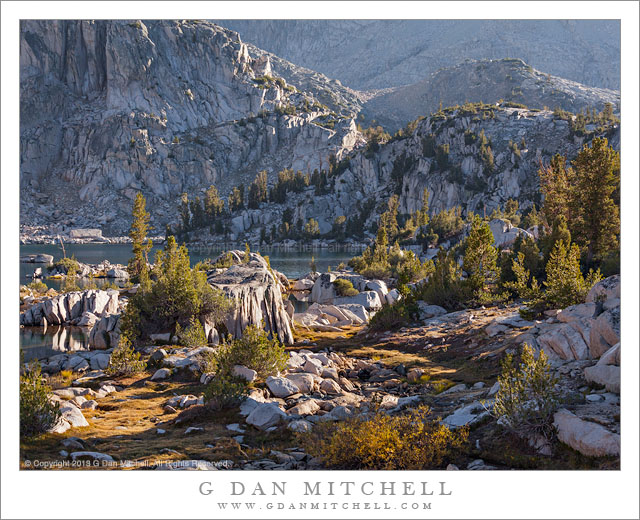
Fractured Granite, Reflections

Fractured Granite, Reflection, Sequoia-Kings Canyon National Parks
“Fractured Granite, Reflection” — The base of a rugged granite wall reflected in the still surface of a sub-alpine Sierra Nevada lake

A few days ago I returned from a 9-day trip into the back-country of Kings Canyon National Park. I was one of a group of four photographers who traveled to a remote location at about 11,000′, where we remained for more than five days, photographing the surrounding terrain morning and evening. We followed the common routine of such work – up before dawn and off to investigate and photograph some valley or lake, back by mid or late morning for breakfast, generally hanging out and doing camp chores during the midday period when the light is often less exciting, then back out in the late afternoon for a few more hours of exploration and photography before returning to camp for a post-sunset dinner. Unlike a typical backpack trip, where one rarely stays in the same place for long, we remained in the same camp for six nights, allowing us to really get to know the surrounding area very well.

With so much time, we were frequently able to return to places that we had already visited – perhaps coming back in the evening after a morning visit, returning to try again to catch a subject that didn’t have the right light the first time, or shooting the subject in various conditions ranging from clear skies to rain. This bit of interesting rock was next to a lake that I walked to on a number of occasions, and on this morning I arrived when the lake was still in shadow but illuminated by light reflected from nearby rock faces. Because it was so early the air was very still, allowing me to photograph this very sharp reflection of the fractured granite cliff where it entered the water. A bit of vegetation just above the waterline has taken on early fall colors.


G Dan Mitchell is a California photographer and visual opportunist. His book, “California’s Fall Color: A Photographer’s Guide to Autumn in the Sierra” (Heyday Books) is available directly from him.

G Dan Mitchell: Blog | Bluesky | Mastodon | Substack Notes | Flickr | Email


All media © Copyright G Dan Mitchell and others as indicated. Any use requires advance permission from G Dan Mitchell.

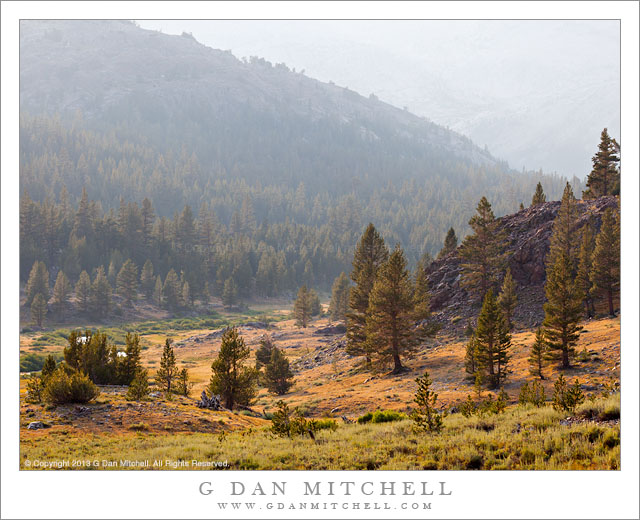
Forest And Meadow, Evening Haze

Forest And Meadow, Evening Haze

Forest And Meadow, Evening Haze. Eastern Sierra Nevada, California. August 6, 2013. © Copyright 2013 G Dan Mitchell – all rights reserved.

Evening haze settles on the Sierra Nevada above forest and meadow near Lee Vining Creek.

Atmospheric haze and I have a special relationship. ;-) While I love crystal clear alpine air, I’m far more fond of “interesting” atmospheric conditions that involve haze that may partially obscure certain details, accentuate distance contrasts between close and far objects, take on interesting colorations, and even glow when lit from behind. During this early August visit to the Sierra on both sides of Tioga Pass, I encountered some significant haze from a serious wildfire in the Mammoth Lakes area. One one hand, this complicated (or rendered nearly impossible!) certain types of “grand landscape” photographs since the constant brown, smoggy haze isn’t quite what we typically are looking for. However, to me this most certainly does not mean that photography and even landscape photography cannot be done. Not only can it be done, but these conditions can create possibilities that are difficult or impossible to find in more typical conditions. (However, in reality, wildfire smoke is “typical” in the Sierra and many other places during certain times of the year.)

There are a number of ways to use smoke and haze in photographs. In this case I found primary foreground subjects that were close enough that they were not obscured. The haze, however, quickly muted the contrast and color of parts of the scene that were even a short distance away on the other side of the valley. The dark, backlit forms of the near trees stand out against this muted background rather than disappearing into the complex patterns and textures of the more distant forest. The backlight had a few other beneficial effects. It intensifies the colors of the low plants growing beneath and between the trees. It creates a sort of highlighting effect on near and far trees, giving a bit more relief to their textures. And it adds a bit of a glow to that smoke and haze, to the point the further alpine slopes in the upper left show only the barest details.

G Dan Mitchell is a California photographer and visual opportunist whose subjects include the Pacific coast, redwood forests, central California oak/grasslands, the Sierra Nevada, California deserts, urban landscapes, night photography, and more.
Blog | About | Flickr | Twitter | FacebookGoogle+ | 500px.com | LinkedIn | Email

Text, photographs, and other media are © Copyright G Dan Mitchell (or others when indicated) and are not in the public domain and may not be used on websites, blogs, or in other media without advance permission from G Dan Mitchell.

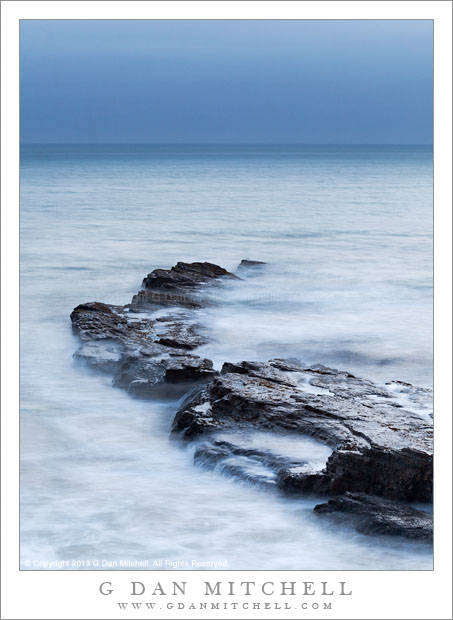
Rocks, Surf, and Dusk Horizon

Rocks, Surf, and Dusk Horizon

Rocks, Surf, and Dusk Horizon. Pacific Coast, California. August 2, 2013. © Copyright 2013 G Dan Mitchell – all rights reserved.

A curving rock shelf extends into the “blue hour” Pacific Ocean surf and toward the fog-darkened horizon as night approaches.

A short, evening visit to the California coast above Santa Cruz began with photography in golden hour light in areas where the fog bank hung just offshore with moist air over the coast creating a gentle, misty atmosphere and soft light. We photographed a few subjects in this light – and looked at others that we did not stop to shoot – and continued north as the sun dropped toward the horizon, where the fog waited to envelop it. We stopped at a beach where large groups of pelicans were resting and then resuming their flight along the coast, and noted that there was still a bit of light in the sky and, oddly, below the bottom of the fog bank along the horizon. As this light died, we turned briefly north, and I soon saw this rocky bench extending into the ocean waves.

Following the evening golden hour there is a time that some call the blue hour – when the warmer colors of sunset drain from the sky and we are left with soft, blue light. It might have seemed odd to anyone watching me photograph this rocky feature, but instead of hurrying to shoot it before the light faded, I took my time – I wanted the light to fade, both for the mysterious blue coloration and because this would make it easier for me to use extended exposure times to allow the water to soften and blur a bit. When I began shooting it was only dark enough to get exposures of perhaps a second or two – at least without adding a neutral density filter – but as I waited, making an occasional photograph in the interim, the light began to move toward a near-night state, and I was able to get exposures of 15 seconds or longer… and that blue light that I was looking for.

G Dan Mitchell is a California photographer and visual opportunist whose subjects include the Pacific coast, redwood forests, central California oak/grasslands, the Sierra Nevada, California deserts, urban landscapes, night photography, and more.
Blog | About | Flickr | Twitter | FacebookGoogle+ | 500px.com | LinkedIn | Email

Text, photographs, and other media are © Copyright G Dan Mitchell (or others when indicated) and are not in the public domain and may not be used on websites, blogs, or in other media without advance permission from G Dan Mitchell.
Eroded Desert Canyon Walls

Eroded Desert Canyon Walls

Eroded Desert Canyon Walls. Death Valley National Park, California. April 5, 2013. © Copyright 2013 G Dan Mitchell – all rights reserved.

The eroded rock strata of the walls of a narrow desert canyon, Death Valley National Park

I made this photograph in a place that I most certainly would not want to visit on the day that I am posting this! Back in early April this popular hike up a narrow canyon was relatively comfortable on a day when the temperature might have made it to about 90 degrees Fahrenheit. By now, that would be considered to be a “cool” day, since temperatures in these “warm” months frequently go well over 100 degrees. Some people choose to visit Death Valley in those awful conditions, but I’ll take the late fall through early spring season any time!

In Death Valley, more so than in just about any other area below timberline, the geology of the place is laid open for us to see clearly. Things do grow there, but sparsely and rarely beyond a height that might be measured in inches. The primary impression is of rock – monumental mountains of rock, vast washes over which floods have spread broken up rock and gravel, and the valley floors which may range from gravel to sand – but are still, ultimately, rock. Very little grows in this canyon aside from a few tiny plants peeking out of the odd crack or cowering in bits of shade, so here the erosion features and the underlying rock strata are easy to see. As I came to this point in the canyon, the wall was mostly still in shadows filled by reflected light, with just a bit of direct sunlight rimming the edges of some of the rocks.

G Dan Mitchell is a California photographer and visual opportunist whose subjects include the Pacific coast, redwood forests, central California oak/grasslands, the Sierra Nevada, California deserts, urban landscapes, night photography, and more.
Blog | About | Flickr | Twitter | FacebookGoogle+ | 500px.com | LinkedIn | Email

Text, photographs, and other media are © Copyright G Dan Mitchell (or others when indicated) and are not in the public domain and may not be used on websites, blogs, or in other media without advance permission from G Dan Mitchell.