
Tag Archives: rugged

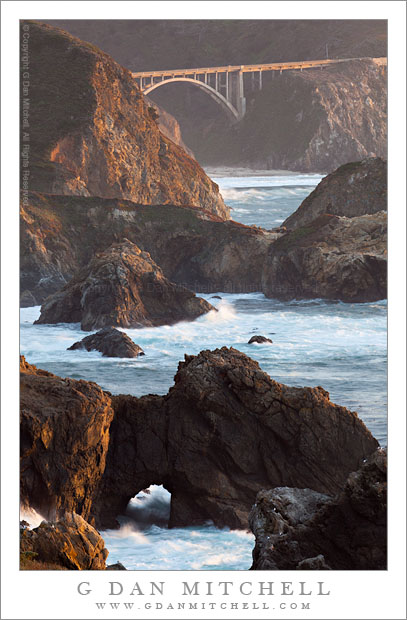
Rocky Creek Bridge, Sunset

Rocky Creek Bridge, Sunset - Sunset light illuminates the Rocky Creek Bridge, winter surf, a natural arch, and a rugged section of the Big Sur coastline.

Rocky Creek Bridge, Sunset. Big Sur Coast, California. December 18. 2011. © Copyright 2011 G Dan Mitchell – all rights reserved.

Sunset light illuminates the Rocky Creek Bridge, winter surf, a natural arch, and a rugged section of the Big Sur coastline.

This is, for me, essentially the prototypical Big Sur coastline photograph. The Rocky Creek bridge spans, not surprisingly, the canyon holding Rocky Creek, located in a bay not far from the well-known Rocky Point south of Carmel, California along the coast highway. This little scene holds most of the elements that we identify with this area: the old coast highway bridge with its curving support structures, turbulent surf, headlands and bluffs, a small beach, steep cliffs dropping into the ocean, and sea stacks, rocky islands, and natural arches.

I have photographed almost this exact same scene many times, but with the variables of season, weather, light, and surf I keep coming back. I have several black and white photographs of the scene that are among my favorites, but I have been trying to get a color photograph for some time. It turns out to be a bit trickier than it might seem. I wanted sun, but not too much sun. In the wrong light, the colors in the scene can be difficult with a lot of neutral gray, brown and dark greens. In the morning the light comes from behind the bridge, in the midday hours the light (when it isn’t foggy!) can be overly harsh, and in the evening fog and offshore clouds can interrupt the light.

On this visit to the Monterey Peninsula area I had several opportunities to photograph this spot in mostly clear weather and near sunset when the light comes from the right side and takes on the warmer, saturated “golden hour” quality. I shot it on two evenings. On one the light went flat too quickly when the sun dropped behind clouds parked well off shore. The same thing almost happened on this evening and, in fact, shortly after I made this exposure the light went flat. But before that happened I got a few moments of this beautiful, warm, low angle light coming from the sun as it dropped toward the horizon and lit up the bridge and portions of the rocky terrain.

G Dan Mitchell is a California photographer whose subjects include the Pacific coast, redwood forests, central California oak/grasslands, the Sierra Nevada, California deserts, urban landscapes, night photography, and more.
Blog | About | Flickr | Twitter | FacebookGoogle+ | 500px.com | LinkedIn | Email

Text, photographs, and other media are © Copyright G Dan Mitchell (or others when indicated) and are not in the public domain and may not be used on websites, blogs, or in other media without advance permission from G Dan Mitchell.

Detail, Red Cathedral

Detail, Red Cathedral
“Detail, Red Cathedral” — The eroded and fluted face of the Red Cathedral, Zabriski Point, Death Valley National Park.

I have recently posted other photographs made in the area of Zabriskie Point in Death Valley, including one other of this feature sometimes known as the Red Cathedral. It stands to the right of the more famous and recognizable parts of the Zabriskie Point Landscape where, for example, Manley Beacon is one of the most well-known visual icons in the park.

This detail photograph was made using a long lens very shortly after the first morning light had arrived on this feature. In my experience, getting good light on Red Cathedral can be a tricky thing. Parts of it face away from the sun and towards Death Valley and because its face is deeply fluted it can be tricky avoiding blocked shadows. But increasing exposure too much creates problems with saturated colors on the brightest strata that cut through its face. If you shoot it in the morning, light somewhat softened by some high clouds can be helpful, and that is what I had on this morning – the sun light is direct, but it is also filtered a bit by passing through broken clouds to the east.


Leave a comment or question using the form. (If you are reading this on the home page, click the article title to see the full article and the comment form.

G Dan Mitchell is a California photographer and visual opportunist. His book, “California’s Fall Color: A Photographer’s Guide to Autumn in the Sierra” (Heyday Books) is available directly from him. Blog | Bluesky | Mastodon | Substack Notes | Flickr | Email

All media © Copyright G Dan Mitchell and others.

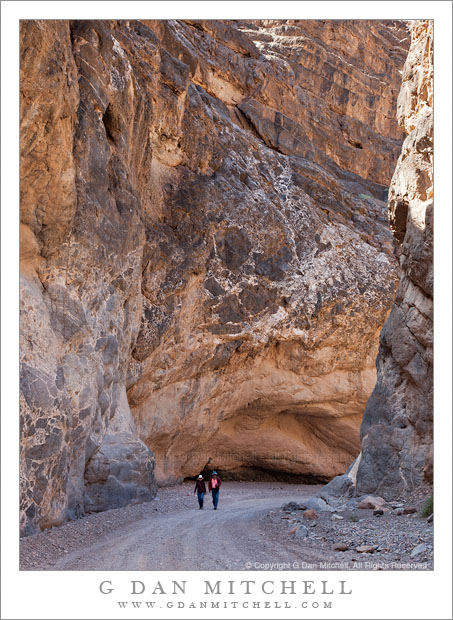
Hikers, Titus Canyon

Hikers, Titus Canyon

Hikers, Titus Canyon. Death Valley, National Park. March 28, 2010. © Copyright 2011 G Dan Mitchell – all rights reserved.

Hikers in Titus Canyon, Death Valley National Park.

There are essentially two ways to get to this portion of Titus Canyon in Death Valley National Park – you can either do a very long drive from near Beatty on gravel roads or you can walk a short distance up from the base of the canyon along the eastern side of Death Valley itself. I’ve done both. The road is quite an experience – in any other park it would probably be regarded as a very special thing, especially the last portion above Death Valley where it twists and turns down a slot canyon that is in places barely wide enough to a vehicle yet so tall that it can be hard to see the tops of the canyon walls. (It is not exactly a bad road, but it isn’t trivial either. There are some very exposed sections where it crosses the mountain ridge and descends past Leadville. Although there are reports of people using lesser vehicles, take seriously the recommendations for reasonably high ground clearance and some from of all-wheel drive.)

However, on this visit I simply parked my car at the base of the canyon, shouldered my camera equipment, and walked up the canyon a ways. There is, of course, much that you probably won’t see if you enter the canyon this way, largely because the road is so long that you won’t likely cover much of it on foot. However, I think that you can more clearly sense the scale of the lower slot canyon when traveling of foot. I included two hikers who happened by to give a sense of that scale to the landscape.

G Dan Mitchell is a California photographer whose subjects include the Pacific coast, redwood forests, central California oak/grasslands, the Sierra Nevada, California deserts, urban landscapes, night photography, and more.
Blog | About | Flickr | Twitter | Facebook | Google+ | 500px.com | LinkedIn | Email

Text, photographs, and other media are © Copyright G Dan Mitchell (or others when indicated) and are not in the public domain and may not be used on websites, blogs, or in other media without advance permission from G Dan Mitchell.
Morning Light, Zabriskie Point, Detail

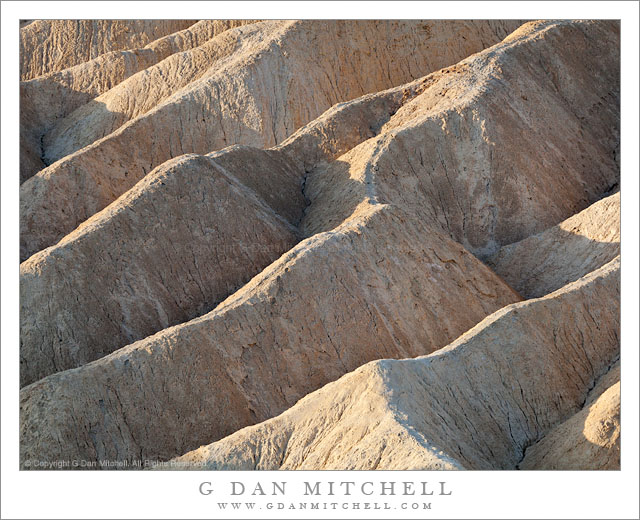
Morning Light, Zabriskie Point, Detail

Morning Light, Zabriskie Point, Detail. Death Valley National Park, California. April 2, 2009. © Copyright 2009. G Dan Mitchell – all rights reserved.

Detail of eroded gullies and hills at the edge of Gower Gulch in morning light, Zabriskie Point, Death Valley National Park.

This photograph focuses on a small section of the contorted and folded geological shapes along the edges of Gower Gulch at Zabriskie Point in Death Valley National Park. These details fascinate me, not only for the amazing variety of forms that they present but also because they change continuously as the light changes. Here they are illuminated by fairly stark light from early morning sun light that has just appeared as the sun rose above the hills to the east. The contrasts between the brightly lit tops of the small hills and the deeply shadowed gullies is clear, but if you look closely you may be able to see that the shadows are lit, as well, by the light reflected into them from the obscured sunlit faces of the gullies that are not visible from this position.

When I return to Zabriskie, I may take a few moments to make photographs of momentary soft light as the first sun strikes Manley Beacon, but I have become much more interested in photographing these small details of the scene. I usually work with a very long lens, and continue to shoot long after the “golden hour” sunrise light has gone since some of the small subjects are better lit by higher light.

G Dan Mitchell is a California photographer whose subjects include the Pacific coast, redwood forests, central California oak/grasslands, the Sierra Nevada, California deserts, urban landscapes, night photography, and more.
Blog | About | Flickr | Twitter | Facebook | Google+ | 500px.com | LinkedIn | Email

Text, photographs, and other media are © Copyright G Dan Mitchell (or others when indicated) and are not in the public domain and may not be used on websites, blogs, or in other media without advance permission from G Dan Mitchell.