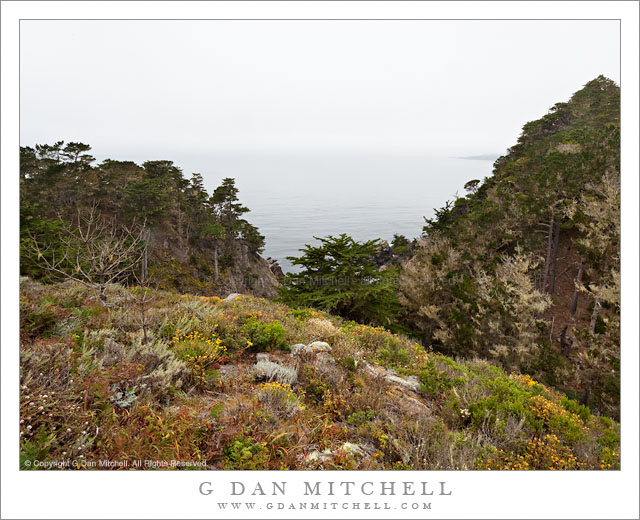
View of foggy Pacific Ocean from Whalers Knoll, Point Lobos State Reserve, California.
Whalers Knoll is yet another feature of Point Lobos named after “whalers” – Whalers Cove is another. Sometimes when I hike the trails along the north shore of the park I detour up a trail to the top of the knoll, from which there is a view of a larger expanse of landscape and seascape. But still, given the rough and rugged landscape of Point Lobos, there is no clear and unobstructed view – instead you can see the ocean between ridges and peaks and then only by looking for a spot where the Monterey Cypress trees are not as thick.
Although Point Lobos is a very popular park, it is usually possible to find some solitude by walking away from the most popular shoreline areas and hiking a bit. Since this trail is a bit out of the way and involves a climb, it isn’t unusual to be alone on at this lookout, especially on a foggy day when many visitors find the view from their cars to be sufficient!
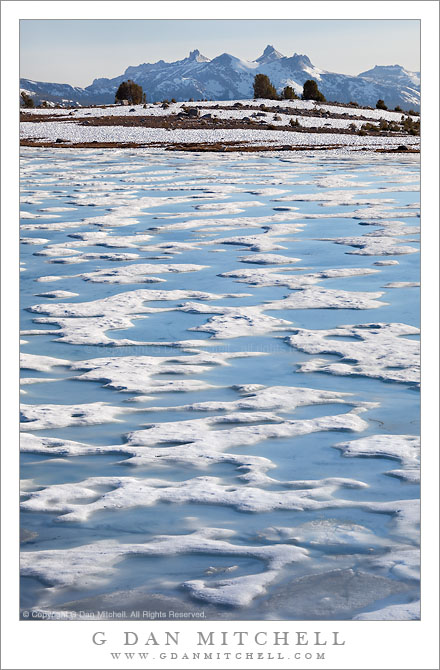
The distant Cathedral Range rises above the melting ice of Gaylor Lake, Yosemite National Park.
Near the end of June last summer I hiked up here late in the day with my friends Mike and Karl. This was a somewhat unusual season in the Yosemite Sierra, in that there had been a lot of snow during the winter season and it had continued right on into spring. Consequently, the high passes opened up later than usual, and on a very late June day when things would typically be a bit more summer-ish, it looked more like late winter up here when we arrived.
I’ve visited this place quite a few times, but had never seen quite this scene before. More typically, the snow and ice are completely gone by the time I manage to get up there, and a typical visit usually entails arriving late on a warm afternoon and then hanging out in the sun while waiting for the evening light to come on. This time we were in snow before we crossed the ridge before the lake, and we had to think a bit about just how to head down toward the lake since the usual path was covered in snow. The lake itself was (obviously, judging from the photo!) still covered in ice, though melting was underway and the surface was a jigsaw puzzle of alternating blue pools and white ice.
We found a location near clumps of trees on rocky talus slopes above the lake to do our photography. In this photograph I shot down the length of the lake to mostly fill the frame with the melting ice. Beyond a small rocky rise at the end of the lake, the terrain drops off towards the meadows of the Tuolumne region, and beyond rise the peaks of the Cathedral range in early evening light.
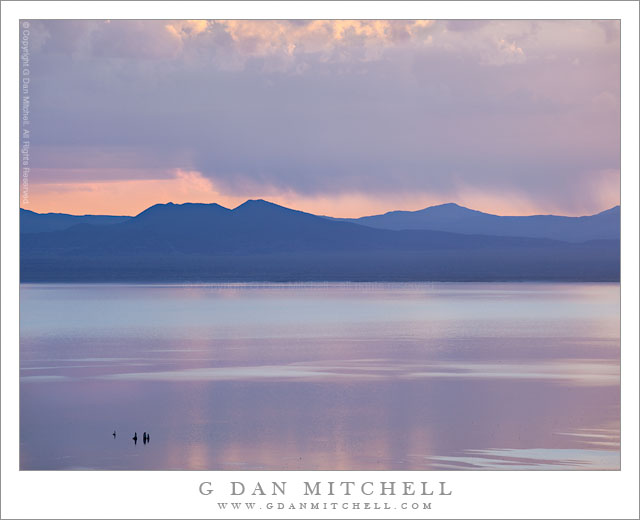
Pastel shades of purple and blue just before dawn at Mono Lake.
Back at the end of 2010 I wrote that I was going through all of my 2010 raw files to look for images that I had passed over, as I do near the end of every year. Things got busy, I got distracted, and I only got about half way through the year’s files. Recently I have returned to the 2010 photographs to try to complete the task, and this is one of the photographs that I rediscovered as I resumed the search with images taken near the end of June.
This was my first real photographic trip to the Sierra during the summer season of 2010. I had made a brief trip up there, visiting Yosemite Valley and then crossing Tioga Pass, back in early June right about the time that the pass opened. However, on this trip I was able to spend several days in the high country and kicking around near Mono Lake. This can be a great time of the year up there since conditions range from what seems like late winter in the high country to real summer in places like Owens Valley and around Mono Lake.
On this morning I decided that I’d head down to Mono Lake well before dawn and see what I could turn up. I did not go to the iconic South Tufa area on this morning, thinking instead that I’d try for some different and longer views of the lake. (Later in the morning I traveled a good distance south of the lake on the less-used section of highway 120.) There were, obviously, clouds in the morning and they blocked the sunrise. However, the light glowed through and over and under and around them, and even though there was not direct light in very early morning image, the colors were quite something. The group of tufa towers at the lower left are offshore not far from the South Tufa area.
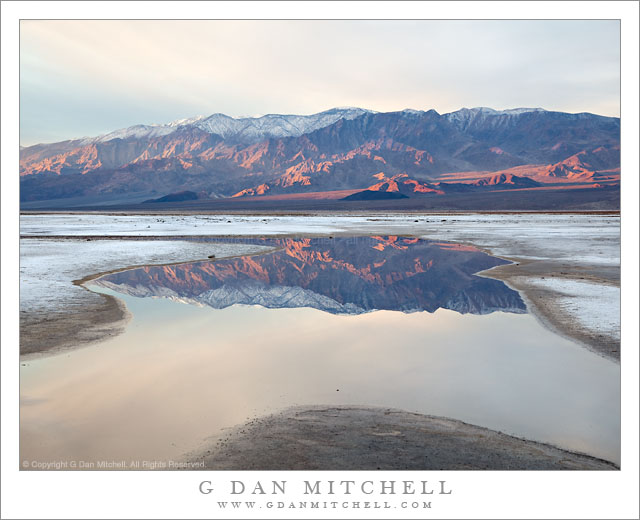
A salt spring pool on the salt flats in Death Valley reflects winter dawn light on the east face of the Panamint Range.
Sometimes I hear people describe how they think or imagine that landscape photography is done, and I wonder where they get their ideas. I will acknowledge that there are many ways to shoot landscape, ranging from working very slowly and carefully to produce a single image, to shooting like crazy and seeing what you end up with. But often people dismiss approaches closer to the latter and assume that the former is the “right way” to shoot landscape.
In my experience it isn’t quite that simple. Sometimes the experience is like certain others in which long stretches of time during which one seemingly accomplishes nothing or perhaps just looks and thinks are suddenly followed by quick and intense spurts of work that come almost as a surprise and may be over as quickly as they begin. This little morning shoot in Death Valley along the edge of a the salt/mud flats where the water from a small salt spring spreads across the flats and forms shallow pools was one of these. Very early in the morning, well before dawn, it was difficult to know what the best shooting option might be. There were clouds in the sky that promised to block the dawn light and everything seemed gray and flat. I wandered a bit, not sure where or what to shoot, and finally, more or less by chance, ended up at this spot that I had visited earlier on this trip. It occurred to me that even if the light wasn’t great I could possibly find a photograph that included this water. So I stopped and began to unpack in no particular hurry.
As I walked across the wash toward the area of the spring, much to my surprise it began to appear that there might be some interesting dawn light after all. I quickened my pace and headed toward the area of the shallow pools, and when I arrived there a moment later I could see some color on the top of the Panamint range. I quickly found a decent foreground pool and as the surprising light worked its way down the front of the range I began photographing. I first made several exposures at much shorter focal lengths, including a larger portion of the sky and the foreground. Then I quickly moved the tripod to place this pool in the center of the frame and hold the reflection of the range. I had little time to contemplate as the light was changing very quickly. I had just enough time to find my composition and make a few exposures, and within moments the light was gone.
Photographer and visual opportunist. Daily photos since 2005, plus articles, reviews, news, and ideas.
Manage Consent
To provide the best experiences, we use technologies like cookies to store and/or access device information. Consenting to these technologies will allow us to process data such as browsing behavior or unique IDs on this site. Not consenting or withdrawing consent, may adversely affect certain features and functions.
Functional
Always active
The technical storage or access is strictly necessary for the legitimate purpose of enabling the use of a specific service explicitly requested by the subscriber or user, or for the sole purpose of carrying out the transmission of a communication over an electronic communications network.
Preferences
The technical storage or access is necessary for the legitimate purpose of storing preferences that are not requested by the subscriber or user.
Statistics
The technical storage or access that is used exclusively for statistical purposes.The technical storage or access that is used exclusively for anonymous statistical purposes. Without a subpoena, voluntary compliance on the part of your Internet Service Provider, or additional records from a third party, information stored or retrieved for this purpose alone cannot usually be used to identify you.
Marketing
The technical storage or access is required to create user profiles to send advertising, or to track the user on a website or across several websites for similar marketing purposes.