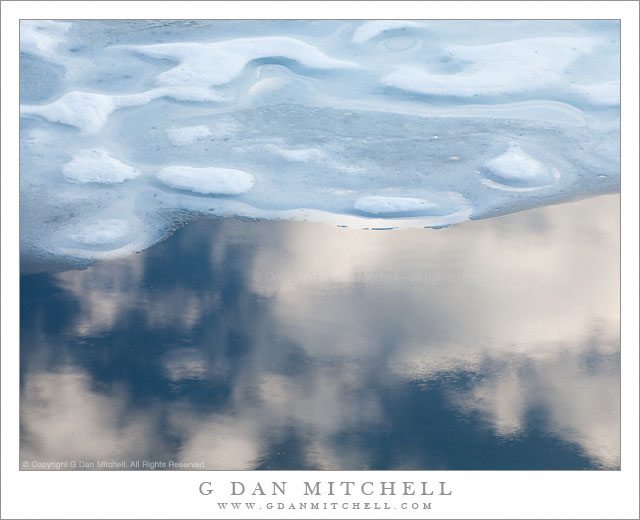
Clouds in blue sky are reflected in the surface of Gaylor Lake next to melting winter ice.
This photograph is very similar to another I made on this late June evening in 2010 when a small group of us hiked over a ridge near Tioga Pass to find a snow covered valley and this lake that was still almost completely covered with ice. The deep blue water near the edge of the melting ice along the shoreline reflected evening clouds passing overhead, and there were quite a few possible compositions combining the clouds, blue sky, curving edge of the ice and the interesting formations where the ice surface was melting. I made quite a few photographs – some up close like this one and others taking in the larger landscape. As I was recently reviewing raw files from 2010, I ended up spending quite a bit of time with this set of images!
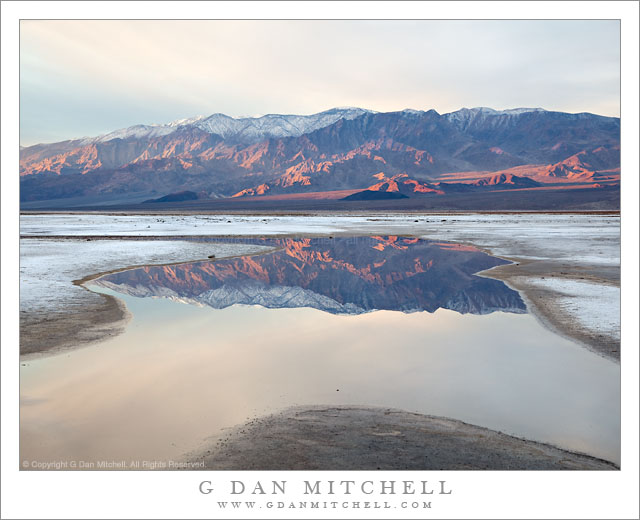
A salt spring pool on the salt flats in Death Valley reflects winter dawn light on the east face of the Panamint Range.
Sometimes I hear people describe how they think or imagine that landscape photography is done, and I wonder where they get their ideas. I will acknowledge that there are many ways to shoot landscape, ranging from working very slowly and carefully to produce a single image, to shooting like crazy and seeing what you end up with. But often people dismiss approaches closer to the latter and assume that the former is the “right way” to shoot landscape.
In my experience it isn’t quite that simple. Sometimes the experience is like certain others in which long stretches of time during which one seemingly accomplishes nothing or perhaps just looks and thinks are suddenly followed by quick and intense spurts of work that come almost as a surprise and may be over as quickly as they begin. This little morning shoot in Death Valley along the edge of a the salt/mud flats where the water from a small salt spring spreads across the flats and forms shallow pools was one of these. Very early in the morning, well before dawn, it was difficult to know what the best shooting option might be. There were clouds in the sky that promised to block the dawn light and everything seemed gray and flat. I wandered a bit, not sure where or what to shoot, and finally, more or less by chance, ended up at this spot that I had visited earlier on this trip. It occurred to me that even if the light wasn’t great I could possibly find a photograph that included this water. So I stopped and began to unpack in no particular hurry.
As I walked across the wash toward the area of the spring, much to my surprise it began to appear that there might be some interesting dawn light after all. I quickened my pace and headed toward the area of the shallow pools, and when I arrived there a moment later I could see some color on the top of the Panamint range. I quickly found a decent foreground pool and as the surprising light worked its way down the front of the range I began photographing. I first made several exposures at much shorter focal lengths, including a larger portion of the sky and the foreground. Then I quickly moved the tripod to place this pool in the center of the frame and hold the reflection of the range. I had little time to contemplate as the light was changing very quickly. I had just enough time to find my composition and make a few exposures, and within moments the light was gone.
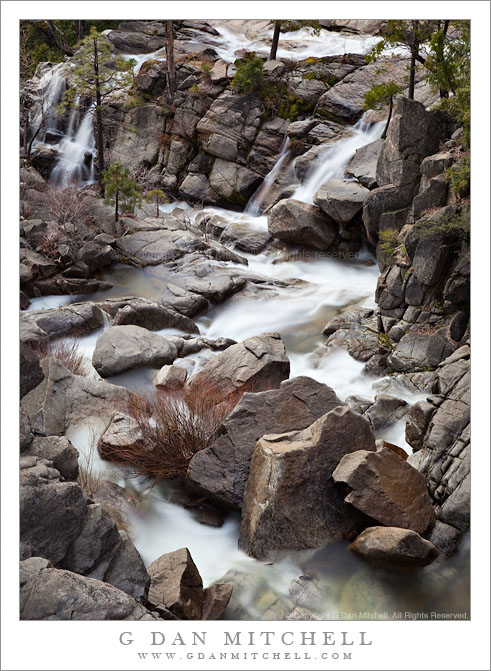
Long exposure in evening light of the boulder-strewn confluence of Cascade and Tamarack Creeks, Yosemite National Park.
Right below the bridge along the Crane Flat Road (often described as highway 120) route into Yosemite Valley, two wildly cascading creeks join together before their final descent to the bottom of the canyon where they join with the Merced River. Cascade Creek is probably the better known of the two since some spectacular sections of its descent are clearly visible right above the roadway. Tamarack Creek is easier to miss since you have to look carefully into the trees if you try to spot it from your car, or else get out of the car and look more closely. In the photograph, Cascade Creek flows away from the bottom of the frame, and Tamarack joins from the right in the upper portion of the frame.
I’ve always paid more attention to the section of Cascade Creek that is above the bridge. However, after recently having several opportunities to carefully (and admiringly) view Charlie Cramer’s stunning print of his “Cascade Creek, Spring, Yosemite”, I decided that I really needed to look off the other side of this bridge! (Charlie, I found your rocks. First, I’m even more impressed now that I realize how obscure and out of the way the subject of your photograph is. Second, how the heck did you position the camera over the side of the bridge to make that photograph!?) With that in mind, I visited this spot several times on this weekend trip to Yosemite and tried photographing it in different types of light.
This photograph is not in the public domain and may not be used on websites, blogs, or in other media without advance permission from G Dan Mitchell.
Dried kelp on rocks near the surf line at Weston Cove, Point Lobos.
On this late-October Saturday I traveled to the Monterey Peninsula for the opening of Charlie Cramer’s ‘Earth, Water, Light’ show and lecture at the Center for Photographic Art in Carmel. (You should go if you are in the area! The show runs from now through the end of the year and perhaps a week or so beyond.) With a winter-season Pacific storm coming in I wasn’t certain of what to expect from the weather, but ended up shooting in some wonderful light at Point Lobos.
There are many subjects to shoot there, and the light is one of the main factors (along with the season, the time of day, and random inclinations…) determining the subjects I’ll focus on. With the edge of the high clouds from the approaching storm diffusing the light it seemed like a good opportunity to shoot the rocks and kelp and other subjects along the shore line. When I shoot these subjects, especially in and around Point Lobos, I often have to slow down and just wander and look before I can really see the possibilities. A quick glance more or less gets me no farther than, “Look! Kelp! And rocks!” But if I wander around slowly and look carefully I’ll usually find some things of special interest among the piles of stones and kelp and other stuff that washes up. I often seen the thick tubular kelp forms like the one at the bottom of this frame, but seeing it with the more delicate material still attached – much less spread out this way on the rocks – is unusual, so I spent some time working with this subject.
This photograph is not in the public domain and may not be used on websites, blogs, or in other media without advance permission from G Dan Mitchell.
Photographer and visual opportunist. Daily photos since 2005, plus articles, reviews, news, and ideas.
Manage Consent
To provide the best experiences, we use technologies like cookies to store and/or access device information. Consenting to these technologies will allow us to process data such as browsing behavior or unique IDs on this site. Not consenting or withdrawing consent, may adversely affect certain features and functions.
Functional
Always active
The technical storage or access is strictly necessary for the legitimate purpose of enabling the use of a specific service explicitly requested by the subscriber or user, or for the sole purpose of carrying out the transmission of a communication over an electronic communications network.
Preferences
The technical storage or access is necessary for the legitimate purpose of storing preferences that are not requested by the subscriber or user.
Statistics
The technical storage or access that is used exclusively for statistical purposes.The technical storage or access that is used exclusively for anonymous statistical purposes. Without a subpoena, voluntary compliance on the part of your Internet Service Provider, or additional records from a third party, information stored or retrieved for this purpose alone cannot usually be used to identify you.
Marketing
The technical storage or access is required to create user profiles to send advertising, or to track the user on a website or across several websites for similar marketing purposes.