I think I generally prefer to not offer too much explanation about images like this one, and to let you take it for whatever it is.
G Dan Mitchell is a California photographer whose subjects include the Pacific coast, redwood forests, central California oak/grasslands, the Sierra Nevada, California deserts, urban landscapes, night photography, and more. Blog | About | Flickr | Twitter | Facebook | Google+ | 500px.com | LinkedIn | Email
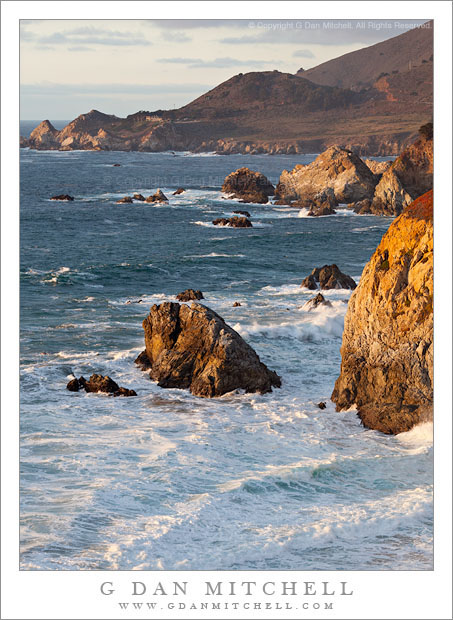
Sea stacks dot the rugged Big Sur coastline at Rocky Point in evening light.
Continuing with the theme of evening light on the Big Sur coastline, I made this photograph along a favorite section of this portion of the California coast not long before sunset. (I left enough time after photographing this scene to drive back up the coast to more or less the small road-cut just visible in the upper right corner of the frame, from which I made another photograph shooting back into a large cove that is out of the range of this photograph to the right.) At this time, perhaps a half hour or so before sunset, the color of the light was warming and intensifying but had not yet reached that obviously red stage that comes right at and right after actual sunset.
The peninsula in the upper part of the photograph is known as Rocky Point and, among other things, is a spot many may know because of a restaurant perched there above these stunning views of the Pacific coast. (I hear it is pricey!) My camera position was at a pull-out along the Pacific Coast Highway at a spot where the road rises to pass around another bit of land that extends to the west, and this high camera position let me aim the camera down to minimize the sky and fill the frame with the ocean, the rocky sea stacks and cliffs, and the “point” itself. With the main variable being the unpredictable patterns in the surf, I made a series of exposures at what I thought might be likely moments and then selected from among them in post. I like the series of diagonal lines in the foreground surf and the way the low sun picks off the tops of the waves.
G Dan Mitchell is a California photographer whose subjects include the Pacific coast, redwood forests, central California oak/grasslands, the Sierra Nevada, California deserts, urban landscapes, night photography, and more. Blog | About | Flickr | Twitter | Facebook | Google+ | 500px.com | LinkedIn | Email
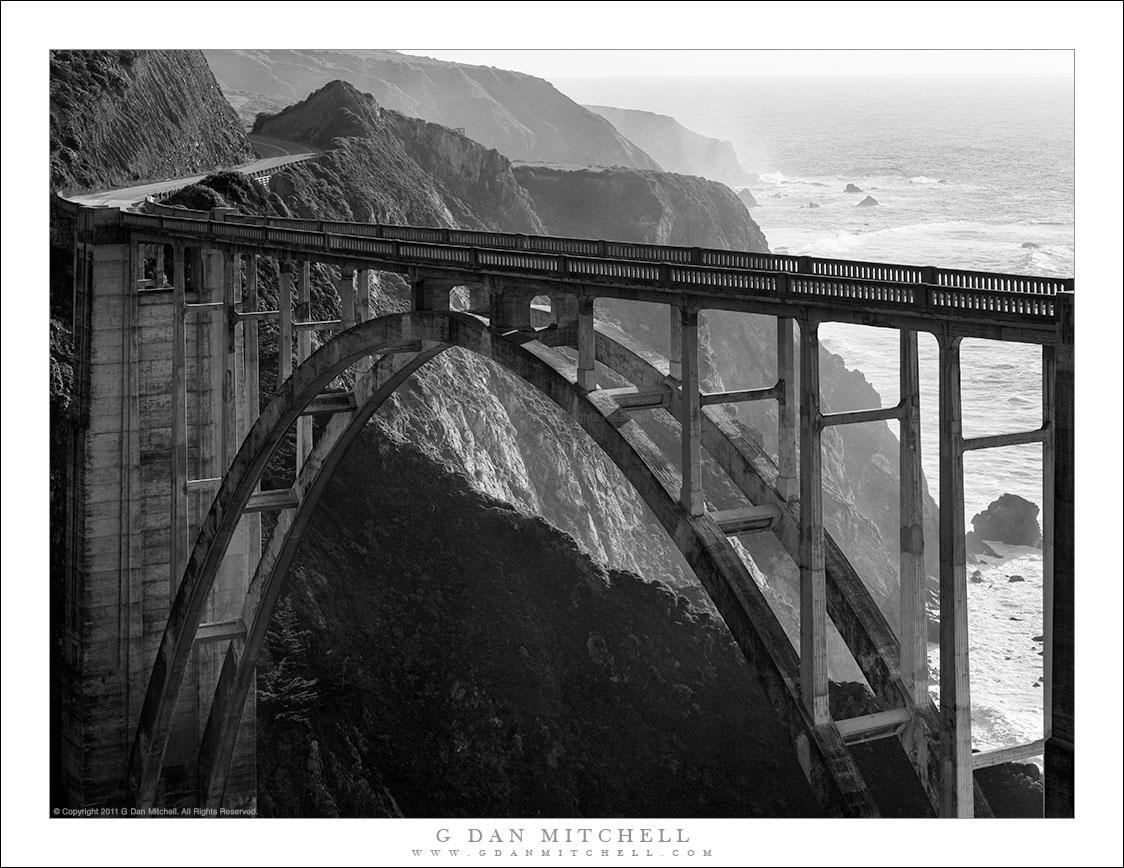
The Pacific Coast Highway crossing Bixby Bridge above the rugged Big Sur coastline of California.
Bixby Bridge is one of the iconic sights along the rugged terrain of California Coast Highway (highway one) in the Big Sur area south of Monterey. Although it is not the only bridge of its type along this route – and, in my opinion, not necessarily the most visually impressive – it is no doubt the best known. Many people drive to this spot and stop to take in the view from high above the ocean and to photograph the bridge and this scenic section of the highway.
I have photographed this bridge before, and I’ve spent a bit of time scoping out alternative points of view. These include some locations visible from “behind” the bridge, up higher in the coastal hills, and from other nearby locations along the highway. While I have photographed the bridge from the backside in the past, the idea of photographing it in black and white from this vantage point was triggered by a photograph by Chris Morrison that I saw in an online photography forum. When I saw it, I almost immediately “saw” a slightly different composition of the bridge and the steep headlands and cliffs running south along the coast.
G Dan Mitchell is a California photographer and visual opportunist. His book, “California’s Fall Color: A Photographer’s Guide to Autumn in the Sierra” is available from Heyday Books, Amazon, and directly from G Dan Mitchell.
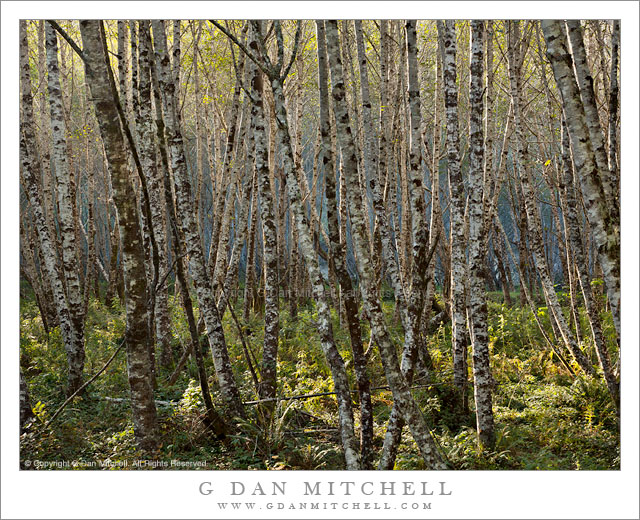
A dense forest backlit by afternoon light along the Northern California coast.
If you follow my blog, you know that I frequently photograph all around the Sierra, in the deserts east and south of the range, in coastal California in the San Francisco Bay Area and south, and even in the Central Valley. I’m almost a bit embarrassed, however, to admit to barely having scratched the surface of the photographic opportunities of “real” northern California, along the coast or inland. While I frequently shoot north of San Francisco, most of this work has been done no farther north than about Point Reyes.
This past weekend my wife and I managed a quick getaway that took us up to and slightly beyond Mendocino, where we spent a couple of nights. This wasn’t meant to be a photographic excursion, but I have a very understanding wife! She did not object when I stopped from time to time on our drive to get out the camera gear and make a few photographs. Truth be told, she made a few herself! I tried to keep the photography under control – after all, this trip was more about relaxing, seeing the sights, enjoying some good food, and so forth – but I did stop a few times make some photographs. And I also realized that I really need to head back up into this area and begin to seriously explore this region that is right at my virtual doorstep, and which is in many ways quite different from the “other Californias” that I’ve become familiar with.
This photograph was made in an extensive deciduous forest in a more or less random spot along the road, north of Fort Bragg and in an area where highway 1 takes an inland jog.
G Dan Mitchell is a California photographer whose subjects include the Pacific coast, redwood forests, central California oak/grasslands, the Sierra Nevada, California deserts, urban landscapes, night photography, and more. Blog | About | Flickr | Twitter | Facebook | Google+ | 500px.com | LinkedIn | Email
Photographer and visual opportunist. Daily photos since 2005, plus articles, reviews, news, and ideas.
Manage Consent
To provide the best experiences, we use technologies like cookies to store and/or access device information. Consenting to these technologies will allow us to process data such as browsing behavior or unique IDs on this site. Not consenting or withdrawing consent, may adversely affect certain features and functions.
Functional
Always active
The technical storage or access is strictly necessary for the legitimate purpose of enabling the use of a specific service explicitly requested by the subscriber or user, or for the sole purpose of carrying out the transmission of a communication over an electronic communications network.
Preferences
The technical storage or access is necessary for the legitimate purpose of storing preferences that are not requested by the subscriber or user.
Statistics
The technical storage or access that is used exclusively for statistical purposes.The technical storage or access that is used exclusively for anonymous statistical purposes. Without a subpoena, voluntary compliance on the part of your Internet Service Provider, or additional records from a third party, information stored or retrieved for this purpose alone cannot usually be used to identify you.
Marketing
The technical storage or access is required to create user profiles to send advertising, or to track the user on a website or across several websites for similar marketing purposes.